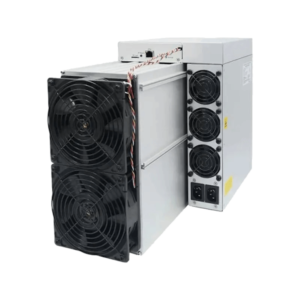
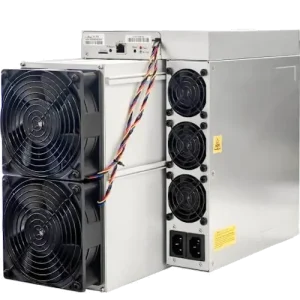
Bitmain Antminer D9 1860Gh Dash Miner
R41200
The Bitmain Antminer D9 1860Gh mines Dash (DASH) on the X11 algorithm at 1,860 GH/s, drawing about 2,984W at about 1.6 J/GH. It is air-cooled with a built-in power supply rated at 3,600W. On South Africa’s 230V supply it needs a dedicated 20A circuit installed by a registered electrician.
Product Description
Product Overview
The Bitmain Antminer D9 1860Gh is an air-cooled ASIC miner for Dash (DASH), the coin secured by the X11 algorithm. It hashes at 1,860 GH/s and is part of our Dash (DASH) X11 ASIC Miners range.
Bitmain released the D9 in February 2023 as its X11 machine, with an official rating of 1,770 GH/s at 2,839W (1.6 J/GH). This unit is a higher-binned D9 rated at 1,860 GH/s, about 5% more hashrate than the standard model. Its power figure of about 2,984W comes from reseller listings rather than Bitmain, so treat it as approximate.
The D9 carries 378 chips on three hash boards and shares its 430 x 195.5 x 290 mm dimensions, 16.1 kg net weight and 3,600W-rated power supply with the Bitmain Antminer KA3 173Th Kadena Miner. Racks, shelving and power distribution planned for one therefore suit the other.
Key Features
- 1,860 GH/s on X11: A higher-binned D9, about 5% above Bitmain’s standard 1,770 GH/s rating, with hashrate held within ±3%.
- About 1.6 J/GH: About 2,984W at full output, in line with Bitmain’s official 1.6 J/GH for the D9, with power within ±5%.
- 70 dBA rated noise: Bitmain’s official figure, quieter than the KA3 and L7 we list, though it still needs its own room.
- Integrated 3,600W-rated PSU: The power supply is built in and feeds from two AC inputs.
- 378 chips on three hash boards: Bitmain’s D9 layout in a 430 x 195.5 x 290 mm chassis weighing 16.1 kg.
- Standard network management: RJ45 Ethernet (10/100M) for pool setup and monitoring over your local network.
Technical Specifications
- Manufacturer: Bitmain
- Model: Antminer D9 (1,860 GH/s version)
- Released: February 2023
- Algorithm: X11
- Coin: Dash (DASH)
- Hashrate: 1,860 GH/s (±3%)
- Bitmain standard D9 rating: 1,770 GH/s at 2,839W
- Power consumption: About 2,984W (±5%)
- Efficiency: About 1.6 J/GH
- Chips: 378 chips on 3 hash boards
- Cooling: Air-cooled
- Noise: 70 dBA
- Input: 200–240V AC, 50–60Hz, 20A, two AC inputs
- Power supply: Integrated, rated 3,600W
- Network: RJ45 Ethernet, 10/100M
- Operating temperature: 0–40°C
- Operating humidity: 10–90% RH
- Dimensions: 430 x 195.5 x 290 mm
- Packed dimensions: 570 x 316 x 430 mm
- Weight: 16.1 kg net, 17.7 kg gross
Power & Installation Notes
South Africa’s 230V single-phase supply at 50Hz sits inside the D9’s 200–240V input range. At about 2,984W the miner draws roughly 13A, just above the roughly 2,944W a 16A domestic circuit should carry continuously. Each unit therefore needs a dedicated 20A circuit, installed and certified by a registered electrician to SANS 10142. The D9 has two AC inputs, so plan two outlets or two PDU ports per machine. Larger installations call for 32A circuits or, in commercial premises, three-phase 400V distribution.
About 3kW of heat leaves the exhaust continuously. Keep intake air between 0°C and 40°C, extract the hot air outside rather than recirculating it, and keep dust away from the intake. Even at 70 dBA the D9 belongs in a mining room, garage or outbuilding.
During load shedding the miner stops when power drops and restarts when supply returns. Save your pool settings so it rejoins mining by itself, and fit surge protection, because spikes often follow restoration. Battery backup for a 3kW continuous load needs a large inverter and battery bank, so most owners let the unit stop.
Electricity Cost Context (South Africa)
Running the D9 24 hours a day at about 2,984W uses roughly 71.6 kWh a day, or about 2,148 kWh over 30 days. At an indicative tariff of R2.80/kWh that comes to about R6,016 a month.
(2,984 / 1,000) x 24 x 30 x R2.80 = about R6,016 per month
Tariffs vary by municipality and by supply type, so check the rate on your own bill. This is an operating cost estimate, not a profitability projection.
Ideal Use Cases
- Dedicated Dash mining: A purpose-built X11 machine for operators who want DASH output.
- Diversifying beyond Bitcoin: Adds a separate algorithm and coin alongside machines from our Bitcoin (BTC) ASIC Miners range.
- Mixed-algorithm farms: Runs beside Scrypt units such as the Bitmain Antminer L7 on the same kind of 20A, two-input power layout.
- Noise-conscious sites: At 70 dBA it runs quieter than the KA3 and L7, which helps where sound carries to neighbours.
Frequently Asked Questions
Will the D9 run on South African power?
Yes. South Africa’s 230V, 50Hz supply sits inside its 200–240V input range. At about 2,984W it needs a dedicated 20A circuit installed by a registered electrician to SANS 10142, with both AC inputs fed.
Which coins and pools can it mine?
It is built for Dash (DASH) on the X11 algorithm. Choose a pool that supports Dash, then enter its stratum address, your worker name and your wallet address in the miner’s settings.
How loud is it, and how should I cool it?
Bitmain rates it at 70 dBA. Keep intake air between 0°C and 40°C, extract the hot exhaust outside and give it a room away from living areas.
How does the 1860Gh compare with a standard D9?
Bitmain’s standard D9 is rated at 1,770 GH/s on 2,839W. This higher-binned unit gives about 5% more hashrate at about the same 1.6 J/GH.
How does it compare with the KA3 173Th?
The Bitmain Antminer KA3 173Th Kadena Miner uses the same chassis, weight and 3,600W-rated power supply but mines Kadena on Blake2S at about 3,287W. Choose by the coin you want to mine, since the power and rack planning is almost identical.
What’s Included
- 1 x Bitmain Antminer D9 1860Gh miner
- Integrated power supply, rated 3,600W (built into the unit)