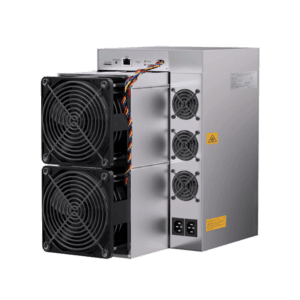
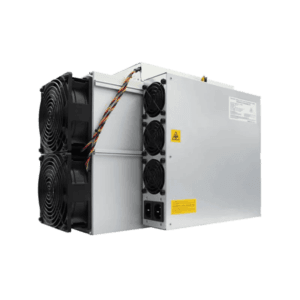
Bitmain Antminer HS3 8.55T
R63120
The Bitmain Antminer HS3 8.55T is an 8.55 TH/s Blake2b ASIC miner dedicated to Handshake (HNS) mining, operating at approximately 2860W. Entry-level model in the HS3 series for Handshake network mining. Air-cooled and compatible with South African 230V power supply.
Product Description
Product Overview
The Bitmain Antminer HS3 8.55T is a dedicated Handshake (HNS) ASIC miner running the Blake2b algorithm. With a hashrate of 8.55 terahashes per second, it is designed specifically for mining on the Handshake blockchain — a decentralised, permissionless naming protocol and certificate authority system that uses proof-of-work to secure domain name ownership on its network.
The HS3 series represents Bitmain’s purpose-built hardware for the Handshake network, where ASIC miners provide significantly more hash power than GPU rigs on the Blake2b algorithm. Handshake (HNS) is a unique project in the mining landscape: rather than competing directly with Bitcoin or other general-purpose cryptocurrencies, it functions as a decentralised alternative to the traditional DNS root zone system.
The HS3 8.55T is the entry-level variant in the HS3 lineup, offering operators access to the Handshake mining market at a lower upfront cost and power draw than the 9T model. It is suitable for small commercial operations, operators exploring the Handshake ecosystem, or those looking to diversify their mining portfolio beyond the dominant SHA-256 and Ethash segments.
Key Features
- 8.55 TH/s hashrate: Dedicated Handshake (HNS) mining output. Provides meaningful contribution to HNS mining pools while keeping capital and operating costs below those of the higher-tier HS3 9T.
- ~2860W power consumption: At approximately 2860W, the HS3 8.55T delivers about 335 MH/W efficiency on Blake2b — competitive within the Handshake ASIC segment.
- Blake2b algorithm: The HS3 8.55T is a dedicated Handshake miner. It is not compatible with SHA-256, Blake2S (Kadena), or Ethash networks. The Blake2b variant used by Handshake is distinct from the Blake2S used by Kadena.
- Air-cooled dual fan design: Standard industrial ASIC form factor with dual high-speed fans. Compatible with standard mining rack deployment without specialist cooling infrastructure.
- Ethernet (RJ-45) connectivity: Single wired network port for pool communication. Web interface for setup and monitoring accessible via local IP address.
- Bitmain reliability and support: Manufactured by Bitmain with standard Antminer firmware and management tooling. Clear upgrade path to the HS3 9T for operators wanting more output from their Handshake mining fleet.
- Niche market access: Handshake mining remains a relatively specialised segment, providing operators with potentially different risk/reward dynamics compared to Bitcoin or ETC mining.
Technical Specifications
- Algorithm: Blake2b (Handshake variant)
- Supported coins: Handshake (HNS)
- Hashrate: 8.55 TH/s (±3%)
- Power consumption: ~2860W (±5%) at 25°C ambient
- Power efficiency: ~335 W/TH (±5%)
- Cooling type: Air-cooled, dual high-speed fans
- Noise level: ~75 dB(A)
- Input voltage: 200–240V AC
- Networking: Ethernet (RJ-45)
- Operating temperature: 5°C to 45°C
- Dimensions (L×W×H): 400 × 195 × 290 mm
- Net weight: ~15 kg
Power & Installation Notes
South Africa’s 230V/50Hz grid supply is compatible with the Antminer HS3 8.55T’s 200–240V input. No voltage adaptor is required.
At approximately 2860W continuous draw, the HS3 8.55T requires a dedicated circuit. A single unit can be operated on a dedicated 20A circuit (safely rated to ~3680W at 80% load = 2944W), which is a comfortable margin. For multi-unit deployments, each unit should have its own circuit breaker on a rated distribution board, installed by a registered electrician.
Load shedding at 2.86 kW means a 10kWh residential battery would provide approximately 3.5 hours of operation at full load. This provides some buffer during shorter scheduled outages, but generators or commercial backup power are required for operations targeting continuous uptime through extended load shedding periods.
Adequate ventilation is required. Keep the mining environment below 40°C with clear airflow at both fan faces. Active air extraction is recommended for enclosed mining rooms in South Africa’s warm climate zones.
Electricity Cost Context — South Africa
Running the Antminer HS3 8.55T at 2860W continuously consumes approximately 68.6 kWh per day, or roughly 2 059 kWh per month. At R2.80/kWh (indicative residential rate — municipal rates vary), the estimated monthly electricity cost is approximately R5 765 per month.
Calculation: (2860 ÷ 1000) × 24 × 30 × R2.80 = ~R5 765/month.
As with all commercial ASIC miners, standard South African residential tariffs make this a meaningful operating cost. Operators should calculate current HNS mining returns against their actual electricity tariff. This is a cost estimate only — not a profitability projection.
Ideal Use Cases
- Handshake (HNS) ecosystem participants: Operators who specifically want to mine HNS and contribute to the Handshake decentralised naming network’s proof-of-work security layer.
- Algorithm diversification: Miners who already run SHA-256 or Ethash hardware and want to add Blake2b/Handshake exposure to their portfolio without stepping up to the higher-cost HS3 9T.
- Small commercial Handshake mining operations: 1–10 unit deployments in purpose-built mining rooms or containers with commercial power supply.
- Domain name protocol investors: Operators who believe in Handshake’s utility as a decentralised DNS alternative and want mining as a means of participating in and supporting the network.
- Exploration of niche PoW markets: For experienced miners looking beyond Bitcoin and ETC to understand smaller, algorithm-specific mining ecosystems.
Frequently Asked Questions
Does the Antminer HS3 8.55T work on South African power?
Yes. SA’s 230V/50Hz supply is within the HS3’s operating range. A dedicated 20A circuit from a registered electrician is recommended for single-unit operation.
What is Handshake (HNS) and why is it mined?
Handshake is a decentralised naming protocol that aims to replace the centralised DNS root zone authority system. It uses proof-of-work (Blake2b algorithm) to secure its blockchain. HNS is the native token used to bid on and manage top-level domain names on the Handshake network.
What mining pools work with the Antminer HS3?
Popular HNS mining pools include 6Block (the largest HNS pool) and F2Pool. Pool configuration is done via the miner’s web interface using the Stratum URL, worker name, and password.
How does the HS3 8.55T compare to the HS3 9T?
Both share the same chassis and algorithm. The 9T delivers 9 TH/s with slightly higher power draw for greater hashrate. See: Bitmain Antminer HS3 9T.
Can I mine Bitcoin or Kadena with the HS3 8.55T?
No. The HS3 is purpose-built for Handshake’s specific Blake2b variant and is not compatible with SHA-256 (Bitcoin) or Blake2S (Kadena). For Bitcoin mining, see our Bitcoin ASIC miners.
What’s Included
- 1× Bitmain Antminer HS3 8.55T ASIC miner unit
- Integrated or bundled PSU (confirm with order)
- Power cable (region-specific — South African plug may require local adaptor or direct wiring)
- Ethernet cable not included
- Quick-start guide