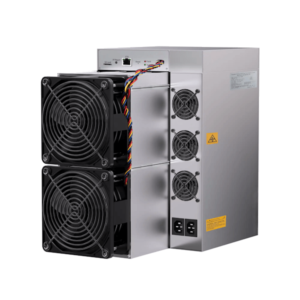
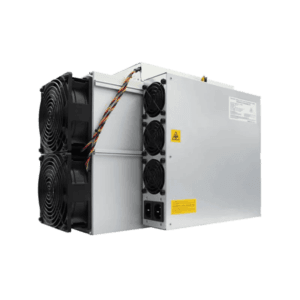
Bitmain Antminer HS3 9T
R65720
The Bitmain Antminer HS3 9T is a 9 TH/s Blake2b ASIC miner dedicated to Handshake (HNS) mining, operating at approximately 3068W. Top-performance variant in the HS3 series for Handshake network mining. Air-cooled and fully compatible with South African 230V power supply.
Product Description
Product Overview
The Bitmain Antminer HS3 9T is the flagship variant of Bitmain’s HS3 Handshake (HNS) mining series, delivering 9 terahashes per second on the Blake2b algorithm. It represents the higher-performance option in the HS3 lineup compared to the 8.55T model, providing operators with increased hashrate and proportionally greater contribution to the Handshake proof-of-work network.
Handshake (HNS) is a decentralised, permissionless naming protocol designed as an alternative to the ICANN-controlled DNS root zone system. The Handshake blockchain’s proof-of-work consensus uses the Blake2b algorithm, and dedicated ASICs like the HS3 series provide considerably more computational efficiency than GPU rigs on this algorithm. Bitmain’s HS3 is the primary purpose-built ASIC solution for HNS mining.
The HS3 9T is suited to operators who want to maximise their Handshake network hashrate contribution per deployed unit. Compared to the 8.55T, it offers approximately 5.3% more hashrate at a slightly higher power draw, making it the better choice when per-unit performance is the priority over per-unit capital cost.
Key Features
- 9 TH/s hashrate: Top-tier output in the HS3 family, providing the highest single-unit Handshake mining contribution available from this product line.
- ~3068W power consumption: At approximately 3068W, the HS3 9T operates at about 341 W/TH — slightly higher power draw than the 8.55T but delivering proportionally more hashrate per unit.
- Blake2b algorithm (Handshake-specific): Dedicated to Handshake (HNS) mining. The Blake2b variant used by Handshake is distinct from Blake2S (Kadena) and not compatible with SHA-256 or Ethash networks.
- Air-cooled dual fan design: Industrial ASIC housing with dual high-speed fans. No specialist cooling infrastructure needed — standard rack deployment in a ventilated mining room.
- Ethernet (RJ-45) connectivity: Single wired network port for reliable pool communication. Standard web interface for configuration.
- Bitmain firmware and support ecosystem: Standard Antminer management interface and firmware update support. Compatible upgrade from the HS3 8.55T with no infrastructure change required.
- Top-of-range HS3 performance: For operators who want to maximise HNS output per deployed unit without transitioning to a different mining hardware platform.
Technical Specifications
- Algorithm: Blake2b (Handshake variant)
- Supported coins: Handshake (HNS)
- Hashrate: 9 TH/s (±3%)
- Power consumption: ~3068W (±5%) at 25°C ambient
- Power efficiency: ~341 W/TH (±5%)
- Cooling type: Air-cooled, dual high-speed fans
- Noise level: ~75 dB(A)
- Input voltage: 200–240V AC
- Networking: Ethernet (RJ-45)
- Operating temperature: 5°C to 45°C
- Dimensions (L×W×H): 400 × 195 × 290 mm
- Net weight: ~15 kg
Power & Installation Notes
South Africa’s 230V/50Hz grid supply is compatible with the Antminer HS3 9T’s 200–240V input voltage range. No voltage adaptor is required.
At approximately 3068W continuous draw, the HS3 9T exceeds the safe continuous load of a standard 16A household circuit (rated 3680W, safely loaded to ~80% = 2944W). A dedicated 20A or 32A circuit, installed by a registered electrician, is required for safe single-unit operation. For multi-unit setups, a dedicated distribution board with individual circuit breakers per unit is essential.
Load shedding planning: at 3.07 kW, a 10kWh residential battery provides approximately 3.3 hours of mining at full load. This may cover shorter scheduled outages, but extended stage 4–6 load shedding requires a generator or commercial UPS solution for continuous operation.
Ventilation: the HS3 9T requires clear airflow at both inlet and exhaust fan faces and an ambient environment below 40°C. Active air extraction is recommended for enclosed South African mining rooms, particularly in warmer climates. Ensure at least 200–300mm clearance around fan panels.
Electricity Cost Context — South Africa
Running the Antminer HS3 9T at 3068W continuously consumes approximately 73.6 kWh per day, or roughly 2 209 kWh per month. At R2.80/kWh (indicative residential tariff — municipal rates vary), the estimated monthly electricity cost is approximately R6 185 per month.
Calculation: (3068 ÷ 1000) × 24 × 30 × R2.80 = ~R6 185/month.
At standard South African residential tariffs, this is a significant operating cost for HNS mining. Operators should evaluate current HNS prices, network difficulty, and their actual electricity tariff before purchasing. This figure represents operating cost only — not a profitability projection.
Ideal Use Cases
- Maximising Handshake network contribution per deployed unit: The 9T delivers the highest HNS mining output in the HS3 range, making it ideal for operators who prioritise per-unit performance over capital cost.
- Operators upgrading from the HS3 8.55T: A straightforward performance step-up within the same hardware family, compatible with the same power and rack infrastructure.
- Commercial Handshake mining farms: Multi-unit deployments where the higher per-unit hashrate of the 9T reduces the number of machines needed to achieve a target total output.
- HNS domain name ecosystem participants: Operators who want to mine HNS for participation in Handshake’s decentralised domain name marketplace or top-level domain ownership auctions.
- Algorithm diversification beyond BTC and ETC: For miners who want exposure to the Blake2b/Handshake segment as part of a diversified multi-algorithm mining portfolio.
Frequently Asked Questions
Does the Antminer HS3 9T work on South African power?
Yes. SA’s 230V/50Hz supply is within the miner’s operating range. A dedicated 20A–32A circuit from a registered electrician is required for safe continuous operation.
What is the difference between the HS3 8.55T and HS3 9T?
Both share the same chassis, cooling design, and Blake2b algorithm. The 9T delivers 9 TH/s versus 8.55 TH/s, with approximately 3068W vs 2860W power draw. The 9T is the higher-performance variant; the 8.55T is the more cost-accessible entry point. See also: Bitmain Antminer HS3 8.55T.
What Handshake mining pools are compatible with the HS3 9T?
The HS3 9T works with all Handshake Stratum-compatible pools. The largest HNS pool is 6Block. F2Pool also supports Handshake. Configure pools via the miner’s web interface.
How loud is the HS3 9T?
At approximately 75 dB(A), it is not suitable for home interiors. A dedicated mining room, outbuilding, or container with sound management is required.
Can I use the HS3 9T to mine Bitcoin or Kadena?
No. The HS3 is a Blake2b Handshake-specific ASIC. It cannot mine Bitcoin (SHA-256) or Kadena (Blake2S). For Bitcoin mining, see our Bitcoin ASIC miners.
What’s Included
- 1× Bitmain Antminer HS3 9T ASIC miner unit
- Integrated or bundled PSU (confirm with order)
- Power cable (region-specific — South African plug may require local adaptor or electrician wiring)
- Ethernet cable not included
- Quick-start guide