
Mining room ventilation layouts
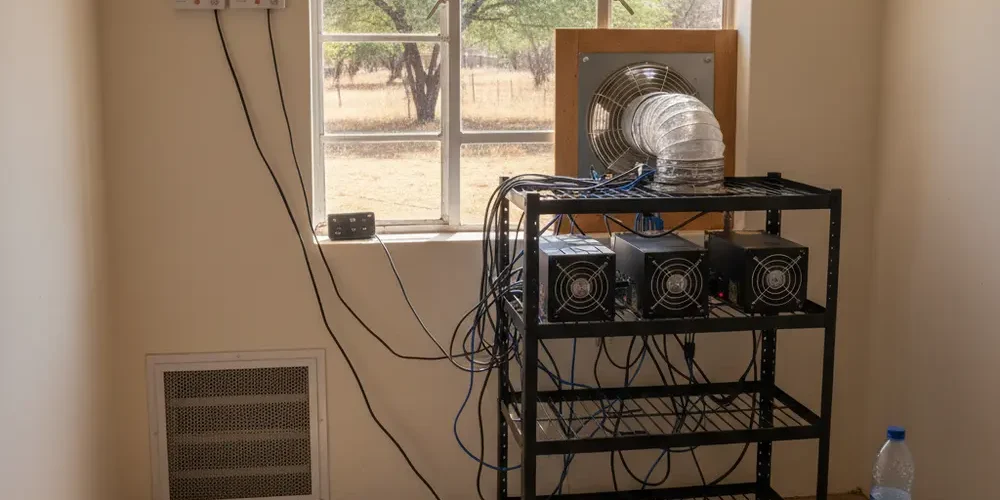
The main failure mode in a small mining room is hot air recirculation, where exhaust is pulled straight back into your miners. It matters because inlet temperatures climb fast, triggering throttling, crashes, or long term reliability issues.
By the end of this guide, you will be able to choose a ventilation layout that matches your room constraints and hardware type. You will also have a simple measurement plan to confirm the airflow path is doing what you think it is.
Note for South Africa:
- Plan for load shedding, if fans stop and miners keep running briefly, room temperatures can rise quickly, so set safe shutdown rules.
- Coastal areas can bring salt and humidity, inland areas can bring fine dust, both change how you plan intake air and filtration.
- If you add circuits, extractor points, or change fixed wiring, use a registered electrician and confirm whether you need an updated CoC.
At a glance:
- Pick one of three layouts, single pass, hot aisle and cold aisle, or ducted exhaust, based on whether you can vent outdoors and how noisy you can be.
- Avoid short circuit airflow, do not let intake and exhaust sit too close or blow into each other.
- Decide early if you want negative pressure, it can reduce recirculation but increases dust ingress if filtration is poor.
- Validate with a 7 day log, track inlet temps, exhaust temps, room delta T, humidity, and fan behaviour during load shedding.
Key takeaways:
- Airflow direction matters more than adding extra fans.
- Containment and sealing gaps can beat brute force airflow.
- Measure before and after changes, guessing is expensive.
Quick safety and constraints checklist for a small-room mining setup
Ventilation is only useful if it is safe, predictable, and stable when you are not watching it. Before you buy fans or cut panels, confirm the constraints below, then choose a layout that works with them.
- Outdoor exhaust path: Can you vent hot air outdoors through a window insert, wall vent, or dedicated duct, without blowing into someone else’s window or a closed courtyard?
- Replacement air: If you exhaust air, where does fresh air come from, under the door gap, a louvre, a window on the opposite side, or a filtered intake?
- Backdraft risk: Do not create strong negative pressure near gas appliances, fireplaces, or attached garages, get professional advice if unsure.
- Noise limit: Decide what is acceptable for neighbours, household, and body corporate rules, before selecting high speed fans.
- Dust and corrosion: Identify your intake air risks, coastal salt, industrial fumes, or Highveld dust, then plan filtration and sealing.
- Power and protection: Use surge protection and set shutdown thresholds so the rigs stop if ventilation fails.
If you are sourcing miners, racks, or basic spares, start with the parts that define airflow and noise, then work outward. Our shop is a practical place to compare mining hardware types and accessories before you commit to a layout.
Common mistakes
- Mounting an exhaust fan with no dedicated intake path, then wondering why the room still runs hot.
- Putting intake and exhaust on the same wall, which causes short circuit airflow.
- Using thick filters on a weak fan, then losing most of the airflow to backpressure.
- Trying to soundproof by sealing the room, which usually increases recirculation and heat.
- Ignoring what happens during load shedding, when fans and routers may drop before miners do.
If you’re new
- Start with one rack and one airflow path, then scale once you understand the room behaviour.
- Assume your first fan choice will be wrong, plan for easy swaps and simple duct runs.
- Place one temperature sensor at the miner inlet height, not on the floor or ceiling.
- Keep cables tidy and avoid blocking fan intakes, airflow obstruction is common in small rooms.
- Prefer layouts that are easy to inspect weekly, dust builds up faster than you expect.
If you already run rigs
- Look for recirculation evidence, inlet temperatures creeping up without an increase in room temperature.
- Confirm your exhaust actually leaves the building, not into a ceiling cavity or a garage.
- Check fan curves and static pressure limits for your ducts, bends and filters can halve real airflow.
- Audit failure modes, what happens if one fan dies, and can the rigs detect it?
- Standardise your sensor placement so logs are comparable after each change.
Airflow basics for mining rooms, heat load, recirculation, and why more fans can fail
Mining hardware turns most of its electrical power into heat inside the room. Your job is to move that heat outdoors, or into another space that can safely absorb it, without mixing it back into the intake.
Recirculation is the silent killer in small rooms because there is not much distance to separate hot and cold air. If exhaust air can find its way back to the intake, the effective inlet temperature rises even if your fan noise increases.
A good mental model is single pass airflow, cool air enters, crosses the miners once, then leaves. The moment the same air loops back, you lose efficiency and stability.
Industry guidance for high heat density rooms focuses on separating supply and return air to reduce mixing, which is the same problem you have in a home mining room. If you want a deeper reference point, see ASHRAE hot aisle and cold aisle guidance and the related practical tips from Energy Star on hot aisle and cold aisle layouts.
A simple airflow sizing method you can use without guessing
You do not need exact specs for every miner to do a first pass estimate. You can start with your measured power draw in kilowatts, then choose an acceptable temperature rise through the room, then calculate the airflow needed.
A widely used engineering relationship for sensible heat in air is based on mass flow, heat capacity of air, and the allowed temperature rise. In practical terms, higher power or lower allowed temperature rise means you need more airflow.
- Step 1: Measure your total room power at the wall using a power meter, include PSUs and fans.
- Step 2: Choose a target delta T between intake and exhaust, smaller delta T needs more airflow and usually more noise.
- Step 3: Use an online calculator, or ask for help sizing, and then verify with real measurements in the room.
If you want help turning your power draw and room geometry into a fan and duct plan, use our contact form and include your measured kW, room size, window or door options, and whether you run ASICs, GPUs, or mixed gear.
| Goal | What to do | What it usually costs you | What to measure |
|---|---|---|---|
| Stop recirculation | Separate intake and exhaust paths | Some sealing, minor carpentry | Inlet vs exhaust temp |
| Lower inlet temps | Increase single pass airflow | Noise, higher fan power | Room delta T |
| Reduce noise | Use larger ducts, fewer bends | More space, more planning | Fan speed vs temps |
| Reduce dust ingress | Filtered intake, mild positive pressure | Filter maintenance | Filter loading trend |
Layout 1, Single-pass airflow (intake on one side, exhaust on the other)
This is the simplest layout that works, and it is often best for a spare room or small office. The key is to force a one way path across the miners, with enough distance and separation that the hot exhaust cannot loop back.
In most homes, the easiest version is an intake through the door gap or a louvred vent, and an exhaust through a window insert panel. If you can, place the miners so their fans blow toward the exhaust side, not across the room.
Where to place intake and exhaust, window and door options, negative pressure vs neutral
Start by picking the exhaust location, because that determines everything else. Exhaust should be as direct as possible to outdoors, with a short duct and minimal bends.
- Exhaust high, intake low: Warm air rises, so exhausting higher can help, but only if your miners are also pushing air toward that point.
- Opposite sides: Put intake and exhaust on opposite sides of the room where possible, even if that means a simple duct run across the top of a rack.
- Door as intake: A door undercut can work, but it is often not enough for higher heat loads, so add a louvre or dedicated intake if needed.
- Window panel: A removable panel with a duct flange can be cleaner than leaving a window open, and it reduces insects and rain entry.
Negative pressure can reduce the chance that hot air escapes into the rest of the house, because air flows into the room rather than out. The downside is that any gaps become dust entry points, and in some homes it can pull smells or fumes from garages or roof spaces, so treat it as a controlled choice, not a default.
For general safety minded ventilation principles, including using fans to exhaust air and bring in outdoor air where appropriate, see NIOSH guidance on using fans and outdoor air.
Layout 2, Hot aisle and cold aisle for home miners (mini containment ideas)
This layout borrows the core data centre concept, keep cool supply air on one side, keep hot exhaust on the other. The point is not to build a perfect containment system, it is to stop mixing so your miners always breathe the coolest air available.
For GPUs, this often means aligning open frames so all GPUs intake from the same side, and their exhaust direction is consistent. For ASICs, it means lining them up so their exhaust faces a defined hot aisle, preferably toward a duct or extractor point.
- Cold aisle: The side where air enters the racks and miners take in air.
- Hot aisle: The side where miner exhaust collects and is extracted.
- Containment: Any barrier that reduces mixing between those two zones.
Sealing gaps, blanking panels, and preventing short-circuit airflow
Small gaps cause big problems in a small room because the pressure differences are low and air takes the easiest path. If there is an easy shortcut from cold aisle to hot aisle, air will bypass your hardware and you lose cooling effectiveness.
- Use simple barriers like foam strips, plastic sheeting, or lightweight panels to block obvious leak paths.
- Add blanking panels or cardboard fillers in rack gaps so air cannot bypass through empty spaces.
- Keep cable bundles tidy and out of the direct airflow path, clutter creates recirculation pockets.
- Do not point a pedestal fan at the miners unless you know the airflow path, it can increase mixing.
Containment and sealing are well established in high density electronics cooling, and the same principles apply at home. If you want practical containment notes, see cold aisle containment sealing tips.
Layout 3, Ducted exhaust for ASICs and mixed rigs (GPU plus ASIC)
Ducted exhaust is the most effective way to prevent hot air from spilling into the room, especially with loud, high airflow ASICs. It can also make the room more livable, because you can control where heat goes and reduce the chance it leaks into hallways.
The trade off is complexity. Ducting adds backpressure, which means the fan has to work harder to move the same air.
Duct sizing, backpressure, fan selection, and why bends and filters matter
Backpressure is the main reason ducted systems disappoint. Long ducts, tight bends, and restrictive filters can reduce real airflow far below what the fan box claims.
- Keep ducts short: Route the exhaust to the closest outdoor point you can.
- Use gentle bends: Avoid tight 90 degree bends, use larger radius bends where possible.
- Match fan type to pressure: Inline centrifugal style fans often handle static pressure better than simple axial fans, but you must read the fan curve.
- Filter the intake, not the exhaust: Intake filtration protects hardware, while exhaust filtration often just adds restriction unless you have a specific reason.
If you are planning a ducted system and want someone to sanity check your fan and duct choices before you cut holes, reach out via contact us with your duct length, number of bends, and your power draw.
Ventilation requirements vary by unit. The Bitmain Antminer S21 Pro 245TH moves around 14 000 BTU/hr at the wall, while the hydro-cooled Bitmain Antminer S21 XP Hydro 473T shifts that heat into a liquid loop instead of room air.
Temperature, humidity, dust, and corrosion, what manufacturers and HVAC guidance actually require
Ventilation is not only about temperature. Humidity, dust, and corrosive air are what quietly destroy fans, heatsinks, and connectors over time.
ASIC manufacturers publish environmental guidance that covers temperature, humidity, dust, and corrosive gas exposure. For Bitmain hardware, use the official reference as your baseline, see Bitmain Antminer environmental requirements.
In South Africa, the risk profile changes by region. Coastal air can be humid and salty, and inland areas can be dry and dusty, so your intake strategy should match your location rather than copying a YouTube build from another climate.
- Humidity: Avoid extremes, and watch for condensation risk if you pull in cool night air into a warmer room.
- Dust: Use a filter you can maintain, and set a cleaning schedule, clogged filters reduce airflow and raise temps.
- Corrosion: If you are near the coast or industry, reduce direct intake exposure, and seal gaps so you can control where air enters.
When you exhaust hot air, the general principle is to discharge it outdoors rather than recirculate it into living areas. Workplace ventilation guidance also emphasises local exhaust for contaminants generated by a process, which maps to capturing miner exhaust close to the source, see OSHA indoor air quality ventilation principles.
Measurement plan, what to log for 7 days and how to tell if the layout is working
The difference between a good layout and a noisy mess is measurement. You are trying to prove two things, that cool air reaches the miners, and that hot air leaves without looping back.
Do a 7 day log because weather, daily routines, and load shedding events change the outcome. A setup that looks fine for one hour can fail after an afternoon heat build up.
What to measure (minimum viable logging)
- Miner inlet temperature: Place a sensor at intake height, near where the miners pull air in, not in the exhaust stream.
- Room ambient temperature: Place a second sensor away from direct airflow to understand the room baseline.
- Exhaust temperature: Measure in the hot aisle or near the duct inlet, not at the fan outlet if it is mixing.
- Humidity: Track trends, especially if you use outside air at night.
- Fan behaviour: Note fan speed settings, noise changes, and any vibration, these often signal restriction.
How to interpret the data
Look for stable inlet temperatures during steady load. If the inlet temperature rises over time without a change in outside conditions, you likely have recirculation or insufficient airflow.
Compare inlet temperature to room ambient. In a well managed setup, inlet should be close to the coolest available air, if inlet is much higher than room ambient, hot air is feeding back.
Also look for step changes during load shedding transitions. If fans stop and the inlet temperature spikes quickly, you need automation, either stop the miners, or power the fans from backup, or both.
Decision tree, choose your layout
Use this to pick a layout without overbuilding.
- Can you vent hot air outdoors safely and directly?
- If yes, go to step 2.
- If no, start with Layout 2 and focus on containment and airflow separation, then plan a proper outdoor exhaust later.
- Can you add a dedicated intake that is not dusty or corrosive?
- If yes, Layout 1 or Layout 3 are strong options.
- If no, prefer mild negative pressure with a controlled filtered intake, or reconsider the room, dust ingress will be your main maintenance cost.
- What hardware dominates the room?
- Mostly ASICs, Layout 3 is usually best, because ducting captures the exhaust close to the source.
- Mostly GPUs, Layout 1 or Layout 2 can work well, because you can align frames and reduce mixing.
- Mixed rigs, start with Layout 2 for separation, then duct the ASIC exhaust as a targeted upgrade.
- Is noise a hard limit?
- If yes, use larger ducts, fewer bends, and avoid tiny high speed fans, then validate with measurements.
- If no, you can brute force more airflow, but still avoid recirculation, more noise does not guarantee lower inlet temps.
When you are ready to upgrade hardware or add better airflow parts, revisit the shop and plan purchases around your chosen layout, fans and ducts first, then racks and accessories.
For professional help with planning, fault finding, or sizing airflow to your measured heat load, see our professional services.
Frequently asked questions
Should I run negative pressure in a small mining room?
It can help reduce heat leaking into the house and can reduce recirculation if your exhaust is strong and your intake path is controlled. The risk is increased dust ingress and possible backdraft concerns in certain home layouts, so treat it as a deliberate design choice and validate with measurements.
Is it better to exhaust through a window or a wall?
A window insert is often reversible and easier in rentals, while a wall vent can be cleaner and shorter if you own the property. Choose the option that keeps the duct short and direct, and confirm you are not exhausting into an enclosed space like a courtyard that traps heat.
Can I just add more fans inside the room?
Internal fans can improve mixing, but they often make recirculation worse if intake and exhaust are not separated. Start by defining a clear intake and exhaust path, then add airflow only if measurements show you need it.
How do I reduce noise without cooking the rigs?
Use larger ducts, fewer bends, and avoid restrictive filters on the exhaust. If you add sound baffles or acoustic ducting, measure inlet temperatures before and after, because noise reduction can come with airflow loss.
What should I do during load shedding to protect hardware?
Plan for ventilation failure. Use automation to shut down miners when temperatures rise or when fans lose power, and consider backing up critical ventilation and networking equipment if you keep mining through outages.
Summary checklist
- Pick a layout that matches your room constraints, not someone else’s build.
- Prioritise airflow separation, then add airflow volume.
- Keep ducts short, minimise bends, and watch backpressure.
- Use filtration and sealing that matches your local dust and coastal corrosion risk.
- Log inlet temp, exhaust temp, and humidity for 7 days, including load shedding events.
This is educational content, not financial advice.

