
Mining warehouse heat recirculation fixes
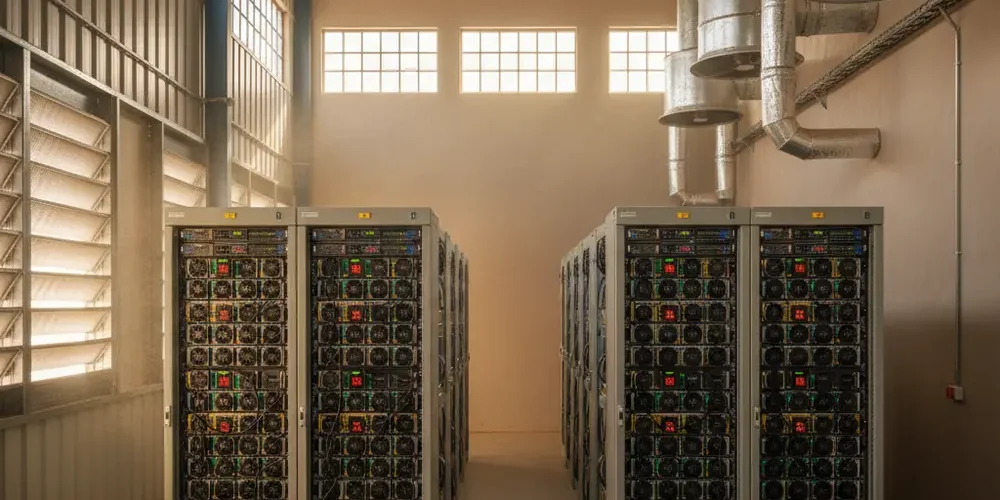
Hot air recirculation is when your miners breathe their own exhaust, then inlet temperatures climb until hash rate drops or fans scream. In a small warehouse, it usually happens because supply air and return air are not physically separated.
By the end of this guide you will be able to map where recirculation is happening, fix the room layout so air flows one way, and choose simple containment and sealing that give you the biggest gains. You will also have a repeatable monitoring routine so the problem does not creep back in when seasons change or you add more rigs.
Note for South Africa:
- Load shedding and fast restarts can leave hot air trapped, plan for safe ramp-up and do not assume airflow returns instantly.
- Warehouses often have leaky cladding and roller doors, uncontrolled gaps can flip pressure and cause wrap-around recirculation.
- Security matters, protect intake openings and filters with grilles and weather covers.
At a glance:
- Confirm the failure mode with a simple intake temperature map at three heights per rack.
- Pick a clear hot aisle and cold aisle layout, then seal the leaks that let hot air cross over.
- Place exhaust high and over the hot aisle, place make-up air low and into the cold aisle, avoid short-circuiting.
- Use a troubleshooting flow when you see throttling, hot spots, or rising fan RPM.
Key takeaways:
- Recirculation is mostly a layout and sealing problem, not a fan brand problem.
- Measure first, then change one thing at a time and re-measure.
- Small containment and blanking panels often beat big room changes for cost per benefit.
What hot air recirculation looks like in a small mining warehouse (and why it happens)
Most ASIC miners and many GPU rigs push air front-to-back, which makes the room behave like a simple supply and return system. Recirculation appears when hot exhaust finds a path back to the front of the same rack row, or into the next row’s intakes.
Typical signs are a rising spread between the coolest and hottest miner inlet temperatures, hotspots near the top of racks, and machines that throttle even though the room feels only warm at head height. You may also see one row stable while the next row runs hotter because the airflow is swirling, not directional.
In small warehouses, the common causes are short airflow paths, mixed-air zones around aisle ends, roofline leaks, and exhaust that is not captured and removed. If your extraction fans pull from the wrong place, they can create a loop where hot air rolls back across the ceiling and drops into the cold aisle.
Common mistakes
- Pointing miner exhaust toward an open door and assuming it will leave the building.
- Putting intake and exhaust openings on the same wall or too close together, causing short-circuiting.
- Leaving empty rack spaces open, letting hot air move through the rack from the rear to the front.
- Allowing cable gaps, broken side panels, or open rack sides that let hot and cold air mix.
- Adding more miners without checking whether exhaust capacity and make-up air still match the heat load.
If you’re new
- Start with one airflow direction in the room and keep it consistent.
- Assume any gap will leak, plan to seal or baffle it.
- Buy basic sensors early, do not rely on a single wall thermometer.
- Keep an access plan, you must still be able to service miners safely.
If you already run rigs
- Look for changes that coincided with new ducting, added fans, or seasonal winds.
- Compare inlet temps between rack bottom, middle and top to spot stratification.
- Audit door habits, a single propped-open door can break containment.
- Re-check filters and louvres, restriction changes pressure and can flip airflow.
Set a baseline, measure intake and exhaust temps, airflow direction, and pressure
You cannot fix what you cannot see, and recirculation often hides behind average room temperature readings. Your goal is to measure at the miner inlets, because that is what determines stability, fan speed and throttling behaviour.
Start with an intake temperature map. For each rack, record intake temperature at three heights, near the bottom miners, middle miners, and top miners, then repeat at both ends of the cold aisle.
Next, do a simple airflow direction check. A tissue test, incense smoke test, or a handheld anemometer can show if air is moving the way you think, especially at aisle ends and near doors.
- Tools that help: cheap temperature probes at rack fronts, an IR thermometer for spot checks, and optionally an anemometer for air speed.
- Where to measure first: cold aisle centreline, rack fronts at three heights, and the hot aisle near the roof or duct pickup point.
- What you are looking for: rising inlet temps at rack tops, hot air pooling above rows, and air moving from hot side to cold side through gaps.
Pressure matters because it controls which direction leaks flow. In a warehouse, you will rarely measure pressure with proper instruments, but you can infer it by checking whether doors pull shut, whether dust is being sucked in through cracks, and whether air backdrafts through roof vents.
For monitoring concepts aligned with data centre practice, use the idea of inlet measurements at multiple heights per rack, not a single point in the room. That approach is commonly recommended in thermal guideline discussions and monitoring write-ups. Sensor placement at rack inlets and hot spot monitoring is a useful reference for how to think about measurement locations.
Quick decision table, pick the airflow approach that matches your building
Before you buy fans or start building ducting, decide what your room can realistically support. The table below is not about perfect engineering, it is about choosing a direction and avoiding short-circuits.
| Option | Best when | Main risk | First low-cost improvement |
|---|---|---|---|
| Open hot aisle, strong extraction | You have high roof space and can exhaust high | Hot air rolls back across ceiling | Add baffles or curtains at row ends |
| Hot aisle containment (HAC) | You can enclose the hot aisle safely | Service access and fire safety planning | Seal row ends and add a roof plenum to exhaust |
| Cold aisle containment (CAC) | You can keep the cold aisle sealed and clean | Leaks pull hot air into cold aisle fast | Blanking panels and close rack side gaps |
| Rack chimneys to ceiling | Racks are fixed and ceiling capture is possible | Bad fitment leads to leaks and noise | Start with one test rack before scaling |
Layout fundamentals, hot aisle and cold aisle for miners (even without raised floors)
Hot aisle and cold aisle is the simplest mental model for stopping recirculation. All miner intakes face the cold aisle, all exhaust faces the hot aisle, and you prevent mixing between those two spaces.
You do not need raised floors to do this. You need consistent orientation, clear aisles, and a plan for where fresh air enters and where hot air leaves.
ASHRAE data centre guidance focuses on separating supply and return air paths, and the same physics applies in a mining warehouse. If you want a standards-based framing for why separation matters, start with ASHRAE guidance on separating supply and return air.
Rack orientation, aisle spacing, and avoiding mixed-air zones
Orient racks so the cold aisle faces your cleanest, coolest make-up air source. Put the hot aisle toward your planned exhaust path, ideally where you can capture hot air high.
Give yourself enough space to avoid blocking miner fans and to allow tech access. In practice, blocked intakes and loose cables can create local turbulence that behaves like recirculation.
- Keep aisle ends controlled, open ends act like mixing zones where hot air can spill into the cold aisle.
- Keep rack fronts and rears consistent across the whole room, mixed orientation creates unpredictable loops.
- Avoid pointing hot exhaust directly at a wall that forces it to roll back toward the racks.
If you are sourcing racks, ducting parts, or simple containment materials as part of a rebuild, plan the layout first, then shop. You can browse options and categories on our shop so you are buying to a plan, not reacting to heat spikes.
Exhaust strategy, where to put extraction fans and ducting to stop wrap-around
Your exhaust strategy must do one thing well, remove hot air from the hot aisle without pulling it back across the room. In a small warehouse, the highest leverage move is usually to capture hot air high and close to the rack exhaust side.
Place extraction points high, because hot air rises and pools at the roofline. If you extract low, you often leave a hot ceiling layer that later spills into the cold aisle when winds or doors change.
- Capture hot air over the hot aisle, not over the cold aisle.
- If you duct, keep runs as short and straight as practical, sharp bends add restriction and reduce effective flow.
- Add simple backdraft prevention where needed, especially if wind can reverse flow through vents.
Be cautious with chasing exact airflow numbers unless you have measured heat load and fan curves. A practical approach is to observe whether hot aisle temperatures drop when extraction increases, and whether cold aisle inlet temperatures stabilise, then tune from there.
Make-up air, intake placement, filtration, and how to avoid short-circuiting fresh air
Exhaust cannot work without make-up air. If you extract hard without controlled intake, the building will pull air through any crack, including roof gaps near the hot aisle, which can drag hot air into the cold side.
Bring make-up air into the cold aisle side, preferably low and distributed, and keep it physically separated from exhaust outlets. If intake and exhaust are too close, you will short-circuit, pulling your own hot air back in.
- Use filtration appropriate for your dust level, and maintain it, clogged filters change pressure and can increase recirculation.
- Add security grilles and weather hoods for SA sites, do not leave open intake holes unprotected.
- Do a quick smoke test at the intake area, confirm air moves toward miners, not out of the building.
For a practical reminder that unused rack openings and poor airflow management can contribute to recirculation and overheating, see Cisco guidance on blanking panels and site airflow basics.
Containment and sealing, curtains, baffles, blanking panels, and closing leakage paths
Containment is any physical barrier that stops hot and cold air from mixing. In a small warehouse, you can get most of the benefit with partial containment and sealing, without building a perfect data centre.
Start by sealing obvious leakage paths. Empty rack spaces, open sides, cable cut-outs, gaps above rack rows, and open aisle ends all behave like free ducts for hot air to return to the front.
- Blanking panels in unused rack spaces, so air cannot recirculate through the rack body.
- Side panels or simple sheet barriers on rack sides if your racks are not enclosed.
- Row end curtains or doors, even a simple strip curtain can reduce mixing at the aisle ends.
- Top baffles above rack rows to stop hot air rolling over into the cold aisle.
When deciding between hot aisle containment and cold aisle containment, choose what you can maintain. Cold aisle containment can keep intakes cleaner, but a single leak can allow hot air to flood the cold aisle quickly, while hot aisle containment focuses on capturing and exhausting the hottest air.
Trade publication overviews can help you think through these containment choices and operational impacts. A balanced starting point is an overview of hot aisle vs cold aisle containment.
Troubleshooting flow, stop recirculation fast when miners start throttling
Use this flow when you see sudden inlet temperature rises, miners throttling, or hot spots that move around the room. The goal is to find the shortest path that hot air is taking back to your intakes.
- Confirm it is recirculation, not a miner fault: check a few miners for blocked intakes, failed fans, or clogged heatsinks, then compare inlet temps across multiple racks.
- Map inlet temperatures: measure at rack fronts, bottom, middle, top, and at both ends of the cold aisle.
- Verify airflow direction: do a tissue or smoke test at aisle ends, door gaps, roof vents, and near any duct pickups.
- Check hot and cold separation: stand in the cold aisle and look for direct openings into the hot aisle, including above racks and through empty rack spaces.
- Find leakage paths: look for open rack units, missing blanking panels, torn curtains, gaps around cable penetrations, and open doors.
- Check exhaust capacity and placement: confirm extraction is capturing hot air high over the hot aisle, not pulling from the cold aisle.
- Check make-up air source: confirm fresh air enters on the cold side and is not being pulled in from the hot side through roof gaps.
- Watch for negative pressure side-effects: if doors slam shut or air backdrafts through vents, reduce extraction or add controlled intake.
- Change one thing, then re-test: seal one gap or reposition one fan, then repeat the inlet map to confirm improvement.
If you want help translating this flow into a specific layout for your warehouse, including intake and exhaust placement, reach out via our contact page with photos, rough dimensions, and your rack count.
Monitoring and maintenance plan, sensors, alarms, dust, seasonal changes and load growth
Recirculation problems often return slowly, especially after you add miners or as filters clog. Monitoring should be simple enough that you actually keep doing it.
Place sensors where they catch problems early, at rack inlets, not only in the room. A practical pattern is three inlet sensors per rack position, bottom, middle and top, plus one or two ambient sensors in each aisle.
- Set alerts on inlet temperature trends, not only absolute spikes.
- Log fan speed changes, sudden fan RPM increases can indicate restriction or recirculation.
- Inspect filters on a schedule tied to dust levels and seasons, not a fixed calendar that ignores reality.
Maintenance matters because dust is both a thermal and reliability issue. Keeping vents unobstructed, cleaning intakes, and managing filters reduces the conditions that allow hotspots to form.
Plan for seasonal airflow shifts. Wind direction and temperature changes can alter how roof vents behave, and a warehouse that was fine in one month can recirculate badly later.
If you are upgrading hardware density, treat it as a new commissioning event. Review rack sealing, verify exhaust capture, and repeat the inlet mapping after the change. If you need to add or replace miners, you can also check suitable categories through Bitcoin ASIC miners or Litecoin and Doge ASIC miners and then re-check airflow before you go live.
Common failure modes and quick fixes (symptoms to root cause)
This section is designed for fast diagnosis. Start with the symptom you see, then apply the first fix that is low-risk and easy to test.
- Hot spots at the top of racks: likely ceiling layer recirculation, add high exhaust capture and top baffles, then re-map inlet temps.
- Only the aisle ends run hot: likely mixing at row ends, add end curtains, doors, or baffles to reduce cross-flow.
- All miners run hotter after adding extraction: likely negative pressure pulling hot air through leaks, add controlled make-up air and reduce uncontrolled gaps.
- One row is fine, the next row throttles: likely mixed orientation or one row exhausting into the other’s intakes, correct rack direction and add separation.
- Temperatures worsen after cleaning or maintenance: likely missing panels or open rack spaces left behind, restore blanking panels and side covers.
If you need a deeper audit, consider documenting your current state with photos and a simple sketch, then compare it to standard separation principles used in data centres. This is the same separation logic described in ASHRAE style references and many airflow management guides.
Frequently asked questions
Should I target a specific intake temperature for ASIC or GPU mining?
Follow the manufacturer guidance for your specific hardware, because models differ and exact limits are not universal. As a rule of practice, aim for stable inlet temperatures with minimal rack-to-rack variation, then use monitoring to avoid creeping upward over time.
Is negative pressure good or bad in a mining warehouse?
It can help if it forces air to move in a predictable direction toward a controlled exhaust, but it becomes harmful when it pulls air through uncontrolled leaks. If you see backdrafts, dust being sucked in everywhere, or intake temps rising after increasing extraction, add controlled make-up air and re-test.
Do I need full containment, or will curtains and sealing be enough?
Many small farms get most of the benefit from partial containment and sealing, especially blanking panels, row end barriers, and top baffles. Full containment can work well, but it increases complexity and requires careful planning for access and safety.
Where should I put temperature sensors for recirculation detection?
Start at miner inlets, with sensors at the bottom, middle and top of racks, and add a few ambient sensors in each aisle for context. This pattern helps you see stratification and mixing that a single room sensor will miss.
What is the cheapest first fix if I suspect recirculation?
Seal the obvious leaks, add blanking panels for empty rack spaces, and control the aisle ends with simple barriers, then re-measure. If inlet temperatures drop and become more uniform, you have confirmed you were dealing with mixing and short-circuits.
Wrap-up, what to do next
Hot air recirculation is solvable if you treat airflow like a system, not a collection of fans. Measure at the inlets, separate hot and cold paths, seal leaks, then monitor so the fix sticks.
- Map inlet temperatures at three heights per rack, then identify where the heat is re-entering.
- Choose a clear hot aisle and cold aisle direction, then control aisle ends and roofline mixing.
- Capture and exhaust hot air high over the hot aisle, and provide controlled make-up air to the cold side.
- Seal gaps with blanking panels, side barriers, and simple curtains or baffles, then re-test.
This is educational content, not financial advice.

