
Bitcoin Mining 101
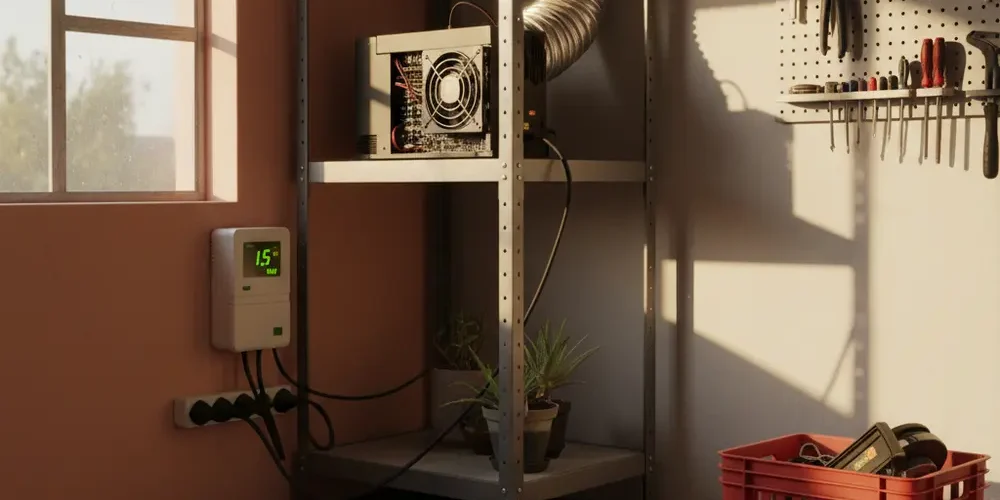
Bitcoin mining sounds like free money until you look at power draw, heat, and the odds of earning steady payouts. This article explains what mining actually does, and how it connects to crypto demand, without hype.
By the end, you will be able to decide if mining makes sense for your home or small business, estimate your real-world running constraints, and plan a safer first setup. You will also know what to track monthly so you can evaluate results honestly, and stay on the right side of compliance.
Note for South Africa:
- Electricity pricing is not one national number, it varies by Eskom direct vs municipal supply and by tariff structure.
- Load shedding and local power quality can affect uptime and hardware stress, plan for interruptions and surge protection.
- Heat and noise are practical deal-breakers in many flats and complexes, plan ventilation and neighbour impact upfront.
At a glance:
- Mining is a competition to add the next block, you get paid only if your miner contributes to a valid block via solo mining or a pool.
- For Bitcoin, ASICs are the normal tool, GPUs are usually not practical for SHA-256 mining.
- Your biggest controllable variable is electricity and uptime, which is why tariffs, load shedding, and cooling matter in South Africa.
- Start with a checklist and a monthly tracker, so you can stop, scale, or sell hardware based on data, not hope.
Key takeaways:
- More hashrate on the network usually means tougher competition, not more Bitcoin per miner.
- After the April 2024 halving, the block subsidy per block is lower, so costs and fees matter more.
- Do not treat mining like a set-and-forget appliance, treat it like noisy, high-power IT equipment that needs planning.
Bitcoin mining in plain English, what miners actually do
Bitcoin mining is the process of building new blocks of transactions and proving, with computation, that you did real work to create that block. The network accepts a block only if it follows the rules and meets the proof of work requirement. Miners compete to find a valid block, and the winner gets paid the block reward.
Two roles matter here. Nodes enforce the rules and validate blocks, miners propose blocks by doing proof of work. In practice, many miners also run nodes, but you can understand mining without running your own node at home.
If you want a protocol-level overview that stays beginner-friendly, read the official explainer on how Bitcoin works.
If you’re new
- Start by separating the idea of owning Bitcoin from mining Bitcoin, you can buy BTC without mining.
- Understand that mining revenue is uncertain, while electricity and noise are guaranteed.
- Assume you will need a plan for heat, dust, and power quality before you buy hardware.
- Use a pool for learning, solo mining is usually a long-odds lottery for small setups.
If you have done GPU mining before
- Do not assume your gaming GPU is a Bitcoin miner, Bitcoin is normally mined with ASICs, not GPUs.
- Expect far higher continuous power draw per device, and much more heat and noise than many GPU rigs.
- Plan electrical safety like a server room, cable quality, breakers, and airflow are not optional.
- Think about downtime differently, power cuts can be more frequent than a typical data centre environment.
The Bitcoin mining economics loop, how mining links to crypto demand
Mining and crypto demand influence each other through price signals and competition. When demand for BTC rises and price rises, mining can look more attractive, so more hashrate tends to join the network. That extra competition pushes up difficulty over time, which can reduce how much BTC an individual miner earns per unit of hashrate.
When demand falls, some miners switch off because they cannot cover electricity and operating costs. If enough hashrate leaves, difficulty can adjust down, which can improve the share of rewards for miners that remain. This is why miners talk about cycles, but the key point is simple, your revenue depends on your share of global competition.
As an investor lens, miners are often forced sellers because they have ongoing bills. That is one reason mining economics can influence market behaviour, even though miners are not the whole market.
Hashrate, difficulty, and why more miners does not mean more BTC per miner
Hashrate is how much computational work is being aimed at the network. Difficulty is the network setting that decides how hard it is to find a valid block at the current hashrate. If hashrate climbs, difficulty tends to rise so blocks keep arriving at roughly the intended pace.
The practical takeaway is that adding more miners to the network does not create more BTC per day for each miner. Instead, it keeps the schedule steady, while splitting the available rewards across more competition.
When you evaluate a miner, think in shares, not absolute numbers. Your device produces a fixed hashrate, but your payout depends on what the global network is doing.
Halving, block subsidy, and transaction fees, what changed after April 2024
Bitcoin has a programmed halving roughly every 210,000 blocks, which reduces the block subsidy. The most recent halving happened in April 2024 at block height 840,000, reducing the subsidy to 3.125 BTC per block. That change is widely referenced in beginner explainers such as Investopedia’s summary of the Bitcoin halving and the new block subsidy.
For miners, this matters because the block reward is made up of the subsidy plus transaction fees. Over time, fees are expected to become a larger share of miner revenue, but fee levels can be volatile. As a beginner, treat fees as a bonus, not a guarantee.
Mining hardware 101, ASICs, PSUs, cooling, and why GPUs are usually not for Bitcoin
Bitcoin mining is specialised. Because Bitcoin uses SHA-256 proof of work, purpose-built ASIC miners dominate because they are far more efficient at that single job than general-purpose hardware. A GPU can compute SHA-256, but it is usually not competitive for Bitcoin mining compared with ASICs.
Think of an ASIC miner as a loud, hot, always-on appliance that behaves more like a small server than a home PC. It needs stable power, strong airflow, and regular cleaning. If you ignore those basics, you increase the risk of failures and downtime.
| Option | Best for | Pros | Cons |
|---|---|---|---|
| ASIC at home | Hands-on learning, small scale | Direct control, fast feedback | Noise, heat, power constraints |
| Mining pool | Most beginners | Smoother payouts, less variance | Fees, pool trust, payout rules |
| Solo mining | Experimenting, lottery style | No pool fees, full block reward if you win | Very low odds for small hashrate |
| Buy BTC instead | Investors, low tolerance for ops | No hardware risk, no noise | Still price risk, no learning about ops |
If you want to browse hardware categories and learn the terminology without locking yourself into a brand, start at the Sell Your PC shop. Treat it as research, not a promise of profitability.
Beyond the miner itself, plan for the boring parts. You will need a quality PSU if your unit does not include one, appropriate cabling, surge protection, and a safe place to exhaust hot air. In South Africa, many home setups also need an uptime plan for power interruptions.
Step-by-step, how to start mining responsibly in South Africa
Starting responsibly means reducing avoidable risk before you spend money. Your first goal is not maximum hashrate, it is a stable, measurable setup that you can operate safely. Once you can run reliably, you can decide whether scaling is worth it.
- Define your goal, learning, hobby income, or business-scale operations.
- Confirm your electrical constraints, breaker capacity, plug type, cable runs, and whether you need an electrician sign-off.
- Choose your mining approach, pool for smoother payouts, solo only if you accept long odds.
- Plan airflow and noise, decide where heat will go and how it affects the space.
- Set up monitoring and record keeping from day one, uptime, kWh, pool payouts, and maintenance.
If you want help sizing airflow, ducting, or planning a safer home layout, use the contact page to reach our team.
Home setup checklist, power, ventilation, noise, and safety
This is the practical checklist to use before you plug in a miner. It is deliberately tool-agnostic so you can apply it to any ASIC.
- Power capacity: confirm the circuit rating, breaker, and cable gauge are appropriate for continuous high load.
- Expected kWh per day: compute kW from the device label, then multiply by expected uptime hours.
- Tariff reality: confirm whether you are Eskom direct or municipal, and whether you have time-of-use or tiered pricing.
- Heat plan: decide where hot air will be exhausted, and keep intake air as cool and clean as possible.
- Noise plan: measure the room context, consider neighbours, complexes, and night-time constraints.
- Ventilation and dust: add filters where practical, and schedule regular cleaning to avoid clogged heatsinks.
- Surge protection: use quality protection, and consider a strategy for safe shutdown during unstable power.
- Load shedding uptime: plan for interruptions, and avoid unsafe improvised wiring to keep mining during outages.
- Pool selection: understand fees, payout threshold, and payout method before you point your hashrate.
- Wallet security: control your keys, protect seed phrases offline, and use strong account security where relevant.
- Record keeping for SARS: keep dates, amounts, and supporting invoices for electricity and equipment.
- Exit plan: decide in advance when you will sell the miner, repurpose it, or stop if conditions change.
Joining a mining pool, payouts, and wallet basics
A mining pool combines hashrate from many miners and shares rewards based on each miner’s contribution. This reduces variance, which is why pools are common for small miners. In exchange, you typically pay a fee and accept the pool’s payout rules.
When comparing pools, focus on a few practical questions.
- What is the fee, and what payout scheme is used, for example pay-per-share vs pay-per-last-N-shares.
- What is the minimum payout threshold, and how often are payouts sent.
- Do you have clear stats and worker monitoring, so you can spot downtime fast.
- Can you set your own payout address, and do you control that wallet.
Wallet basics for miners are simple but important. Use a wallet you control for payouts, and keep backups of recovery phrases offline. If you use an exchange account as a payout address, remember you are adding counterparty risk.
Costs and constraints in South Africa, electricity, load shedding, and tariffs
Electricity is the biggest operating cost for most miners. In South Africa, the complication is that the headline increase is not the same as your bill, because tariffs vary by supplier and structure. You should avoid using a single national cents-per-kWh number in your planning, it is rarely accurate.
Eskom announced NERSA-approved Financial Year 2026 tariffs with an average increase for Eskom direct customers effective 1 April 2025, and municipal bulk tariffs effective 1 July 2025. You can read the official statement on the Eskom FY2026 tariff changes.
Tariff structure also matters, not only the percentage. Changes like unbundled charges and time-of-use ratios can shift what your mining kWh actually costs at different times. Eskom’s distribution tariff explainer for 2025-2026 is a useful starting point for understanding why bills can move in non-obvious ways.
Load shedding and local voltage swings add an operational cost that is easy to ignore. Downtime reduces uptime hours, and unstable power can increase hardware stress. If you plan to use inverters or UPS systems, size them for continuous load, not for a few minutes of backup, and follow manufacturer safety guidance.
- Measure before you assume: use a power meter where possible and log kWh weekly.
- Price uncertainty: keep a buffer in your model for future tariff changes and municipal markups.
- Heat is a cost: if you have to add fans or extraction, that adds more kWh and more noise.
- Uptime is a lever: even small interruptions can change results, track it like a KPI.
Rules and risk, taxes, scams, and what to track monthly
Mining has three risk layers, technical, financial, and compliance. The technical risks are mostly heat, dust, power quality, and fire safety. The financial risks are that mining revenue changes while your costs keep running.
For tax, SARS treats crypto assets under normal tax principles, and mining is one way a crypto asset can be acquired. The practical point is that your facts matter, and you need records to support your position. Start with SARS’s own page on crypto assets and tax, then consider professional advice for your situation.
On regulation, consumer-facing crypto asset financial services can fall under FSCA oversight and licensing, but mining itself is typically discussed as an infrastructure activity rather than a service to clients. If you want a readable South Africa-focused summary of CASP licensing boundaries, see the legal commentary in this FSCA CASP licensing overview. If you plan to offer services to others, do not assume you are out of scope.
Common mistakes
- Buying hardware before confirming circuit capacity, plug standards, and ventilation.
- Ignoring municipal tariffs and fixed charges, then being surprised by the bill.
- Running a miner in a closed room, then overheating or cooking the space.
- Using cheap adapters, thin extension cords, or unsafe multi-plugs for high continuous load.
- Pointing hashrate at a pool without understanding fees, payout thresholds, or wallet control.
What to track monthly (your reality check dashboard)
If you do not track, you cannot decide. A simple spreadsheet is enough, as long as you update it consistently.
- Uptime hours: estimated hours the miner was hashing.
- Total kWh: from a meter or from kW x hours, with notes if power was unstable.
- Electricity cost: based on your actual bill structure, not a generic rate.
- Pool payouts: BTC received, fees paid, and payout dates.
- Maintenance: cleaning dates, fan replacements, firmware changes.
- Incidents: trips, surges, overheating events, or neighbour complaints.
If you are also rotating or reselling gear, add asset tracking. The sell your items page can help you understand how to think about exit value when you are done testing.
Frequently asked questions
Is Bitcoin mining legal in South Africa?
Owning and operating mining hardware is generally treated as a technical activity, but you still need to follow normal laws, contracts, and safety requirements, including building and electrical rules. Tax obligations can apply to mined coins, and consumer-facing services may trigger additional regulation, so get advice if you move beyond personal mining.
Do I need a CASP licence to mine Bitcoin?
Mining itself is not typically described as a consumer-facing crypto asset service, but licensing can apply to specific financial services activities. If you are providing custody, exchange, or related services to others, check current FSCA guidance and professional legal advice. Do not assume your business model is out of scope just because it involves mining hardware.
Can I mine Bitcoin with a gaming PC or GPU?
You can technically compute SHA-256 on a GPU, but Bitcoin mining is dominated by ASICs that are far more efficient. For most people, a gaming PC is better treated as a general-purpose machine, not a Bitcoin miner. If you want to learn mining concepts with a GPU, you would usually look at other networks and algorithms, not Bitcoin SHA-256.
How do I estimate my electricity cost without guessing a single kWh price?
Start with the miner’s power draw in kW, multiply by expected hours per day to estimate kWh, then apply your tariff structure from your bill. If your bill includes fixed charges, add those into your monthly baseline so you understand marginal cost. If you are on a municipal supply, remember the municipal markup and timing can differ from Eskom direct increases.
What is the safest way to run a miner during load shedding?
The safest approach is to accept downtime unless you have properly sized, professionally installed backup power designed for continuous high load. Avoid improvised wiring, underrated inverters, or extension leads that can overheat. Focus on surge protection, safe shutdown behaviour, and monitoring so the miner restarts cleanly when power returns.
Next steps, buy vs mine vs buy used hardware
Many beginners decide between three paths. Each can be reasonable depending on your goals and constraints, especially in a South African power context.
- Buy BTC: simplest operationally, but you do not learn mining operations.
- Mine at home: best for learning, but requires planning for heat, noise, and power quality.
- Buy used hardware: can reduce upfront cost, but increases inspection and reliability risk.
If you are comparing options or planning to source parts, browse the Bitcoin ASIC miners category for terminology and typical accessory needs. If you want a more hands-on assessment for your space, our professional services can help with planning and practical constraints.
Summary
- Mining is a proof of work competition, you earn based on your share of global hashrate and your uptime.
- For Bitcoin, ASICs are the practical standard, and they require serious power and airflow planning.
- In South Africa, tariffs, load shedding, and power quality can make or break a small mining setup.
- Use a checklist before you plug in, and track kWh, uptime, and payouts monthly so you can decide rationally.
This is educational content, not financial advice.

