
Free Bitcoin mining, is that a thing?
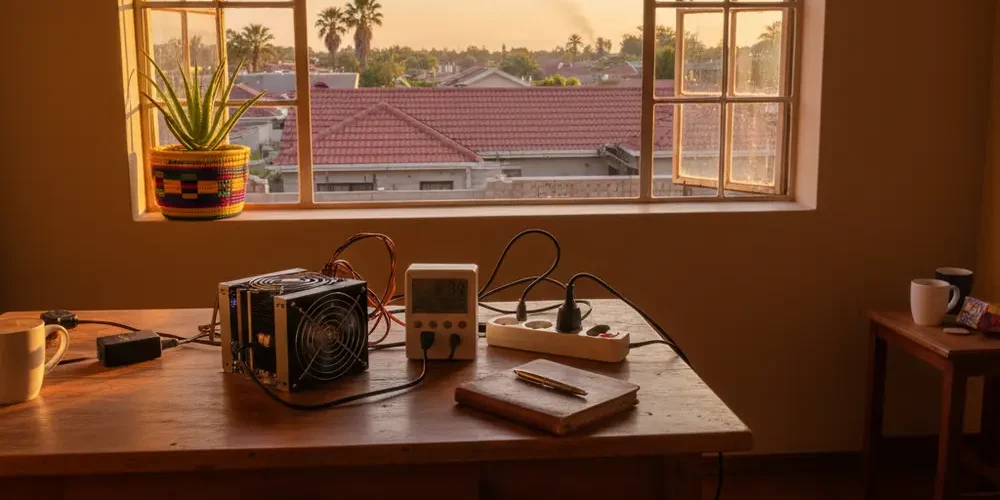
People keep asking if there is a way to mine Bitcoin for free, usually after seeing an app, a Telegram group, or a cloud mining ad promising daily returns. It matters because the wrong choice can cost you money, data, and time, and it can be hard to recover losses once funds leave your wallet.
By the end of this guide you will be able to label most offers as real mining, subsidised mining, rewards dressed up as mining, or a scam. You will also have a practical decision tree, plus a South African reality check on power, uptime, noise, heat, and tax record-keeping.
Note for South Africa:
- Electricity tariffs differ by municipality and supply type, and a home miner’s true cost usually includes more than a single c/kWh figure.
- Load shedding and voltage events can reduce uptime and increase hardware stress, plan for protection and safe shutdowns.
- So-called free electricity like Free Basic Electricity is limited and not designed for high-load devices like miners.
At a glance:
- If you are not paying for hardware or power, you are usually not mining, you are earning rewards, watching ads, or subsidising someone else’s miner.
- Solo mining is a lottery, you can win, but the expected wait time for a small miner can be extremely long.
- Pool mining smooths payouts but does not change the underlying economics, power and hardware costs still matter.
- Cloud mining is where most “free mining” scams live, treat fixed daily return promises as a deal-breaker.
Key takeaways:
- Real Bitcoin mining needs specialised hardware, reliable power, and a realistic plan for heat and noise.
- Most “free mining apps” are not mining, and many are designed to lock you behind withdrawals, fees, or referrals.
- In South Africa, uptime, tariffs, and record-keeping for SARS often matter more than the headline hashrate.
What people mean by "free Bitcoin mining" (and what it is not)
When someone says free Bitcoin mining, they usually mean one of four things. Only one of them is real mining in the strict sense of contributing hashrate to Bitcoin’s proof-of-work network.
- Real mining: You own or control a miner, you point it at a pool or solo endpoint, and rewards depend on valid blocks and pool rules.
- Subsidised mining: Someone else pays the big costs, hardware, power, hosting, and you get a small cut as a promo or for providing capital.
- Rewards labelled as mining: Faucet payouts, ad rewards, cashback, surveys, referrals, loyalty points converted to BTC.
- Scams: Upfront deposits, "activation fees", locked withdrawals, guaranteed fixed daily returns, fake dashboards.
If you remember one rule, it is this. If you do not pay for hardware or electricity, then "free mining" is either marketing, subsidised exposure, or a trap.
How Bitcoin mining actually works in 2026, quick primer for beginners
Bitcoin mining is the process of using computing power to find a valid block, which confirms transactions and secures the network. Miners compete to find a block by repeatedly hashing candidate block headers, and the network adjusts difficulty so blocks average around one every 10 minutes. citeturn2search0turn2search1
Miners are rewarded with the block subsidy plus transaction fees, and the subsidy halves on a schedule. The key point for this article is not the exact number today, it is that the subsidy reduces over time, which changes mining economics. citeturn2search0
For most individuals, Bitcoin is mined with ASIC devices, not GPUs. A normal gaming PC can still be useful for learning, monitoring, running a node, or mining other coins, but it is not competitive for mining Bitcoin directly.
If you want a deeper, plain-language explanation, Investopedia’s overview of how Bitcoin mining works is a decent starting point. citeturn2search0
If you’re new
- Start by separating "earning BTC" from "mining BTC", they are not the same activity.
- Learn the basic terms, hashrate, difficulty, block reward, pool fee, payout threshold.
- Assume any ad that promises fixed daily BTC is not mining education, it is marketing at best.
- Use a small test wallet for experiments, never reuse your main wallet seed for random apps.
- Plan for heat, noise, and continuous power before you plan for hashrate.
If you have done this before
- Recheck your assumptions after the most recent halving, subsidy drops can change break-even fast.
- Audit your uptime, a miner that is offline for load shedding is quietly unprofitable for longer.
- Review pool payout rules and custody risk, especially if you used a pool that holds balances.
- Re-evaluate cooling, fans, and dust, South African summer heat can be the bottleneck.
- Keep better records, invoices, power estimates, and payout logs help with SARS compliance.
Solo mining and the "lottery" idea, why the odds are extreme
Solo mining means you keep the full block reward if you find a block, but you also carry all the variance. Think of it like buying a ticket for every hash attempt, most attempts lose, and the win events are rare.
The problem is scale. The Bitcoin network’s total hashrate is enormous, so a small miner’s share can be tiny, and the expected time to find a block can stretch into years. This is why you will see experienced miners call solo mining a lottery for hobbyists. citeturn2search2
Anecdotes can be misleading, because someone can get lucky and win quickly, while most people never do. Tom’s Hardware covered a real case where a hobbyist mined a block with extremely low odds, which is possible but not a strategy. citeturn2search3
Variance explained with network hashrate and difficulty (no profitability promises)
Mining difficulty is the network’s way of keeping blocks near a steady cadence. Roughly every 2,016 blocks the network adjusts difficulty based on how fast blocks were found in the previous period. citeturn2search0turn2search1
Expected time-to-find-a-block for solo mining is based on your share of total network hashrate, but real life results vary a lot. Even if your expected time is, for example, 5 years, you could still find a block next week or you could wait decades.
Because network hashrate and difficulty change all the time, any numeric example can become stale quickly. If you want a safe way to think about it, focus on the direction, higher network hashrate and higher difficulty generally mean tougher solo odds for the same miner. citeturn2search1
Pool mining vs solo mining, what changes and what does not
Pool mining combines hashrate from many miners and shares rewards according to the pool’s rules. The big benefit is smoother payouts, you trade rare big wins for frequent small payments.
What does not change is the fundamentals, hardware cost, electricity cost, heat, uptime, and the network difficulty. Pooling improves predictability, not the laws of physics.
This is also where beginners can confuse "I got paid today" with "mining is profitable". A payout is just a distribution of expected value over time, it is not a guarantee that you are covering your costs.
Fees, payout models, custody of rewards, and pool centralisation risks
Pools charge fees, and they have different payout models, which change when you get paid and how variance is shared. The common models include pay-per-share (PPS) and pay-per-last-n-shares (PPLNS), and each has trade-offs.
There is also a custody question. Some pools pay directly to your wallet address, others keep a balance behind an account login, which can introduce account freeze and KYC risk.
Finally, there is a centralisation risk. When too much hashrate concentrates in a small number of pools, it can reduce the network’s decentralisation and resilience.
If you want a basic, non-technical overview of why pools exist, this explainer on why miners use a pool is useful, read it as education, not as an endorsement of any specific pool. citeturn2search2
Quick comparison table, what "free" usually means
Use this table to sanity-check what you are being offered before you sign up or pay anything.
| Offer type | What it really is | What you control | Main risk |
|---|---|---|---|
| Home mining (ASIC) | Real mining | Hardware and wallet | Power cost, heat, noise |
| Pool mining | Real mining via pool | Miner setup, sometimes wallet | Fees, custody, pool rules |
| Solo mining | Real mining, high variance | Everything | Very long expected wait |
| Faucet or ad app | Rewards, not mining | Usually limited | Data, time, withdrawal traps |
| Cloud contract | Remote hosted mining | Often little control | Scams, hidden fees, lock-ins |
"Free" options you will see online, and what you really get
Most free options are either very small rewards for attention, or they are cloud mining offers with hidden costs. The key is to separate marketing labels from what you can verify.
Faucets, earn programs, referral schemes, browser miners, and cloud mining contracts
Faucets: These pay tiny amounts of BTC (or sometimes tokens) for completing tasks. They are not mining, and you should expect friction like captchas, withdrawal thresholds, and sometimes KYC.
Earn apps and rewards: Some apps pay you for watching ads, filling surveys, or shopping, then label it as "mining". Treat them like rewards programmes, not a path to meaningful hashrate.
Referral schemes: If earnings mainly come from recruiting, the system is not funded by mining. It is funded by new users, which is a classic collapse pattern.
Browser miners: These used to run scripts in browsers, typically mining CPU-friendly coins, not Bitcoin. They also raise security and performance concerns, and many are blocked for good reasons.
Cloud mining contracts: This is the big one. A legitimate hosting company can exist, but the scam rate is high, and it is hard for beginners to verify whether real hardware is running and whether fees will eat all returns.
Practical decision tree: is it real mining or a scam?
Use this yes or no flow before you spend money or share documents. If you hit a red flag, stop and reassess.
- Do you have to pay upfront to "activate" mining? If yes, proceed with extreme caution, many scams start here.
- Does it promise a fixed daily return (for example, 1% per day)? If yes, treat it as a scam and walk away.
- Can you withdraw to your own wallet without extra steps? If no, assume you are being locked in behind fees, KYC, or delays.
- Is there a verifiable payout address and transparent fee schedule? If no, you cannot audit anything, avoid.
- Do you control the miner settings (pool URL, worker, payout address)? If yes, it is more likely to be real mining or legitimate hosting.
- Can you point the miner to any pool you choose? If no, you might be in a closed system where numbers can be faked.
- Are power costs and hosting fees clearly disclosed? If no, the "profit" is usually a dashboard illusion.
- Action: If it passes the checks, test with the smallest possible amount and a short period, and still assume risk.
Common mistakes
- Confusing an app reward balance with mined Bitcoin, and then planning around it.
- Buying hardware before planning power, noise, airflow, and where the heat will go.
- Assuming a single national electricity rate, instead of checking your Eskom or municipal tariff structure.
- Leaving a miner unprotected on unstable power, then blaming the pool when hardware fails.
- Ignoring fees in cloud contracts, which can silently reduce payouts to near zero.
South African reality check, power costs, load shedding, and noise and heat
In South Africa, the practical constraints often decide whether home mining is even viable. Two homes in the same city can have very different tariffs and reliability depending on supply and municipal rules.
It is also not just the energy charge. Many bills include fixed or service components, plus tiered rates, which means your marginal cost for a high-load device can be higher than you expect. Eskom tariffs also change over time and by customer type, so you need to check the official tools and your municipality’s schedules. citeturn2search6
Then there is uptime. Every hour offline during load shedding is an hour you are not contributing hashrate, but you still paid for the hardware.
- Heat: ASICs turn electricity into heat, if you cannot vent it, your room becomes the heatsink.
- Noise: Many miners sound like a loud vacuum cleaner, check your living situation and neighbours.
- Power quality: Surges and dips can damage PSUs and control boards, plan surge protection and safe shutdown.
- Dust: Dust blocks heatsinks and raises temps, which raises fan speed and failure rates.
On the topic of "free electricity", Free Basic Electricity exists as a limited poverty-alleviation allocation, and eligibility and allocation can vary by municipality. It is not intended to run high-load equipment like miners. See Eskom’s Free Basic Electricity (FBE) explained and the DMRE government FAQ on free basic electricity for the official framing. citeturn2search4turn2search5
Hardware reality: ASIC vs GPU for Bitcoin (and what your PC can still do)
If your goal is mining Bitcoin on the Bitcoin network, ASICs dominate. A GPU or CPU can hash, but it is not competitive against specialised ASIC hardware, so the expected outcome is usually effectively zero over time.
This does not mean your PC is useless. A PC can help you learn the ecosystem and reduce risk by building skills first.
- Run monitoring tools and dashboards for your miner.
- Learn basic networking, VLANs, and safe remote access.
- Run a Bitcoin full node for education and validation, even if you do not mine.
- Experiment with mining other networks that are designed for GPUs, with the same scam awareness.
When you are ready to look at hardware options, use the shop pages as a catalogue, not as a promise of returns. You can browse Bitcoin ASIC miners and compare form factors, power draw ranges, and cooling approaches, then plan around your real constraints first.
Solo infrastructure note: pools and services that support solo style mining
Some services allow solo-style mining where you mine "solo" but still use shared infrastructure for block templates and connectivity. This can reduce setup effort compared to running everything yourself, but it does not change the variance problem.
If you explore solo endpoints, read the documentation carefully, check fee disclosure, and understand whether you need your own node, your own payout address control, and how they handle stale shares. If the service is vague about any of that, treat it as a risk signal.
If you are shopping specifically for small solo-oriented devices, see solo lucky miners for the hobbyist segment, and keep expectations realistic.
Safer paths for beginners who want Bitcoin exposure without mining at home
If what you actually want is Bitcoin exposure, mining is only one path, and it is often the hardest path for a beginner in South Africa. There are alternatives that reduce operational risk.
Buying small amounts, DCA, mining education rigs, or hosting options (with risk notes)
- Buy small amounts over time: A disciplined approach can be simpler than managing hardware, power, and downtime.
- Education rig first: Start with a small device to learn thermals, power, noise, and monitoring before scaling.
- Hosting, with scepticism: Legit hosting exists, but verify terms, fees, payout method, and exit options before you commit.
- Used gear carefully: Used miners can be good value, but inspect for corrosion, fan wear, hashboard issues, and PSU condition.
If you need help planning airflow, ducting, noise control, or safe power, use the contact page and describe your room size, circuit rating, and load shedding schedule. If you are looking for repairs or inverter support as part of an uptime plan, see professional inverter repairs.
Compliance and record-keeping in South Africa (SARS basics)
Mining and mining-like rewards can have tax implications. SARS states that normal tax rules apply to crypto assets, and it explicitly lists mining as a way crypto assets can be acquired. citeturn2search7
You do not need a perfect system to start, but you do need records. Keep enough detail to explain what happened if you ever need to reconstruct your activity.
- Date and time of payouts received, plus wallet addresses involved.
- Pool statements, invoices, and fee summaries.
- Hardware purchase invoices and repair costs.
- Estimated power usage method, for example, measured wattage times hours, and tariff context.
SARS has also published compliance warnings about crypto assets activity, which is another reason not to treat "free mining" as invisible. citeturn2search8
Buying used miners or PCs in South Africa: practical protections
Second-hand mining hardware is common, and it can be a sensible way to start. Your protection depends on who you buy from and whether they sell in the ordinary course of business.
As a practical rule, a registered supplier selling used goods may trigger Consumer Protection Act expectations, while private sales and certain sale types can have different outcomes. If you want a plain-language discussion of how CPA issues can apply to second-hand purchases, see this overview on South Africa CPA and second-hand goods. citeturn2search9
If you are selling older GPUs or PCs that are no longer ideal for your plan, consider using sell your items to keep the upgrade cycle clean and documented.
Frequently asked questions
Is there any legit free Bitcoin mining app?
In most cases, no, not in the sense of contributing real Bitcoin hashrate without cost. Many apps that say "mining" are ad or referral rewards, and some are outright scams with withdrawal locks.
Can I mine Bitcoin with a gaming PC?
Technically you can run hashing software, but practically it is not competitive against ASIC miners on the Bitcoin network. A gaming PC is better used for learning, monitoring, and general crypto tooling.
Is solo mining worth it for a small miner?
Solo mining can be a fun hobby and a learning tool, but you should treat it like a lottery because variance is extreme. Pool mining is usually chosen for smoother payouts, even though it does not remove costs.
Does load shedding damage miners?
Frequent hard power-offs can increase stress on power supplies and electronics, and downtime reduces your effective hashrate. Common mitigations include surge protection, stable wiring, safe shutdown strategies, and planning cooling for restart conditions.
Do I need to declare mined Bitcoin to SARS?
SARS indicates that normal tax rules apply to crypto assets and mining is a recognised way crypto can be acquired. Keep records of payouts, fees, and costs, and consider professional tax advice for your situation. citeturn2search7turn2search8
Next steps, a simple checklist
Use this checklist to move forward without getting trapped by "free" narratives.
- Decide your goal, learn, hobby mine, or maximise BTC exposure without hardware.
- Confirm your power reality, tariff structure, circuit capacity, and load shedding impact.
- Plan heat and noise management before buying equipment.
- Pick a mining mode, pool for smoother payouts, solo for hobby lottery.
- Set up record-keeping from day one, payouts, fees, and costs.
If you want more background reading, browse our insights section for related mining and hardware posts, and use about us to understand how we test, refurbish, and support gear.
Summary
- Real Bitcoin mining is not free, it needs hardware, power, and a plan for heat and noise.
- Solo mining is possible but highly variable, pool mining is usually the practical on-ramp.
- Most "free mining" offers are rewards programmes or cloud contracts with hidden risk.
- In South Africa, tariffs, uptime, and power quality often decide outcomes more than hashrate.
- Keep records for SARS and treat compliance as part of the project, not an afterthought.
This is educational content, not financial advice.

