
How Bitcoin price impacts Bitcoin mining
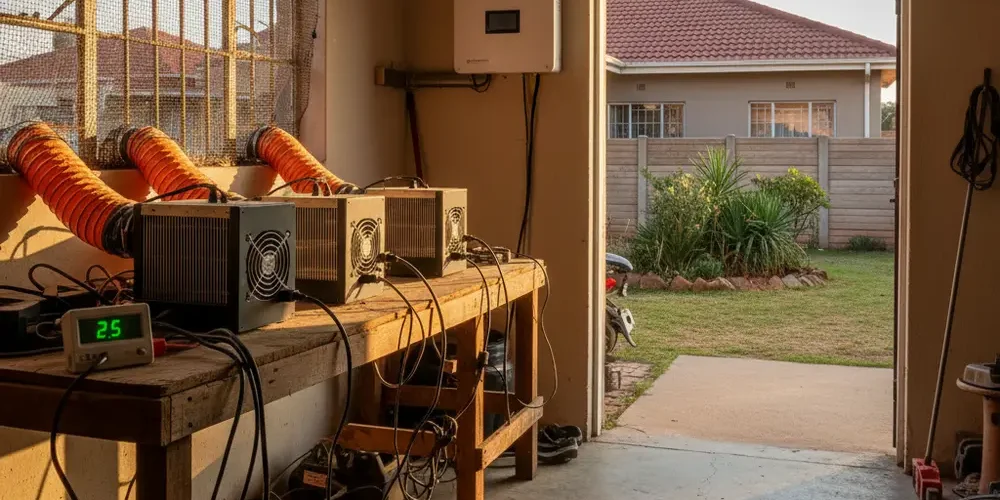
Bitcoin’s price moves can make mining look easy on a chart, but the actual impact on miners is slower and messier in real life.
To mine profitably you need to separate what changes immediately, like your revenue in rand, from what changes later, like difficulty and competition.
By the end of this article you will be able to map a BTC price move to your expected mining revenue, the likely difficulty response, and the practical actions you can take.
You will also have a simple decision tree and a sensitivity table framework you can reuse without guessing prices or tariffs.
Note for South Africa:
- Your costs are mostly in ZAR, but your mining revenue is effectively priced in BTC and often measured against USD markets, so FX moves matter.
- Electricity tariffs and tariff structures can change, and municipal supply can differ from Eskom direct, always confirm the tariff that applies to your meter and account.
- Uptime risk from load shedding and equipment protection (surge, heat, dust) can quietly erase profits even when the price looks strong.
At a glance:
- BTC price moves change your revenue immediately, difficulty and competition usually react with a delay.
- Profitability is a three-part equation, BTC price, your all-in cost per kWh, and your share of network hashrate.
- In South Africa, downtime and tariff structure often matter as much as the headline c/kWh.
- Use a decision tree to choose, keep mining, mine off-peak, underclock, switch off, colocate, or sell hardware.
Key takeaways:
- Price up does not guarantee profit because difficulty and fees can move against you.
- Model in ZAR and include downtime, cooling, pool fees, and exchange spread.
- Make decisions on break-even electricity cost and risk, not on hope.
Quick answer, what changes immediately when BTC price moves, and what changes with a delay
When BTC price rises, your gross revenue value (in ZAR) for the same amount of BTC earned usually increases immediately.
What does not change instantly is the amount of BTC you earn per terahash, because network difficulty only adjusts periodically and other miners need time to react.
The practical result is that a sudden price spike can create a short window where mining looks unusually good, then competition catches up.
- Immediate: revenue in ZAR terms, sentiment, and often pool payout value.
- Fast but not instant: transaction fee levels, as on-chain activity and mempool congestion change.
- Delayed: hashrate growth and difficulty increases, as miners switch on, ship new machines, or relocate.
- Always present: your own uptime and cooling limits, these can dominate outcomes in SA.
Quick reality check for beginners
Mining is not just a bet on BTC price.
It is also a bet on your ability to buy electricity, convert it to hashrate efficiently, stay online, and manage risk better than the average miner.
If you want to invest based on price only, that is closer to buying BTC than running miners.
Mining revenue basics, price, block subsidy, fees, and your share of hashrate
Bitcoin mining revenue has two main parts, the block subsidy and transaction fees.
Miners compete to find blocks, and a pool pays you based on your share of contributed hashrate, minus pool fees and sometimes payout method effects.
Price matters because both subsidy and fees are paid in BTC, but your bills are typically in ZAR.
- Block subsidy: the protocol-defined BTC paid to the miner of a block, it halves roughly every four years.
- Transaction fees: paid by users to get transactions included, this varies a lot by demand for block space.
- Your share: your hashrate divided by the pool or network hashrate, adjusted for pool method and luck.
The April 19, 2024 halving reduced the subsidy from 6.25 BTC to 3.125 BTC, which means fees and operational efficiency matter more than they used to. April 2024 Bitcoin halving explained
The difference between BTC-denominated revenue and ZAR-denominated costs
Most miners earn BTC but pay costs in local currency, that mismatch is a core risk.
Even if BTC is flat in USD terms, your profitability in South Africa can change if ZAR weakens or strengthens.
If you sell mined BTC frequently to pay bills, FX rate and exchange spread become part of your cost base.
- Revenue side: BTC earned per day times BTC price (often priced on global markets).
- Cost side: kWh used times your all-in cost per kWh, plus fixed charges, plus downtime losses.
- Conversion layer: pool payout rules, exchange fees, bid-ask spread, and withdrawal costs.
Early decision points table, what to do when price moves
Use this as a quick triage before you open spreadsheets.
It is not a profitability calculator, it is a decision aid that forces you to check the right variables in the right order.
| What changed | What to check next | Likely action |
|---|---|---|
| BTC price up fast | Fees and difficulty trend, your uptime | Keep mining, watch for difficulty catch-up |
| BTC price down fast | Your break-even kWh, cash runway | Underclock, mine off-peak, or pause |
| Difficulty rising | Your efficiency, cooling, power cost | Optimise, or plan to sell older units |
| Fees unusually high | Pool payout method and variance | Stay online, avoid unnecessary downtime |
| Electricity cost up | Tariff structure, TOU windows | Shift runtime, consider solar-battery strategy |
Why price affects hashrate and difficulty, feedback loops and the 2,016-block adjustment
When BTC price rises and stays higher, mining revenue per unit of hashrate usually improves, so more miners can afford to run.
That tends to push total network hashrate up as machines come online or new hardware is deployed.
Bitcoin then adjusts difficulty so that blocks keep averaging around 10 minutes, even if more hashrate is online.
Difficulty adjusts every 2,016 blocks based on how fast blocks were found versus the target time. Bitcoin difficulty explained
- Feedback loop: price up, miners expand, hashrate up, difficulty up, BTC earned per TH down.
- The reverse: price down, inefficient miners stop, hashrate down, difficulty can adjust down, BTC earned per TH can recover.
- Timing: difficulty responds on the protocol schedule, miner behaviour responds on business timelines.
What miners mean by capitulation and why it can be temporary
Miner capitulation is shorthand for a period where many higher-cost miners are forced to shut down or sell BTC to cover bills.
You may see it alongside falling hashrate, slower blocks until the next adjustment, and pressure on mining companies.
It can be temporary because once difficulty drops, the remaining miners often earn more BTC per TH again.
- Capitulation is usually about cash flow, not ideology.
- A miner can be right long-term and still go bust short-term.
- In SA, load shedding plus high tariffs can create capitulation-like stress at smaller scales inside your own operation.
Demand versus price, what crypto demand usually means for miners
Miners often say demand when they mean a mix of investor buying pressure and demand for block space.
Investor demand can lift price, which raises the value of your BTC earnings.
Block space demand raises transaction fees, which can materially boost miner revenue even if price is flat.
- Price-driven demand: investors buying BTC, risk-on or risk-off cycles.
- Usage-driven demand: more transactions competing for inclusion, higher fees.
- Mining demand: miners buying machines and hosting, which raises network hashrate and competition.
Indicators miners watch, spot demand, derivatives, ETF flows, and on-chain activity, and the limits
It is tempting to look for one magic indicator, but miners should focus on what changes revenue or risk.
Spot price and fee levels are the two direct revenue inputs, difficulty and hashrate are the competition inputs.
Everything else is supporting context, and can be noisy.
- Spot market: price trend and volatility, this drives ZAR value of payouts.
- On-chain: fee pressure and mempool congestion, this influences the fee portion of revenue.
- Derivatives: funding and open interest can signal leverage and liquidation risk, but do not overfit it.
- Operational: your own uptime, temperature, and reject rate, these often matter more than market indicators.
Practical SA lens, electricity tariffs, load shedding risk, and operating strategy
In South Africa, mining is usually constrained by electricity cost, electricity availability, and heat management.
That means a miner with slightly worse hardware can outperform a miner with better hardware if their power cost and uptime are superior.
Tariff changes and tariff structure matter, because fixed charges and time-of-use windows can shift your real break-even.
- Confirm your tariff type: Eskom direct vs municipal, residential vs business, and whether TOU applies.
- Model downtime: treat load shedding as a probability and expected hours offline, not as a surprise.
- Protect equipment: surge protection, earthing, and proper wiring reduce catastrophic losses.
- Cooling and dust: high ambient temperatures and dust can reduce hashrate and increase failures.
For tariff timing and structural changes, use official sources and check effective dates for your supply type. NERSA-approved Eskom tariffs effective dates
If you are planning a new setup or resizing ventilation and ducting, consider getting help early. Contact Sell Your PC
How to stress-test profitability without guessing prices or tariffs
You do not need the perfect forecast to make good decisions.
You need ranges, and you need to know which inputs you control.
Stress-testing means asking, if BTC price drops by X or tariffs rise by Y, what is my action plan.
- Pick a conservative BTC price range and a more optimistic range, then test both.
- Use your current tariff, then test a higher tariff scenario to reflect future increases or seasonal changes.
- Add a downtime factor, even 5 to 20 percent downtime can flip results.
- Include a cooling overhead factor, fans and extraction power draw are real.
Decision tree, when to mine, hold, switch off, or sell hardware
This decision tree is designed for small to medium SA miners, including hobby miners scaling up.
It starts with the inputs that usually break mining first in South Africa, electricity and uptime.
Use it monthly, and also after any major BTC move or tariff change.
- Calculate your all-in electricity cost per kWh. Include energy charges, fixed charges that are triggered by higher usage, and any time-of-use peak pricing.
- Estimate realistic uptime. Include load shedding, trips, maintenance, and internet downtime.
- Check current network conditions. Look at difficulty trend and fee environment, do not assume last month repeats.
- Check hardware efficiency and thermal headroom. If you are heat-limited, your effective efficiency gets worse.
- Choose a treasury strategy. Decide what percentage of mined BTC you sell monthly to cover costs versus hold.
- Pick an action: keep mining, mine only off-peak, underclock, switch off, colocate, or sell the ASIC and redeploy capital.
If you are comparing ASIC options or looking for quieter, lower-power alternatives for learning, start with the catalogue and filter by your constraints. Bitcoin ASIC miners in the shop
Common misconceptions, price up equals profit, per-transaction energy comparisons, and difficulty means scarcity
Beginners often get stuck on one variable, usually BTC price.
Mining is multi-variable, and the network adapts, so the easy profits get competed away.
Clearing up misconceptions early saves money.
- Price up equals profit: difficulty and hashrate often rise after price, reducing BTC earned per TH.
- Fees are always small: fees can spike in busy periods, but can also be negligible, plan for variability.
- Difficulty means scarcity: difficulty is an adjustment mechanism, it targets block time, not market value.
- Energy per transaction is the right metric: this framing can be misleading for PoW networks and changes with usage patterns. Why per-transaction energy comparisons mislead
- My miner runs, so it is fine: reject rate, stale shares, and thermal throttling can silently reduce payouts.
If you are new
These steps help you avoid expensive mistakes before you buy hardware or upgrade power.
- Start by learning the difference between revenue in BTC and costs in ZAR.
- Measure your real power draw with a meter, do not trust assumptions.
- Choose a pool payout method you understand, then stick with it long enough to see variance.
- Plan noise and heat management first, especially in summer regions.
- Set a simple rule for selling some BTC to cover bills so you do not panic sell later.
If you have mined before
Experienced miners usually win by tightening operations, not by chasing every market move.
- Audit downtime and reject rates, then fix the biggest leak first.
- Re-check your tariff and fixed charges, unbundled charges can change the picture.
- Build an off-peak or underclock profile, then automate switching where possible.
- Review whether your older units still make sense, or if selling them funds a more efficient upgrade.
- Track your ZAR break-even monthly, not once per year.
Worked example framework, build your own mining sensitivity table (no numbers)
You do not need to publish your numbers to build a useful model.
The goal is to see which variable moves your outcome the most, then focus there.
Start with one machine, then scale to your full fleet.
- Inputs you control: power cost, uptime, cooling, pool choice, and when you sell BTC.
- Inputs you do not control: BTC price, network difficulty, and fee market.
| Scenario | BTC price direction | Difficulty direction | Your uptime | Expected result |
|---|---|---|---|---|
| Baseline | Flat | Flat | Normal | Use as reference month |
| Price up, difficulty lag | Up | Flat to up later | Normal | Short-term improvement |
| Price down, difficulty not yet down | Down | Flat | Normal | Fast margin squeeze |
| Tariff shock | Any | Any | Normal | Recompute break-even kWh |
| High downtime month | Any | Any | Low | Revenue drop, fixed costs hurt |
If you want a second opinion on whether to upgrade, pause, or sell your gear, you can also look at non-mining options like selling hardware and redeploying capital. Sell your items
Decision, when to mine, hold, switch off, or sell hardware
This is where price impact becomes practical.
Do not aim for perfect timing, aim for repeatable rules that protect your cash flow.
- Mine and sell regularly: best when you need stable cash flow and your tariff is high.
- Mine and hold some BTC: best when you can cover bills and you want long-term exposure.
- Mine off-peak only: best when TOU pricing is punitive at peak and your setup can handle cycling.
- Underclock: best when you are near break-even and want to reduce heat and improve efficiency.
- Switch off: best when you are clearly below break-even and risk damaging hardware for small returns.
- Sell hardware: best when the opportunity cost is high, or you expect sustained tariff pressure and cannot improve efficiency.
If you are planning a more professional, safer setup, including compliance and power quality, consider structured help. Professional services
Frequently asked questions
Does Bitcoin price affect mining difficulty immediately?
No. Price can change instantly, but difficulty only adjusts on the protocol schedule, which is every 2,016 blocks, based on how fast the last set of blocks were mined. How Bitcoin difficulty adjusts
Why do miners talk about fees, and can fees replace the subsidy?
Fees are the variable part of miner revenue and can surge when block space is in high demand. Over time, as the block subsidy continues to halve, fees become more important, but they are not reliably high every day.
What is the single biggest driver of profitability in South Africa?
For most small miners it is all-in electricity cost combined with uptime. A slightly cheaper kWh and fewer hours offline often beat marginal improvements in hashrate.
Should I mine during load shedding if I have an inverter or generator?
Only if you model the full cost and risk. Battery cycling costs, generator fuel, noise constraints, and equipment protection can make mined BTC very expensive during outages.
Is it better to buy BTC or buy a miner?
Buying BTC gives price exposure with fewer operational risks. Buying a miner adds exposure to difficulty, fees, electricity costs, and uptime, which can outperform or underperform depending on your setup and discipline.
Short summary
- BTC price moves affect your revenue value immediately, but difficulty and competition react later.
- Model profitability in ZAR and include downtime, cooling overhead, and conversion costs.
- Use a decision tree to choose actions, do not improvise under stress.
- In SA, tariff structure and uptime can matter as much as hardware efficiency.
This is educational content, not financial advice.

