
Inland vs Coastal Mining: Cable and Plug Care in Humid Air
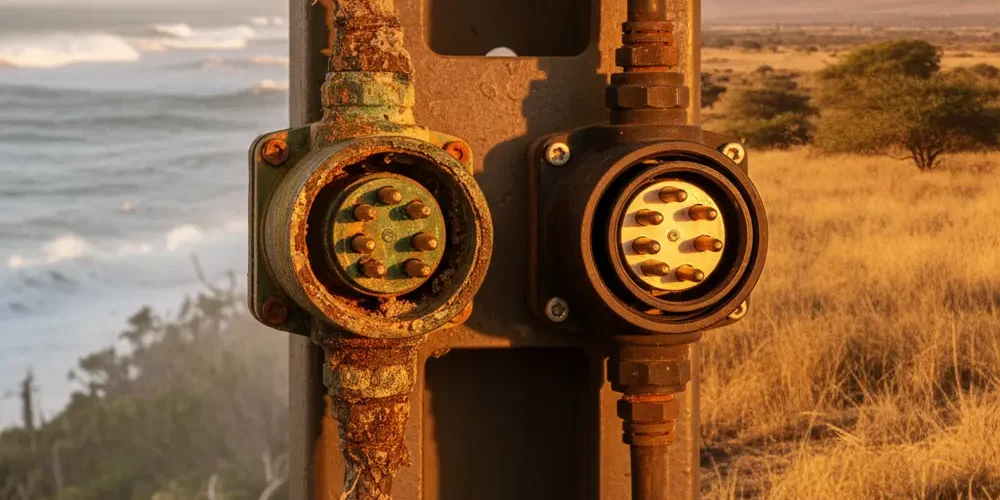
Where you run your mining rig in South Africa matters more than most home miners realise, and the reason is humidity. A rig running in a Durban garage faces a completely different corrosion environment than one sitting in a Johannesburg spare room, and ignoring that difference quietly kills your connectors and cables.
By the end of this article you will know how humidity damages your power cables and plugs, which connectors are most at risk, and exactly what to do each month to stop corrosion before it becomes an expensive repair bill.
Note for South Africa:
- Durban is subtropical and humid year-round, while Johannesburg and the Highveld are much drier, especially in winter. Cape Town sits in between, with dry summers and wetter winters. Do not treat all coastal locations as the same risk level.
- Load shedding means most South African home miners cycle their rigs on and off repeatedly. Each power cycle adds thermal stress to connectors, which compounds humidity-related corrosion. Factor in the ongoing load shedding reality when planning your maintenance schedule.
- SANS 10142 is the South African wiring standard governing domestic electrical installations, including damp and wet locations. If your rig runs in a garage or outbuilding without climate control, check the SABS standards page for the current version before making any fixed wiring changes.
At a glance:
- Humidity above roughly 60 percent accelerates oxidation and corrosion on copper and tin-plated connectors.
- ATX, PCIe, and SATA connectors are the most vulnerable points on a typical home mining rig.
- Coastal miners need more frequent checks and additional protective steps compared to inland miners on the Highveld.
- Contact cleaner, isopropyl alcohol, desiccants, and good airflow are your main tools, and most are available locally in South Africa.
Key takeaways:
- Oxidation on power connector pins increases contact resistance, which causes heat buildup and can lead to connector failure under mining loads.
- Salt air in coastal areas accelerates corrosion far beyond what general humidity alone causes, so location matters significantly.
- A simple monthly inspection routine, adjusted for your region, is the single most effective thing you can do to protect your cables and plugs.
Why Your Location Changes Your Hardware Maintenance Game
South Africa has some of the most varied regional climates of any country, and that variation has a direct effect on how quickly your mining hardware degrades. The question is not whether humidity affects your rig, but how much and how fast.
Understanding safe humidity levels for electronic equipment is the starting point. Electronics generally perform best between 40 and 60 percent relative humidity. Below 40 percent you risk static damage; above 60 percent you begin accelerating oxidation on metal contacts.
The Humidity Difference Between Inland and Coastal South Africa
According to the South African Weather Service climate information, KwaZulu-Natal coastal areas including Durban are among the most humid regions in the country, with subtropical conditions year-round. Johannesburg and the broader Highveld sit at altitude and are noticeably drier, particularly through the winter months.
Cape Town is different again. Its Mediterranean climate brings dry, warm summers and wetter, cooler winters. A miner in Cape Town faces seasonal humidity risk rather than year-round exposure, but winter months can still push indoor humidity into ranges that accelerate corrosion.
The practical result is simple: a miner in Durban needs to inspect and treat their connectors more often than one in Johannesburg. A miner within a few kilometres of the ocean also faces salt aerosols in the air, which is a significantly more aggressive corrosion environment than humidity alone.
How Humid Air Damages Cables and Plugs Over Time
Humidity does not destroy connectors overnight. It works slowly, through a process called atmospheric corrosion in humid environments. Moisture in the air forms a thin film on metal surfaces, which enables electrochemical reactions that oxidise the metal. The higher the humidity and the more pollutants in the air, the faster this happens.
For home miners, the most damaging combination is high humidity plus heat cycling. Your rig runs hot all day, then cools overnight. As it cools, the relative humidity inside your mining space rises and condensation can form on metal surfaces. Repeat this cycle daily for months and the damage adds up quickly.
Oxidation, Corrosion, and Contact Resistance Explained
When copper or tin-plated connector pins oxidise, they develop a resistive surface film. This increases what is called contact resistance at the connector interface. Contact resistance and heat in power connectors are directly linked: higher resistance means more heat generated at that connection point under load.
Mining rigs draw sustained high current loads. An ATX 24-pin connector or a set of PCIe power cables carrying full GPU or ASIC load will generate noticeable heat even at normal contact resistance. Add an oxide film and that localised heat increases, softening insulation, discolouring connector housings, and eventually risking a failure or fire at the connector. This is not a theoretical risk; it is a known failure mode in high-draw home mining setups.
Which Connectors Are Most Vulnerable on a Mining Rig
Not all connectors carry the same risk. The ones to watch most carefully are:
- ATX 24-pin motherboard connector – carries sustained load and has many individual pins that can oxidise independently.
- PCIe 6-pin and 8-pin power connectors – high current, often run warm, and frequently unplugged and replugged during rig changes.
- SATA power connectors – more fragile physically and prone to corrosion on the thin blade contacts.
- Modular PSU cable connectors – the junction between the modular cable and the PSU is a common overlooked corrosion point.
- Extension cables and adapters – each additional connection point is another place for oxidation to build resistance.
Inland vs Coastal Mining – A Side-by-Side Maintenance Comparison
The table below compares the key differences between a typical inland Highveld setup and a coastal setup. These are general patterns based on climate differences, not exact thresholds for every location.
| Factor | Inland (Highveld) | Coastal (Durban / East London) | Coastal (Cape Town) |
|---|---|---|---|
| Year-round humidity risk | Low to moderate | High, year-round | Moderate, higher in winter |
| Salt aerosol exposure | None | High near the ocean | Moderate near the ocean |
| Recommended check frequency | Every 6 to 8 weeks | Every 3 to 4 weeks | Every 4 to 6 weeks |
| Conformal coating benefit | Low priority | High priority for PCB areas | Worth considering in winter |
| Dehumidifier needed | Rarely in dry season | Strongly recommended | Useful in winter months |
| Load shedding compound risk | Moderate | High (humidity plus cycling) | Moderate to high in winter |
Practical Cable and Plug Care Routine for Humid Environments
A consistent routine is worth far more than an occasional emergency clean. The checklist below is split by region so you can use the column that fits your setup. Perform these checks with the rig powered off and unplugged.
Cleaning, Protecting, and Inspecting Your Connections
Before you start, gather your tools. You will need a torch or headlamp, isopropyl alcohol at 90 percent or higher, a contact cleaner spray (DeoxIT or equivalent, available from local suppliers such as Communica or RS Components), cotton swabs, and a can of compressed air. For coastal miners, also have conformal coating spray on hand for non-contact PCB areas.
On how to clean oxidised electrical contacts, the key principle is to match the cleaner to the contamination. Light dust and surface film: use IPA. Heavier oxidation or corrosion: use a dedicated contact cleaner with a lubricating residue. Never use abrasive tools on plated pins.
Monthly inspection checklist – Inland vs Coastal:
| Check | Inland (every 6 to 8 weeks) | Coastal (every 3 to 4 weeks) |
|---|---|---|
| Visual check: ATX 24-pin pins | Look for discolouration or dullness | Look for green or white oxidation; clean if found |
| Visual check: PCIe power connectors | Check for heat marks or dull contacts | Check and clean with contact cleaner each cycle |
| Visual check: SATA connectors | Check for bent or dull blade contacts | Check, clean, and consider replacement if pitted |
| Smell test: burning insulation | Sniff near all connectors while warm (not hot) | Same; do this before the visual check |
| Modular PSU junction check | Inspect every second cycle | Inspect every cycle; clean with IPA |
| Conformal coating inspection | Not usually required | Check PCB areas for coating integrity; reapply if worn |
| Dehumidifier filter or desiccant check | Replace desiccant packs every 2 to 3 months | Replace desiccant monthly; empty dehumidifier weekly |
| Cable routing and tie audit | Check for chafing or pinching every 3 months | Check every 6 weeks; look for moisture traps in bends |
Always allow connectors to dry completely after applying any liquid cleaner before reconnecting and powering on. Even IPA needs a minute or two to fully evaporate. Rushing this step risks a short circuit.
Hardware choice also affects how aggressively cable and plug care needs to be enforced. Sealed hydro units like the Bitmain Antminer S21 XP Hydro 473T shift the moisture-exposure problem off the hashboards entirely, while the lower-power Avalon Q 90T reduces the contact-current stress on plugs and connectors.
Environmental Controls – What Actually Helps in a South African Home Setup
Most South African home miners run their rigs in garages, outbuildings, or spare rooms without air conditioning. Climate control does not have to mean an expensive system. A few practical steps make a real difference.
If you are new to managing mining environment humidity:
- Buy a basic digital hygrometer (under R200 at most hardware stores) and place it near your rig. You cannot manage what you do not measure.
- Keep the room humidity target between 40 and 60 percent relative humidity.
- Start with silica gel desiccant packs in enclosed spaces or cabinets near your rig. These are cheap and widely available.
- Ensure your rig has good airflow through the chassis so hot, moisture-laden air is pushed out rather than recirculating.
- Check the RS Components South Africa electronics supplies catalogue for locally stocked desiccants, cable sleeving, and humidity indicators.
If you have managed a mining environment before:
- Consider a small portable dehumidifier for coastal or high-humidity rooms. A unit sized for a small room (10 to 20 square metres) is adequate for most home setups and pays for itself in avoided hardware damage.
- Use split loom tubing or heat shrink on exposed cable runs to reduce direct moisture contact on the cable jacket.
- For rigs within a kilometre or two of the ocean, apply conformal coating to PCB areas (not mating connector surfaces) to add a barrier against salt aerosols. Check the IPC conformal coating standards for guidance on correct application and which surfaces to mask off.
- Install a UPS with surge protection to reduce the electrical stress from load shedding power cycling. This protects connectors from micro-arcing as well as your hardware from surges.
- Log your maintenance cycles in a simple spreadsheet so you can track when connectors were last cleaned and spot patterns in degradation.
When to Replace vs When to Clean – Making the Call
Not every corroded connector is salvageable, and trying to clean a connector that needs replacing wastes time and risks further damage. Here is how to decide.
Common mistakes South African home miners make with cables and plugs:
- Ignoring discolouration on connector pins because the rig is still running. Heat discolouration means the contact resistance is already elevated and damage is in progress.
- Using abrasive tools like sandpaper or wire brushes on plated connector pins. This removes the protective plating and accelerates future corrosion.
- Applying contact cleaner and immediately reconnecting without allowing full evaporation. This can cause short circuits on power-up.
- Treating all coastal locations as identical. A rig in central Cape Town faces a different risk profile from one 200 metres from the Durban beachfront.
- Skipping the PSU modular junction as a check point. This connection is often overlooked and is a known weak point under sustained load.
- Using cheap extension cables or adapters to stretch cable runs. Each added connection is another oxidation risk, and low-quality connectors corrode faster.
Replace a connector or cable when you see:
- Green or white powdery corrosion on multiple pins that does not clean off with contact cleaner.
- Melted, darkened, or deformed plastic on the connector housing.
- A burning smell that comes back within a week of cleaning.
- Physical pitting or erosion on the metal contact surfaces.
Clean and monitor when you see:
- Light surface dullness or mild discolouration with no heat marks.
- Minor oxidation film that lifts cleanly with IPA or contact cleaner.
- No smell and no housing damage.
Replacing a corroded modular PSU cable harness or a failed PSU in South Africa is a significant cost. Sourcing a quality replacement locally, or checking our shop for available hardware, is often faster than importing. Prevention genuinely costs less than replacement.
If you are unsure whether a connector needs replacing or professional assessment, contact us and we can help you work through it.
Frequently asked questions
Does humidity affect ASIC miners differently from GPU rigs?
The connector types are similar, so the corrosion risks are comparable. ASIC miners often run at higher sustained power draws, which means elevated contact resistance from oxidation creates proportionally more heat at the connector. The maintenance principles are the same, but the consequences of neglect can be faster and more severe on a high-draw ASIC setup. Browse our range of Bitcoin ASIC miners to see the hardware specs involved.
Is isopropyl alcohol enough, or do I need a dedicated contact cleaner?
IPA at 90 percent or higher is suitable for light cleaning and general maintenance. For heavier oxidation or connector pins that have visible corrosion buildup, a dedicated contact cleaner with a lubricating residue is more effective. The lubricant left behind by specialist contact cleaners also slows future oxidation, which IPA alone does not do.
Can I apply conformal coating to my connectors to protect them?
No. Conformal coating should not be applied to mating connector surfaces. It creates an insulating barrier that prevents electrical contact and will cause connection failures. Coating is appropriate for PCB surfaces and non-contact areas of the board. Always mask off connectors before applying any coating spray, and check the IPC-CC-830 guidelines for correct application practice.
How does load shedding make humidity damage worse?
Every time your rig powers down and cools, the relative humidity in your mining space effectively rises as the air temperature drops. Connectors that were warm and dry during operation can experience condensation during an extended off period in a humid room. Frequent power cycling from load shedding repeats this thermal stress cycle, which compounds oxidation over time. A UPS that keeps the rig at a stable low-power state during outages reduces this effect.
Where can I buy contact cleaners and desiccants in South Africa?
Communica, Mantech Electronics, and RS Components South Africa all stock contact cleaning products and desiccant packs. IPA at high concentration is also available at most electronics and hardware retailers. For specialty conformal coating sprays or marine-grade connector accessories, RS Components South Africa is a reliable local source with delivery available nationally. You can also browse our insights section for more hardware maintenance guides relevant to South African conditions.
Summary
- Your location in South Africa determines how aggressive your cable and connector maintenance needs to be. Durban requires the most frequent attention; Johannesburg the least.
- Oxidation on connector pins raises contact resistance, which generates heat under load. Left unchecked, this leads to connector failure on a running mining rig.
- A monthly inspection routine adjusted for your region, using IPA and contact cleaner, is the most cost-effective maintenance habit you can build.
- Environmental controls like desiccants, basic dehumidifiers, and good airflow are practical and affordable for most South African home setups.
- Know when to replace rather than clean. Green powder, melted housings, and recurring burn smells are replacement signals, not cleaning challenges.
This is educational content, not financial advice.

