
Mining Hardware Trends 2026
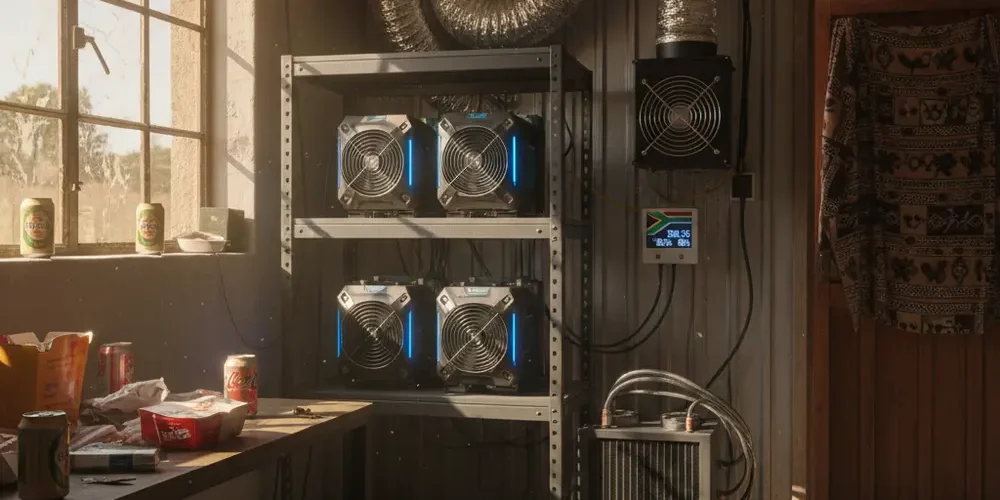
In 2026, the miners that survive are not always the ones with the most TH/s, they are the ones that control electricity cost, heat, and complaints. In South Africa, noise and cooling are often the hidden reasons a home setup gets switched off.
By the end of this article you will be able to compare efficiency using J/TH, choose a cooling path that fits your space, and test your noise risk before you buy. You will also have a decision tree and a measurement checklist you can use for a garage, a small workshop, or a container.
Note for South Africa:
- Eskom direct tariffs typically change from 1 April, while many municipal tariffs change from 1 July, always confirm your exact tariff and fixed charges before you calculate ROI.
- Load shedding, high summer temperatures, and single-phase limits change what is realistic at home, plan around inlet temperature and circuit headroom first.
- Noise complaints and by-laws are practical constraints, measure dBA at the property boundary and verify your municipality’s rules before scaling.
At a glance:
- Use J/TH to compare miners, then validate in your own environment because inlet temperature and recirculation can change real efficiency.
- Pick a cooling strategy based on location, power type, and ambient temperature, not on what looks impressive in photos.
- Reduce noise with airflow design first, then consider hydro or immersion if you need higher density or better neighbour tolerance.
- Before you order hardware, measure inlet temp, exhaust temp, circuit amperage, and boundary noise, then sketch your airflow path.
Key takeaways:
- Efficiency is a system metric, miner plus fans plus cooling plus your heat removal.
- Air cooling can work well if you stop recirculation and control static pressure and filtration.
- Hydro and immersion can cut acoustic pain, but they add maintenance disciplines you must be ready for.
What efficiency means in 2026 mining hardware, and why J/TH matters more than raw TH/s
For most SHA-256 miners, efficiency is best discussed as joules per terahash (J/TH). Lower J/TH means you use less energy for the same hashrate, which matters more when tariffs rise or when you are limited by breaker capacity.
TH/s alone can be misleading because higher hashrate models often draw more power, and your real constraint is usually kW, heat, and noise. If you have a fixed power budget, you want the most TH/s per kW, which is the same conversation as J/TH.
Also remember that published figures are typically manufacturer-stated under specific conditions. Your inlet temperature, dust load, altitude, and airflow path can push fan speed up, raise temperatures, and change the watts you actually pull.
- J/TH: the metric to compare models and tune profiles.
- W (watts): what your breaker, cabling, and inverter must handle continuously.
- Heat (kW): almost all electrical power becomes heat in the room, you must remove it.
- Acoustics (dBA): what triggers complaints, fatigue, and workplace exposure risk.
If you are shopping for hardware, treat the efficiency number as a starting point, then build your plan around how you will keep inlet air cool and clean. If you want help matching hardware to a realistic home or small-farm plan, start with our mining category in the Bitcoin ASIC miner shop section.
A quick way to sanity-check efficiency for your site
Before you get excited about a new miner model, do a site check with measurements that do not need lab equipment. This keeps you honest about what you can actually run without throttling.
- Measure inlet air temperature at the miner intake, not in the middle of the room.
- Measure exhaust air temperature, a big spread often signals poor airflow or recirculation.
- Read real power at the wall using a suitable meter, do not rely only on the miner UI.
- Log fan speed trends, rising fan speed usually means rising heat or blocked filters.
Early comparison table, which cooling path fits your constraint
Most miners end up choosing a cooling approach based on one hard constraint, like neighbours, dust, or density. Use this table to pick the direction, then use the decision tree later to validate it.
| Option | Best when | Main trade-off | What to measure first |
|---|---|---|---|
| Optimised air cooling | Budget is tight, space is available | Noise and dust management | Inlet temp and airflow path |
| Hydro or liquid-to-air | You need quieter, denser racks | Pumps, water quality, leak risk | Cooling loop capacity and access |
| Immersion cooling | You want high density and stable temps | Fluid handling and service workflow | Space, safety, warranty terms |
| Colocation or hosting | Home is too noisy or hot | Less control, contract risk | Total cost, uptime terms |
Cooling trend 1, better air cooling and airflow engineering
Air cooling is not outdated, it is often just poorly implemented. In 2026, the practical trend is airflow engineering, ducting, isolation of hot and cold air, and control of inlet temperature.
The biggest performance killer is hot air recirculation, where exhaust air loops back to the intake. The second biggest killer is static pressure problems from restrictive ducts, clogged filters, or wrong fan selection, which makes fans scream and temperatures rise.
Air cooling can be made more neighbour-friendly if you move noise outside, reduce turbulence, and avoid resonant structures. You do not need perfection, you need consistent intake air and a predictable exhaust path.
- Separate intake and exhaust paths, even a simple partition helps.
- Use straight duct runs where possible, avoid sharp bends near the miner.
- Add filtration that is easy to service, then schedule cleaning.
- Control the room pressure, too negative can pull dust in through gaps.
Practical airflow checks for a garage or container setup
Start with a sketch of your airflow, draw intake, miner rack, and exhaust. Then walk the room with a temperature probe and look for warm pockets, those are your recirculation zones.
- Recirculation test: if intake air rises quickly after startup, exhaust is looping back.
- Filter reality check: if filters are hard to access, they will not get cleaned.
- Static pressure clue: whistling, rattling duct, and high fan RPM suggest restriction.
- Door and gap check: uncontrolled gaps can become the true intake, pulling dust.
If you plan to buy ducting, extraction, or enclosures, consider building the airflow plan first and then matching parts. For infrastructure help beyond DIY, see professional services and if you are unsure about your site, talk to us via contact.
Cooling trend 2, hydro and liquid-to-air systems for higher density and lower acoustic footprint
Hydro cooled and liquid-to-air designs are attractive because they can reduce the need for high-RPM fans and can keep heat removal more controlled. The trend is not only about performance, it is about density and managing noise, especially when you cannot vent hot air safely.
In practice, you are moving heat from the miner into a liquid loop, then rejecting it through a radiator or heat exchanger. That can move the noisy, hot part of the system to a more suitable location.
Do not assume it will be silent, pumps, radiator fans, and water flow noise still exist. The benefit is that the noise profile can be lower and easier to muffle, and you can engineer the airflow at the radiator instead of at the miner.
- Better rack density for a given room volume.
- More stable temperatures, less throttling during hot days.
- Potentially easier acoustic treatment than many small high-speed fans.
- Higher upfront cost and more parts to maintain.
What changes operationally, pumps, radiators, leak risk, water quality, and maintenance cadence
Liquid systems add a maintenance rhythm. If you do not do routine checks, the failure modes can be expensive.
- Pumps: monitor flow, keep spares, and plan for failure without overheating the miners.
- Radiators: dust still matters, clean fins and check fan health.
- Leaks: build in drip trays, leak sensors, and isolation valves.
- Water quality: treat the loop as a system, corrosion and contamination are slow killers.
Before you buy, ask for written warranty and support terms from your supplier, especially on what is considered user damage. If you are comparing options, you can also browse hydro and immersion oriented hardware in our hydro and immersion section.
Cooling trend 3, immersion cooling, when it fits, what it breaks, and what it simplifies
Immersion cooling can be a good fit when you need high density, stable temperatures, and a better noise profile. The miner boards sit in a dielectric fluid, and heat is moved to a heat exchanger or radiator system.
Immersion can simplify dust and corrosion risk because you are no longer pushing dirty air through heatsinks. It can also change the service workflow, instead of swapping a fan you might be draining, lifting, and handling fluid safely.
It can also break assumptions, like quick resale, easy RMA, and simple on-site repairs. In South Africa, you must consider transport, support, and who will service the system when something goes wrong.
- Good for hot climates and high density if designed properly.
- Less fan noise at the miner, but you still have pump and radiator noise.
- Requires safe fluid handling and good housekeeping.
- Warranty and insurer questions must be answered in writing.
Dielectric fluids, safety, serviceability, and warranty considerations to verify before you buy
Do not treat immersion like a simple bolt-on accessory. It changes materials exposure, connectors, and your ability to do quick board swaps.
- Verify the exact fluid compatibility with seals, cables, and plastics used in your gear.
- Confirm the electrical safety approach, including bonding, earthing, and spill control.
- Ask how you will do routine tasks, like hashing board inspection or cleaning connectors.
- Get written warranty guidance for the specific model and supplier, not forum advice.
For general context on how energy use and policy constraints shape mining, see the IEA report on cryptocurrencies and electricity.
Noise trend, from fan scream to compliance risk
Noise is not only annoying, it is a scaling limit. In suburbs, it triggers neighbour complaints, and in workshops it can become a workplace exposure issue.
The practical trend is to treat noise like a design constraint, measure it, then engineer it down. You want to reduce noise at the source, reduce vibration transmission, and manage where the noise exits the property.
As a starting point, use an app-based meter for rough checks, but do not assume it matches legal measurement standards. If you are near the edge of acceptable levels, you may need a proper sound level assessment.
- Measure at the boundary fence and at the nearest neighbour-facing wall.
- Check day versus night risk, many rules tighten after hours.
- Listen for tonal noise, whining tones travel further than broad fan noise.
- Reduce structure-borne vibration with proper mounting and isolation.
For an example of how a municipality frames disturbing noise and enforcement powers, review an example municipal noise by-law text. For a practical explainer of how noise complaints are often assessed and why limits vary, read acceptable noise levels and noise limits in South Africa.
Workplace exposure, do not ignore it
If you run miners in a workshop, container, or small farm where people work nearby, manage occupational exposure. The safe approach is to treat high noise as a PPE and measurement issue, not a personal tolerance issue.
- Measure near the work position, not only outside the building.
- Set rules for hearing protection when entering the miner area.
- Limit time spent in high-noise zones, rotate tasks if needed.
- Document what you do, even simple logs help.
For a South African-focused summary discussing changes around noise exposure regulations and action levels, see South Africa workplace noise exposure action levels.
Firmware, pool protocols, and security trends that affect uptime
In 2026, hardware trends are tied to firmware and pool communication, because uptime is the true profit driver. The trend is better monitoring, better security hygiene, and more attention to protocol features that reduce risk.
Stratum V2 is often discussed for efficiency and security improvements compared to older approaches, but real-world support depends on your pool and firmware. Treat it as a roadmap item, check what your pool supports today, and what you can enable without breaking stability.
- Keep firmware updated from trusted sources, do not install unknown builds.
- Segment your mining network from your home network and IoT devices.
- Use strong credentials and disable default accounts.
- Monitor temperature, hashrate, and rejected shares, then alert on drift.
If you want a plain-language overview of what Stratum V2 is and why it matters, read Stratum V2 explained.
South Africa realities for 2026, tariffs, load shedding mitigation, and where efficiency upgrades pay back first
Electricity cost in South Africa is a moving target, and it is split between Eskom direct and municipal customers. On top of the per-kWh energy price, fixed charges and tariff structures can dominate your bill if you are a smaller user.
Do not calculate mining cost on a single blended number you saw online. Instead, pull your exact tariff schedule, including fixed charges, time-of-use windows if applicable, and the dates when changes apply.
Start your tariff research with official references and then confirm what applies to your address. Eskom has a central hub for tariffs and charges and it also explains timing differences for increases in its tariff increase notices.
- First payback: stopping recirculation and lowering inlet temperature often improves stability immediately.
- Second payback: moving from noisy, dusty air paths to controlled ducting and filtration reduces downtime.
- Third payback: a better tariff match can matter, but only after you understand fixed charges and eligibility.
- Be realistic: backup power is about continuity and protection, not guaranteed profit.
For planning context on multi-year tariff adjustments, review the DMRE statement on NERSA-approved tariff adjustments. For a practical discussion on how structural changes and fixed charges can affect households, see this analysis on fixed charges and household electricity bills.
Decision tree, pick a cooling and noise strategy that fits
This decision tree is designed for South African home miners and small farms. Use it to choose one of four outcomes, optimised air cooling, hydro or liquid-to-air, immersion, or colocation.
- Location type: If you are in a residential suburb with close neighbours, assume noise is your first constraint. If you are light industrial or on a farm, heat removal and dust may dominate.
- Power availability: If you are single-phase with limited breaker headroom, prioritise J/TH and reduce peak fan draw. If you have three-phase and proper distribution, higher density designs become feasible.
- Ambient temperature: If your summer inlet temperatures are high, plan for intake air control, shading, and exhaust separation before you add more miners.
- Noise tolerance and complaint risk: If you cannot keep boundary noise under control with ducting and location, move toward hydro, immersion, or hosting.
- Infrastructure budget: If you can afford ducting, extraction, and basic acoustic treatment, optimised air cooling is often the first step. If you can afford radiators, pumps, and sensors, hydro becomes realistic.
- Maintenance capacity: If you cannot commit to filter schedules, do not scale air cooling. If you cannot commit to pump checks, leak detection, and fluid handling, do not scale liquid or immersion.
Outputs:
- Optimised air cooling: best first choice when budget is tight and you can vent safely.
- Hydro or liquid-to-air: best when you need better acoustics and higher density.
- Immersion cooling: best when you want stable temps and high density, and you can manage fluid workflows.
- Colocation: best when residential constraints make the project fragile.
Measurement checklist before you buy hardware
Do these measurements before you order miners or cooling gear. It prevents expensive changes later.
- Inlet temperature at the miner intake, at peak afternoon heat.
- Exhaust temperature and where it goes, confirm it cannot loop back.
- Noise level in dBA at the property boundary, day and night.
- Circuit amperage under continuous load, check breaker rating and cable size.
- Airflow path sketch, include doors, vents, filters, and extraction points.
Common mistakes
- Buying for TH/s and ignoring J/TH and heat removal.
- Exhausting hot air into a roof space or closed room and expecting it to disappear.
- Assuming a single air filter will solve dust, then never servicing it.
- Running on undersized cabling or adapters for a continuous load.
- Ignoring noise at night, then reacting only after the first complaint.
If you’re new
- Start with one unit and learn your site’s heat and noise behaviour before scaling.
- Put monitoring in on day one, temperature, hashrate, and power at the wall.
- Keep the mining network separate from home devices and change default passwords.
- Budget for airflow and noise control, not only for the miner.
- Use a qualified electrician for any high-current continuous load work.
If you have done this before
- Re-check recirculation as seasons change, summer failures often start as small intake temp rises.
- Track fan speed and rejected shares trends, they are early warnings.
- Review tariff structures and fixed charges annually, do not assume last year’s maths holds.
- Standardise maintenance, filters, spare fans, pump spares, and cleaning schedules.
- Audit firmware and access controls, old credentials are a common uptime killer.
Frequently asked questions
Should I upgrade to a newer miner if my current unit still runs?
Upgrade decisions should start with your electricity cost and breaker limit. If you are power constrained, a lower J/TH model can let you add hashrate without adding kW, but only if your cooling keeps inlet temperature stable.
How much quieter is hydro or immersion compared to air cooling?
It depends on the system design, not only the cooling type. Hydro and immersion can reduce high-RPM fan noise at the miner, but pumps and radiator fans still produce sound, measure the full system at your boundary before you scale.
Can I run an ASIC on a normal home plug in South Africa?
Some smaller loads may work, but many ASICs are high, continuous loads and can exceed what a standard circuit is designed for. Treat this as an electrical compliance and safety question, involve a qualified electrician and confirm breaker rating, cable size, and earthing.
Does better cooling improve efficiency, or only stability?
Better cooling mainly improves stability by preventing thermal throttling and reducing fan speed spikes. It can also improve real-world efficiency if lower temperatures allow lower fan power and fewer errors, but you should validate with power-at-the-wall measurements.
What is the first noise fix that usually works?
The first win is usually stopping hot air recirculation and moving exhaust out cleanly, because it reduces fan speed and avoids turbulence. After that, isolate vibration, use smoother ducting, and relocate the loudest airflow components away from neighbour-facing walls.
Summary
- Use J/TH to compare miners, but design for real inlet temperatures and airflow.
- Optimised air cooling is still the best first step if you control recirculation and dust.
- Hydro and immersion can improve density and noise profiles, but add maintenance disciplines.
- In South Africa, tariffs and fixed charges differ by Eskom versus municipality, confirm your exact schedule before doing ROI.
This is educational content, not financial advice.

