
Reading XRP Charts: Volatility Traps and Key Levels
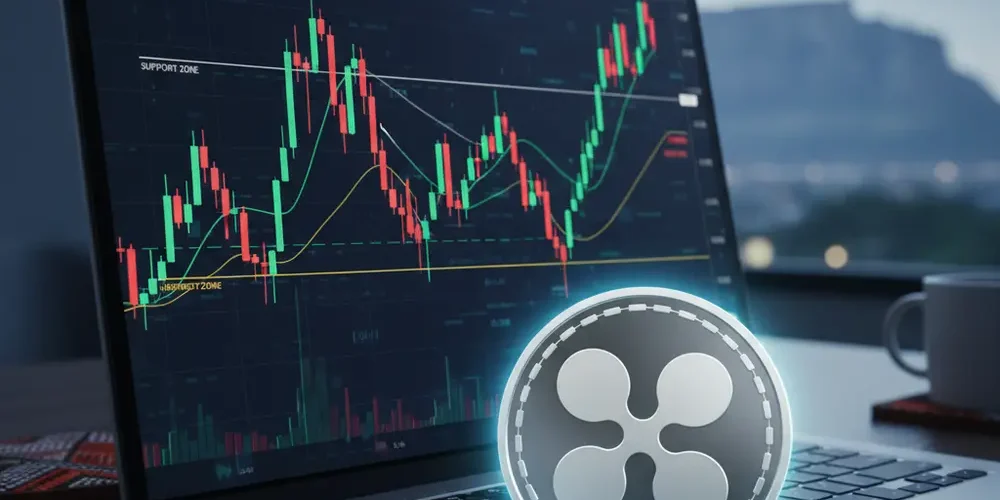
XRP is one of the most actively traded cryptocurrencies in the world, and it is also one of the most unpredictable for beginners to follow on a price chart. If you have ever watched the XRP price spike or collapse without warning, you already know how quickly a misread chart can cost you.
By the end of this article, you will know how to read an XRP price chart from scratch, how to spot the volatility traps that catch new investors off guard, and how to identify the key support and resistance levels that matter most. These skills apply whether you are watching a chart on VALR, Luno, or TradingView XRP analysis.
Note for South Africa:
- South African investors primarily access XRP through FSCA-licensed platforms like VALR and Luno. The ZAR/XRP pair on these platforms may show slightly different price levels and volume compared to international USD/XRP pairs.
- The FSCA crypto regulation South Africa framework requires crypto exchanges to register as crypto asset service providers. Always verify that the platform you use holds a valid FSCA licence before trading.
- SARS treats crypto gains as taxable events. Chart signals do not account for your tax obligations, so factor this into any decision to buy or sell XRP.
- Load shedding and unreliable internet can prevent you from acting on real-time chart signals. Be cautious about placing trades during known outage windows.
At a glance:
- XRP charts are best read using candlestick charts, not line charts, even as a beginner.
- XRP volatility is often driven by Ripple company news, legal developments, and regulatory headlines rather than pure market forces.
- Support and resistance levels are the most practical chart tool for beginners to learn first.
- Volume confirms whether a price move is real or a false breakout trap.
Key takeaways:
- Read the daily or 4-hour chart before making any XRP decision.
- Never act on a price move without checking volume and recent news first.
- Use FSCA-licensed South African platforms and cross-reference with TradingView for chart depth.
What Is a Price Chart and Why Does It Matter for XRP Investors?
A price chart is simply a visual record of what buyers and sellers have agreed to pay for XRP over time. It shows you where the price has been, how quickly it moved, and at what price levels the market paused or reversed. For XRP investors, reading a chart is not about predicting the future with certainty. It is about understanding context before you act.
Technical analysis basics rests on the idea that historical price and volume data contains patterns that can inform short-to-medium term decisions. You do not need to master every indicator to get value from a chart. Even a beginner who understands support, resistance, and volume is better equipped than someone trading on price alone.
Candlestick Charts vs Line Charts – Which Should Beginners Use?
Line charts show only the closing price over time. They are clean and easy to read, but they hide a lot of useful information. Candlestick charts show the open, high, low, and close for each time period, which gives you a much richer picture of what the market actually did.
Learning how to read candlestick charts is the single most useful skill a beginner XRP investor can develop. Each candle tells a story. A long wick at the top of a green candle, for example, suggests buyers pushed the price up but sellers forced it back down before the candle closed. That is information a line chart simply does not show you.
| Chart Type | What It Shows | Best For | Limitation |
|---|---|---|---|
| Line Chart | Closing price only | Quick price overview | Hides open, high, and low data |
| Candlestick Chart | Open, high, low, close per period | Pattern recognition, entry and exit decisions | Steeper learning curve for beginners |
| Bar Chart | Open, high, low, close per period | Similar to candlestick, less visual | Less intuitive to read quickly |
Understanding XRP Volatility – Why Does It Move So Sharply?
XRP is not volatile for the same reasons Bitcoin is volatile. Bitcoin price swings are largely driven by market sentiment, macro conditions, and supply dynamics. XRP has all of those influences too, but it carries an additional layer of event-driven risk tied directly to Ripple’s role in the XRP ecosystem and its ongoing relationship with regulators.
Ripple Labs holds a significant portion of total XRP supply in escrow and releases tokens on a schedule. Any news about those releases, about Ripple’s institutional partnerships, or about regulatory developments can move the price sharply and quickly. The 2023 partial court victory against the US SEC is a clear example. As reported by Daily Maverick on the Ripple ruling’s impact for SA investors, the ruling caused an immediate and significant price rally that affected South African holders on local exchanges just as much as international ones.
Understanding what drives XRP price helps you interpret chart spikes in context. A sudden green candle on the XRP chart might not be a technical breakout at all. It might be a news headline.
Common Volatility Traps That Catch New XRP Investors Off Guard
These are the patterns that repeatedly hurt beginners on XRP charts:
- The fake breakout: Price breaks above a well-known resistance level on low volume, attracts buyers, then reverses sharply. Without checking volume, beginners buy into what looks like a confirmed move.
- The news spike: A positive Ripple headline sends price up quickly. Beginners enter near the top, and price corrects once the news cycle fades.
- The slow bleed: Price drops gradually with no dramatic candles. Beginners hold, expecting a bounce, while the chart shows a steady downtrend.
- The wick trap: A long wick below the candle body looks like strong rejection of lower prices. Sometimes it is. Sometimes it is a brief dip before further selling resumes.
- Timeframe confusion: A 5-minute chart looks bullish while the daily chart is in a clear downtrend. Acting on the short timeframe without checking the bigger picture is a classic beginner error.
Key Chart Levels Every XRP Beginner Should Know
Before you look at any indicator, learn to identify where price has stopped moving up and where it has stopped moving down. These are your support and resistance levels, and they are the foundation of practical chart reading.
How to Identify Support and Resistance on an XRP Chart
Support is a price zone where buying pressure has historically been strong enough to stop a decline. Resistance is a zone where selling pressure has historically capped upward moves. These levels are not exact numbers. They are zones, and price often moves through them briefly before respecting them.
To find them on an XRP chart, zoom out to the daily or weekly view. Look for price areas where the chart paused, bounced, or reversed multiple times. The more times a level has been tested, the more significant it is. When a resistance level is broken convincingly, it often becomes a new support level, and vice versa.
- Use the daily chart to find major support and resistance zones.
- Look for areas where price paused or reversed at least twice.
- Treat these as zones, not exact prices.
- Note when a broken resistance becomes new support – this is called a role reversal.
What Are Moving Averages and How Do They Apply to XRP?
A moving average smooths out price noise by calculating the average closing price over a set number of periods. The 50-day and 200-day moving averages are the most widely watched. When the 50-day crosses above the 200-day, this is known as a golden cross and is generally read as a bullish signal. The reverse is called a death cross and is considered bearish.
Moving averages are not a crystal ball for XRP specifically, because XRP is so sensitive to news events that it can break through moving averages in both directions on a single headline. Use them as context, not as standalone signals. If the price is trading well below the 200-day moving average and there is no clear catalyst for a reversal, that context matters before you enter a position.
Reading Volume on XRP Charts – The Signal Most Beginners Ignore
Volume is the number of XRP units traded in a given period. It sits below the main price chart as a series of vertical bars. Most beginners look past it entirely. That is a mistake.
Understanding how volume confirms price moves is critical for XRP in particular. A price breakout above resistance on high volume is far more reliable than the same move on low volume. Low-volume breakouts are where many fake moves originate. Volume spikes can also signal the end of a trend, not the beginning of a new one, especially when they accompany a sharp price spike without follow-through.
- High volume on a rising price move suggests genuine demand.
- Low volume on a breakout is a warning sign of a potential trap.
- A volume spike with no sustained price follow-through often marks short-term exhaustion.
- Divergence between price direction and volume trend is worth noting before you act.
Practical Chart Reading Routine for South African XRP Investors
This checklist is designed for South African investors using VALR, Luno, or TradingView. Run through it before acting on any XRP chart signal.
Before you act on an XRP chart, check these 7 things:
- Confirm your timeframe. Are you looking at a 5-minute, 4-hour, or daily chart? Short timeframes can mislead. Start with the daily view for context.
- Identify the nearest support and resistance levels. Where is price relative to the last major level? Is it testing resistance or sitting on support?
- Check trading volume. Is the current move backed by above-average volume, or does it look thin? Thin volume moves are less reliable.
- Check for recent Ripple or regulatory news. A price spike without a news trigger behaves differently to one driven by a headline. Search for recent XRP news before acting.
- Note the 50-day and 200-day moving average positions. Is price above or below both? Is a crossover forming? This gives you trend context.
- Confirm whether the candle is closed or still forming. Acting on an incomplete candle is a common beginner mistake. Wait for the candle to close before reading its pattern.
- Confirm your data source. If you are on VALR or Luno, note that the ZAR/XRP pair may show slightly different figures to TradingView’s USD/XRP chart. Cross-reference if needed. You can view XRP charts directly on VALR within the trading interface.
If You Are New to Crypto Charts
- Start with the daily candlestick chart on TradingView before touching a shorter timeframe.
- Learn to identify one or two support and resistance zones before adding any indicators.
- Do not trade on a chart you cannot explain to someone else in plain language.
- Use a demo or paper trading account to practise reading charts without risking capital.
- Bookmark the Sell Your PC insights blog for ongoing practical guides on crypto investing in South Africa.
If You Have Read Crypto Charts Before
- Apply your existing support and resistance knowledge specifically to XRP by accounting for its news sensitivity before acting on a technical signal.
- Cross-reference volume on your XRP trades more deliberately, given how often XRP produces low-volume fake breakouts.
- Consider whether your usual timeframe is appropriate for XRP’s volatility profile, which can move significantly within hours on a news event.
- If you are upgrading your hardware for better chart-monitoring capability, check out the Sell Your PC shop for relevant technology options.
Mistakes to Avoid When Interpreting XRP Price Charts
- Acting on a single timeframe only. Always check the higher timeframe for context before acting on a short-term signal.
- Ignoring volume entirely. Price moves without volume confirmation are the most common source of fake breakout traps in XRP.
- Treating resistance as an automatic buy signal. A breakout above resistance is only meaningful if it holds. Wait for a confirmed close above the level.
- Chasing a news-driven spike. If the price has already moved 10 to 20 percent on a headline, the easy money has been made. Entering late into a news spike is high risk.
- Using only one exchange for price data. Always cross-check the ZAR price on VALR or Luno against a global chart on TradingView to avoid acting on a local anomaly.
- Forgetting that charts do not account for tax. Every time you sell XRP at a profit in South Africa, SARS expects a declaration. Chart signals say nothing about your after-tax return.
Frequently asked questions
What is the best timeframe for beginners reading XRP charts?
The daily chart is the most practical starting point for beginners. It filters out short-term noise and gives you a clearer view of support, resistance, and trend direction. Once you are comfortable with the daily view, you can add the 4-hour chart to refine entry and exit zones.
Why does XRP move so much more than other cryptos?
XRP carries both standard crypto market volatility and event-driven volatility tied to Ripple Labs as a company. Regulatory news, legal outcomes, and institutional partnership announcements can move XRP sharply in a short space of time. This makes news monitoring as important as chart reading for XRP specifically.
Can I read XRP charts directly on VALR or Luno?
Both VALR and Luno provide basic in-platform charting tools that are sufficient for a quick read. For deeper analysis, with moving averages, drawing tools, and volume indicators, TradingView is the recommended free option. South African users can access it via web browser without an account for basic chart viewing.
What is a support level and why does it matter for XRP?
A support level is a price zone where buyers have historically stepped in to prevent further decline. On an XRP chart, these zones are worth watching because they often represent areas where demand picks up. If price falls through a strong support level on high volume, it is a meaningful signal that sentiment has shifted.
Do I need to worry about SARS when trading XRP based on chart signals?
Yes. SARS treats profits from XRP trades as taxable events, whether you are swing trading or holding long term. Chart signals help you time trades, but they do not calculate your tax liability. Keep records of every XRP transaction and consult a tax professional familiar with crypto if you are unsure of your obligations. If you have questions about how crypto fits into your broader investment setup, you are welcome to contact the Sell Your PC team for guidance.
Summary
- Candlestick charts give beginners far more information than line charts and are worth learning from the start.
- XRP volatility is often news-driven, so chart signals must always be checked against recent Ripple and regulatory developments.
- Support and resistance zones are the most practical tool for beginner XRP chart readers.
- Volume is the most commonly ignored signal. A price move without volume confirmation is suspect.
- South African investors should use FSCA-licensed platforms like VALR or Luno and cross-reference with TradingView for a complete picture.
This is educational content, not financial advice.

