
Hidden Liability in IT Disposal
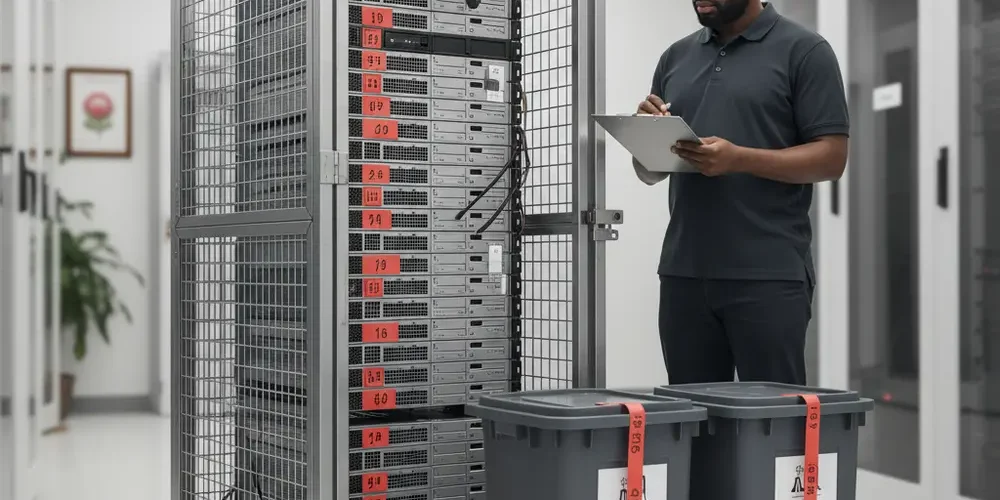
Improper IT disposal is one of the few server room tasks that can turn into a data breach, a compliance failure, and an audit finding at the same time. The risk usually sits quietly in a cupboard, a storeroom, or a cage until the day a device leaves your control.
By the end of this article, you will be able to run a defensible decommission process, choose sanitisation methods based on risk, and build an evidence pack that stands up to internal audit and regulator questions. You will also know what to ask an ITAD vendor in South Africa before any asset leaves site.
Note for South Africa:
- POPIA obligations around security safeguards, retention limits, and security compromise notification should shape your disposal process, not just your information security policy POPIA (Protection of Personal Information Act) full text.
- E-waste governance and downstream handling matter, because your risk can extend beyond the point where equipment exits the building DFFE waste classification regulations.
- Operational realities like load shedding, remote sites, and outsourced facilities increase chain-of-custody gaps, so your controls need to assume interruptions and handovers.
At a glance:
- Decide early, for each asset, whether it will be reused, resold, recycled, or destroyed, then lock the decision into your runbook and approvals.
- Select media sanitisation per risk tier using Clear, Purge, or Destroy, then verify and record results at serial level using NIST 800-88 media sanitization.
- Build a chain-of-custody trail from rack to recycler, including sealed packaging, handover logs, and serial reconciliation before and after transport.
- Procure ITAD services like a security supplier, require certificates, subcontractor transparency, and breach response timelines that match your POPIA incident playbook.
Key takeaways:
- Decommissioning is an information risk and governance function, not a facilities clean-out.
- Evidence is the product, wipe logs, serial lists, and certificates matter as much as the physical disposal.
- Vendor due diligence should focus on process control, not marketing claims.
Why IT decommissioning is a hidden liability, not a facilities task
Server rooms tend to accumulate end-of-life equipment because there is always a more urgent project. The problem is that decommissioned assets are still assets, they can still contain personal information, credentials, or configuration data. When the organisation treats disposal as a logistics task, the security and compliance controls arrive too late.
Decommissioning also creates a "high-change" window. Teams are busy, access is temporarily broadened, and equipment is often moved to temporary holding areas. That is exactly when assets go missing, serial numbers stop matching, or drives get separated from chassis.
In practice, the highest risk is not a sophisticated attacker. It is a well-meaning disposal path that skips verification, a subcontracted pickup with weak paperwork, or a resale route that assumes a quick format is enough.
If you’re new
- Start by naming an owner for the decommission project, not just a ticket in the service desk.
- Assume every storage device contains something sensitive until proven otherwise.
- Keep decommissioned assets in a locked, access-controlled holding area with a simple sign-in log.
- Focus on repeatability, a simple runbook is better than a perfect one that nobody follows.
If you have done this before
- Review where you have "silent handovers", security to facilities, IT to logistics, or branch to head office.
- Check whether your evidence is serial-level, or only box-level, auditors usually want reconciliation.
- Re-test your sanitisation approach for SSDs, self-encrypting drives, RAID sets, and virtualised storage.
- Spot-check downstream outcomes, where assets actually ended up, not where the PO says they should.
Risk map: what can go wrong if you dispose of IT equipment incorrectly
Think about risk in three layers, data exposure, compliance failures, and downstream environmental liability. Each layer has different triggers and different evidence requirements. A good runbook turns these risks into decision points and checkpoints.
The table below is a practical way to align asset type to common failure mode and a control that is easy to audit.
| Asset | Common failure mode | Defensible control | Evidence to keep |
|---|---|---|---|
| Servers and storage | Drives removed, then mixed | Serial-level reconciliation | Drive list + photos |
| SSD and NVMe | Quick wipe leaves data | Purge or Destroy decision | Wipe logs or destruction cert |
| Network gear | Configs, keys, creds remain | Factory reset plus config wipe | Reset checklist sign-off |
| Laptops and mobiles | MDM offboarding missed | Remote wipe plus verification | MDM export + device status |
| Backup media | Tapes forgotten in cupboards | Backup inventory and purge | Media manifest |
Data exposure risks: drives, SSDs, mobile devices, network gear
Data survives disposal when teams confuse usability with sanitisation. A quick format, a factory reset, or deleting a VM does not automatically meet a defensible sanitisation standard. The safest approach is to treat data-bearing components as a separate workstream from the rest of the hardware.
Pay attention to the "hidden storage" problem. RAID members, spare drives, iDRAC or iLO logs, switch configs, and copier or printer drives often slip through because they are not on the main asset register.
Common places sensitive data and secrets can persist include:
- SSD over-provisioning areas and wear-leveling blocks, which can make simple overwrites unreliable, depending on the device.
- Self-encrypting drives where encryption state and key management are unknown, making cryptographic erase risky if you cannot verify the conditions.
- Out-of-band management interfaces and BIOS or UEFI settings that store credentials, certificates, or network details.
- Branch devices that were never centrally imaged, with local admin accounts and saved VPN profiles.
Compliance risks: POPIA retention, deletion, and breach notification duties
Disposal intersects with POPIA because it is part of the information lifecycle. POPIA includes obligations relating to security safeguards and retention limitation, and it also has a security compromise notification requirement POPIA retention and secure deletion requirements.
Do not rely on a vague policy statement like "we destroy old drives". If an incident happens, you need to show what happened to the specific device, what method was used, who verified it, and when control transferred.
Also treat disposal mistakes as incident candidates. The Information Regulator provides guidance on completing a security compromise notification, which is useful when your incident is about lost media, suspected leakage, or uncertain downstream handling Section 22 POPIA security compromise guidance.
Environmental and waste risks: e-waste handling, manifests, downstream liability
From a governance perspective, the biggest environmental risk is using informal collectors without traceability. Even if your intention is recycling, you still need to know where the equipment went and what was done to it. Documentation and handovers matter because they prove diligence.
South Africa’s waste framework includes classification and management requirements that can influence how waste is handled and documented, especially when equipment is treated as waste rather than reusable product Waste manifest document requirements.
Extended Producer Responsibility is also part of the local landscape. While EPR is primarily aimed at producers, it affects the ecosystem of schemes and recyclers you may interact with, so it is worth understanding the policy intent Extended Producer Responsibility for EEE in South Africa.
What good looks like: a defensible ITAD and decommissioning standard
A defensible standard is one you can explain in an audit without hand-waving. It has clear roles, clear decision points, and a consistent evidence pack. It also distinguishes between data-bearing items and non-data items, because they need different controls.
Good programmes separate three outcomes, reuse, recycling, and destruction. They treat resale or redeployment as a controlled release, not a default. They also use risk tiers so that high-risk systems are handled with stricter methods and more verification.
Key design principles that make the process defensible:
- Serial-level accountability, every device and every drive is tracked and reconciled.
- Segregation of duties, the person authorising disposal is not the only person verifying sanitisation.
- Evidence-first mindset, if you cannot prove it, assume it did not happen.
- Exception handling, unknown media, failed wipes, and missing drives have a defined path.
Media sanitization methods and verification (clear, purge, destroy)
NIST SP 800-88 Rev. 1 is widely used to structure sanitisation decisions into Clear, Purge, and Destroy, and it emphasises verification and documentation Guidelines for secure drive wiping and destruction. You do not need to copy the standard into your policy, but you can align your choices to its logic. This is especially helpful for SSDs and modern storage where simplistic overwrites can be unreliable.
Use a simple rule, choose the method based on the sensitivity of the data and the likelihood that the device will leave your control. If the device will be resold or leave the country, raise the bar, because you are reducing your ability to investigate later.
Verification is where many programmes fail. Build in checks that are practical, like automated wipe logs, sample-based validation, and a signed exception register for any asset that could not be sanitised as planned.
Chain of custody and audit evidence: serials, logs, certificates, photos
Chain of custody is not a single form. It is a trail of controls, physical seals, sign-offs, and reconciliations that show who had control, when, and under what conditions. In South Africa, chain-of-custody controls also help when you have remote sites, third-party facilities, and transport delays caused by scheduling and power constraints.
Build an evidence pack that can be handed to internal audit without extra work. It should be a folder per project or pickup, with a consistent naming convention. When an incident happens, this evidence pack becomes your time machine.
Minimum evidence pack contents:
- Approved decommission scope and asset list with serials.
- Data classification and retention hold check sign-off for in-scope systems.
- Sanitisation method decision per asset class, with wipe logs or destruction details.
- Chain-of-custody log, including seals, times, and handover signatures.
- Certificates of erasure or destruction that match your serial list, not just "10 drives".
- Recycling or waste transfer documentation where equipment is treated as waste.
Vendor due diligence checklist for South African ITAD and recyclers
Vendor selection is where you either buy risk down or lock risk in. Many organisations focus on price per kilogram or turnaround time, and ignore process control. Treat ITAD vendors like security suppliers, because they will handle your data-bearing assets.
Before you engage, align internally on your non-negotiables. Decide which categories require on-site destruction, which can be sanitised for resale, and which must never be resold. Then encode those requirements in the contract and the statement of work.
Questions to ask: subcontractors, facility controls, processes, reporting
- Do you use subcontractors for transport, wiping, or recycling, and can you name them upfront?
- Can you provide serial-level certificates of erasure or destruction, plus wipe logs where applicable?
- What is your process for failed wipes, missing drives, or mismatched serials, and how quickly do you escalate?
- Can you support secure packaging, tamper-evident seals, and controlled pickup windows?
- What reporting do you provide after each job, and can you reconcile quantities and serials to our manifest?
- What is your incident response commitment if an asset is lost in transit or a compromise is suspected?
If you need help evaluating an ITAD partner, start from your internal process requirements and then map vendor capability to them. Where you are unsure, ask for a walkthrough and sample paperwork, then compare it to your runbook. If you want a second set of eyes, speak to our team via our corporate disposal service page corporate IT asset disposal.
Common mistakes
- Relying on quick format, factory reset, or "delete" as if it equals sanitisation.
- Moving assets to a shared storeroom without access controls, then losing serial-level traceability.
- Allowing drives to be removed without a drive manifest, creating orphan drives with unknown status.
- Accepting certificates that do not list serial numbers, or that do not match the assets picked up.
- Assuming recycling equals secure destruction, without verifying the sanitisation step.
Practical playbook: a step-by-step decommission process for server rooms
This playbook is designed to be copied into a runbook and used repeatedly. It separates governance decisions from technical execution, and it produces an evidence pack as an output. Adjust the level of rigor by risk tier, not by convenience.
- Define scope and owner. List racks, systems, and sites in scope, name a single accountable owner, and confirm who signs off release.
- Freeze inventory. Export asset register data, take photos of rack positions if useful, and capture serials for chassis, drives, and key modules.
- Classify data and check holds. Confirm whether systems hold personal information, regulated records, or incident-related data, then check retention or legal hold requirements before wiping.
- Choose sanitisation method per asset. Use a risk tier, then decide Clear, Purge, or Destroy aligned to your internal standard and NIST 800-88 media sanitization.
- Decide self-wipe vs third-party. If you have tooling and skills, self-wipe can reduce custody transfers. If not, require on-site wiping or on-site destruction for high-risk tiers.
- Execute sanitisation. Collect wipe logs automatically where possible, and record operator, date, device identifiers, and outcome for each item.
- Verify and handle exceptions. Verify a sample or all, depending on risk tier, then move any failed or unknown items into a "quarantine" path for Destroy with documented sign-off.
- Prepare for transport. Package assets in locked cages or sealed containers, apply tamper-evident seals, and record seal numbers on the chain-of-custody form.
- Handover and reconcile. At pickup, reconcile quantities and serials, capture driver details, vehicle registration if policy allows, and timestamps, then obtain signatures.
- Downstream confirmation. Receive the vendor report, reconcile to your manifest, and file certificates, disposal notes, and any waste transfer documentation.
- Close out and archive evidence. Store the evidence pack in a controlled repository, link it to the change record, and update the asset register to show final disposition.
Simple decision points to add to your runbook
- Reuse vs destroy: If you cannot prove sanitisation conditions, default to Destroy for data-bearing media.
- On-site vs off-site: If custody transfers are high, for example remote sites, prefer on-site sanitisation for high-risk assets.
- Whole device vs component: If drives are removed, treat drives as the primary controlled item, not the chassis.
How to structure your audit file (so it is not a scramble later)
Audits and investigations usually ask the same questions, what left your control, what was done to it, and how do you know. If your evidence is scattered across emails and photos on someone’s phone, you will lose time and confidence during an incident. Build a standard audit file template and make it a required deliverable.
A practical audit file template can be:
- 01 Scope and approvals.
- 02 Asset and drive manifest, serial list.
- 03 Sanitisation decisions and risk tier mapping.
- 04 Wipe logs and verification records.
- 05 Chain-of-custody forms and seal log.
- 06 Certificates and downstream reports.
- 07 Exceptions, failed wipes, missing items, and corrective actions.
If you want to formalise this across the business, publish it as part of your IT asset disposal policy and link it from your internal IT governance page. For external assistance and a structured service option, see our professional services overview professional services.
Export and transboundary movement: when disposal becomes an international compliance issue
If any part of your disposal route involves exporting used equipment or scrap, add a compliance checkpoint. International controls for e-waste under the Basel Convention can trigger prior informed consent requirements, depending on how the material is classified and shipped Basel Convention e-waste controls.
Basel e-waste amendments took effect on 1 January 2025, and regulators and logistics partners may treat shipments more strictly as a result Basel e-waste amendments effective 1 January 2025. Even if you do not export directly, downstream partners might, so ask the question and document the answer.
Frequently asked questions
Does a factory reset or quick format count as secure disposal?
Not on its own. These actions can remove access to data through the normal user interface, but they may not meet a defensible sanitisation standard for data-bearing media, especially where verification is needed.
What evidence should I keep to prove drives were wiped or destroyed?
Keep serial-level manifests, wipe logs or destruction records, verification results, and certificates that match your serial list. Add chain-of-custody handovers and exception notes for any failed wipes or missing items.
How do I treat network devices like switches and firewalls?
Treat them as data-bearing because they can store configurations, credentials, and keys. Use a documented reset and config wipe process, confirm boot settings and management accounts are cleared, then record the sign-off.
Do I need to report a disposal mistake as a POPIA security compromise?
If personal information may have been accessed, lost, or exposed through the incident, it can fall into the category of a security compromise under POPIA. Use the Information Regulator’s guidance to structure your assessment and notification content Information Regulator POPIA forms.
How can I reduce risk at remote sites with limited IT staff?
Use sealed packaging, simple manifests, and strict pickup windows, and prefer on-site sanitisation for higher-risk assets. Also reduce handovers by centralising approvals and using standard forms that branch staff can follow.
Where to go next
If you are building a repeatable programme, create a short internal policy, a runbook, and an evidence pack template, then pilot it on one site. If you need help designing the process or executing a pickup with strong chain-of-custody controls, contact our team contact us.
For organisations that also refresh mining or high-density compute equipment, treat those assets the same way, data-bearing components get sanitised and verified, and custody transfers are controlled. You can also browse more operational IT and hardware insights in our knowledge hub insights.
Summary
- Run IT disposal as a security and governance process, not a storeroom clean-out.
- Track assets and drives at serial level, and reconcile at every handover.
- Choose sanitisation methods based on risk tier, then verify and retain logs.
- Vet ITAD vendors on process, subcontractors, and evidence quality, not only price.
This is educational content, not financial advice.

