
How to Get a Certificate of Data Destruction
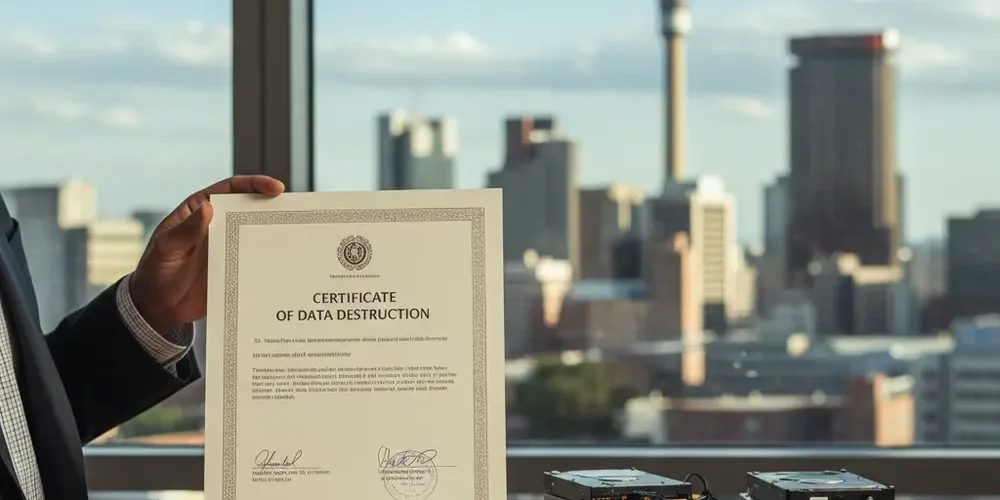
When an organisation disposes of a laptop, server, or storage device, the physical asset leaving the building is only half the story. The data it held may still be perfectly recoverable, and under South African law, that risk sits squarely with the responsible party.
By the end of this article, you will know exactly what a certificate of data destruction must contain, why auditors and regulators treat it as non-negotiable evidence, and how to commission a compliant service from a South African vendor. You will also have a practical checklist you can use during vendor onboarding or your next supplier review.
Note for South Africa:
- The Protection of Personal Information Act (POPIA) is the primary legislative anchor. Section 8 places accountability on the responsible party across the full information lifecycle, including disposal.
- The Information Regulator of South Africa is the sole supervisory authority. Enforcement actions, including investigations and administrative fines, are handled exclusively by this body.
- South Africa does not currently have a dedicated national standard for data destruction. International frameworks such as NIST SP 800-88 and ISO/IEC 27001 serve as the de facto technical references used by local auditors and ITAD vendors.
At a glance:
- A certificate of data destruction is a formal, auditable record proving that data on a disposed asset was permanently eliminated using a recognised method.
- POPIA does not prescribe a certificate format, but audit practice and governance frameworks demand one as evidence of the accountability obligation.
- Accepted destruction methods include physical shredding, degaussing, and certified software wiping. The appropriate method depends on data sensitivity.
- Certificates must be retained and linked to your asset register. Sector regulations may impose specific retention periods beyond general guidance.
Key takeaways:
- A certificate without a serial number, destruction method, and technician sign-off is not audit-ready and should be rejected.
- King IV Principle 12 and ISO 27001 Annex A both support the expectation that data destruction is documented and evidenced at board level.
- Your vendor must hold both data destruction accreditation and e-waste handling authorisation. These are separate obligations under separate laws.
What Is a Certificate of Data Destruction?
A certificate of data destruction is a formal document issued by an authorised vendor or internal IT function confirming that data stored on a specific device has been permanently and irreversibly eliminated. It is not a receipt. It is an auditable record that links a specific asset to a specific destruction event, carried out by an identified person, on a recorded date, using a defined method.
The certificate serves as the documentary bridge between your organisation’s data destruction policy and the audit trail that regulators and internal auditors require. Without it, the destruction event may as well not have happened from a governance perspective.
What Information a Valid Certificate Must Contain
Industry practice, informed by standards such as NIST SP 800-88 and ISO 27001, converges on a consistent set of required fields. A certificate missing any of these fields is not audit-ready.
| Field | Why It Matters |
|---|---|
| Device serial number | Ties the certificate to a specific physical asset. Without this, the certificate cannot be matched to your asset register. |
| Asset tag or internal reference | Links the event to your internal records management system. |
| Make, model, and media type | Confirms the destruction method was appropriate for the device type. |
| Destruction method applied | Must specify the technique used, e.g. physical shredding, degaussing, or certified software overwrite. |
| Standard or framework referenced | e.g. NIST SP 800-88, ISO 27001. Confirms the method meets a recognised benchmark. |
| Date and time of destruction | Establishes the audit timeline and supports chain-of-custody requirements. |
| Technician name and sign-off | Assigns personal accountability to the destruction event. |
| Vendor name and accreditation details | Allows auditors to verify the vendor’s credentials independently. |
| Outcome or pass/fail status | Confirms the process was completed successfully, not merely attempted. |
Why Auditors and Regulators Require It
The short answer is accountability. Auditors cannot verify destruction without evidence, and regulators cannot enforce compliance without a paper trail. The certificate is how an organisation proves it met its legal obligation at a point in time that may be years in the past by the time a question is asked.
South African organisations that cannot produce certificates of data destruction during an audit face two distinct risks. The first is a finding that the organisation failed to demonstrate compliance with its data protection obligations. The second is exposure to enforcement action if a breach is later traced to a disposed asset.
POPIA, King IV, and the Audit Trail Obligation
POPIA does not prescribe a specific certificate format or destruction method. What it does prescribe, under Section 8, is that the responsible party must be able to demonstrate compliance with all conditions for lawful processing, including the obligation to destroy or de-identify personal information when it is no longer needed. The Information Regulator of South Africa is empowered to investigate, issue enforcement notices, and recommend criminal prosecution where this obligation is not met.
King IV Principle 12 on the governance of technology and information requires that the governing body ensure responsible management of information assets across their full lifecycle. Governance practitioners and auditors interpret this as requiring documented, evidenced disposal. For JSE-listed entities, King IV applies on an apply-and-explain basis, meaning boards must be able to account for how IT asset disposal is governed.
ISO 27001 Annex A requires controls for the disposal and reuse of equipment and media. Organisations certified to the standard, or audited against it, are expected to maintain records of asset disposal as evidence of control effectiveness. A certificate of data destruction from a credible vendor can serve directly as this audit evidence.
When Finance and Compliance Teams Are Directly Liable
Finance managers and compliance officers are not passive observers in this process. Under POPIA, the responsible party, typically the organisation as a legal entity, bears accountability. However, internal audit functions and external auditors routinely expect named individuals to own data destruction procedures.
Finance teams in regulated sectors carry additional exposure. Entities supervised by the Financial Sector Conduct Authority (FSCA) may face record-keeping obligations under the FAIS Act or the Banks Act that intersect with data destruction documentation. Sector-specific requirements should be verified with your legal counsel, as these obligations sit alongside and do not replace POPIA.
A practical data destruction policy should define who in the organisation is authorised to commission a destruction event, what methods are approved for each data classification, and how the resulting certificate is stored. Comparitech’s overview of data destruction policy components provides a useful general framework for building this structure.
If you are new to this process:
- Start by mapping which assets in your organisation hold personal information, as defined by POPIA.
- Confirm that your organisation has a written data destruction policy, even a simple one, before commissioning any disposal.
- Ask your IT team or vendor to explain the destruction method in plain language before you sign off on any certificate.
- Retain every certificate you receive and link it back to your asset register entry for that device.
- Check that your vendor holds some form of accreditation, even if it is not ISO 27001, and ask them what standard they reference on their certificates.
The Data Destruction Methods That Qualify for Certification
Not every deletion method qualifies as certified data destruction. Formatting a drive, deleting files, or performing a factory reset does not constitute destruction for compliance purposes. Only methods that render data unrecoverable by any technically feasible means are acceptable, and the choice of method depends on the sensitivity of the data and the intended fate of the device.
Degaussing, Physical Destruction, and Certified Software Wiping Compared
The NIST SP 800-88 media sanitisation guidelines define three sanitisation categories used widely by South African auditors and ITAD vendors.
- Clear – Logical overwrite using software tools. Suitable for lower-sensitivity data on devices being reused internally. Does not qualify for high-risk personal information disposal.
- Purge – Cryptographic erasure or degaussing. Renders data unrecoverable using current laboratory techniques. Suitable for most disposal scenarios involving personal information.
- Destroy – Physical disintegration, shredding, or incineration. Recommended for high-sensitivity data such as financial records, health information, or government-classified material. The device cannot be reused after this method.
Certified software wiping can produce a legally defensible certificate if the tool used is independently audited, the process is fully documented, and the certificate references the applicable standard. Physical destruction, by contrast, provides the highest assurance but ends the asset’s useful life. For most corporate disposal scenarios involving personal information, a Purge or Destroy method is the defensible choice.
If you have managed asset disposal before:
- Review whether your previous certificates referenced a recognised standard such as NIST 800-88 or ISO 27001. If not, those certificates may not satisfy a current audit request.
- Confirm that your vendor’s certificates include device serial numbers. Batch certificates covering multiple assets without individual identifiers are a red flag.
- Check whether your organisation’s data destruction policy distinguishes between data classifications and specifies which method applies to each. A single method for all assets is likely inadequate.
- Verify whether your vendor holds professional indemnity insurance. This is a basic commercial protection that reputable vendors carry.
- Assess whether your certificates are stored in a way that allows you to retrieve a specific certificate by asset serial number within minutes, not hours.
How to Commission a Certified Data Destruction Service in South Africa
South Africa has a growing number of IT asset disposal vendors offering data destruction services. The market includes vendors with international accreditations such as ISO 27001 and vendors who operate without formal certification but follow recognised frameworks. Your procurement process must be able to distinguish between these categories.
Our corporate IT asset disposal service is designed to support organisations that need documented, compliant disposal with certificates that are audit-ready. For broader professional services context, see our professional services overview.
What to Ask a Vendor Before You Sign Anything
The checklist below is a practical tool for compliance officers to use during vendor onboarding or an annual supplier review. Print it, work through it with the vendor, and keep the responses on file alongside your destruction certificates.
Before You Accept a Certificate of Data Destruction: 12 Things to Verify
- Does the certificate include a unique serial number for each asset? Batch certificates without individual device identifiers are not audit-ready.
- Is the asset tag or internal reference number recorded on the certificate? This is how the certificate links back to your asset register.
- Is the destruction method clearly stated? Generic terms like "securely destroyed" are insufficient. The method must be specific.
- Does the certificate name the standard or framework applied? Look for NIST SP 800-88, ISO 27001, or a recognised equivalent.
- Is the date and time of destruction recorded? Audit trails require a precise timestamp, not just a date.
- Is the technician’s name and sign-off included? Anonymous certificates cannot be verified and carry less weight in an audit.
- Does the vendor hold ISO 27001 certification or reference a recognised accreditation? Ask to see the certificate, not just a logo on their website.
- Does the vendor’s process align with NIST 800-88 sanitisation categories? Ask them to confirm which category (Clear, Purge, or Destroy) they apply to different asset types.
- Has the vendor acknowledged their obligations under POPIA as a data processor or operator? A written operator agreement is a POPIA requirement where the vendor processes personal information on your behalf.
- Does the vendor offer witness or audit rights during the destruction process? Reputable vendors accommodate client observers for high-sensitivity destruction events.
- Does the vendor carry professional indemnity insurance? Ask for confirmation in writing. This protects you if the vendor’s process is later found to be deficient.
- Does the vendor hold e-waste handling authorisation? Under NEMWA and the Extended Producer Responsibility regulations, disposed equipment must be channelled to registered handlers. This is a separate obligation from data destruction.
Keeping Certificates as Part of Your Asset Disposal Records
A certificate that cannot be retrieved is functionally useless. Compliance depends not only on obtaining the certificate but on storing it in a way that makes it immediately accessible when an auditor, regulator, or legal team requests it.
Retention Periods and Where Certificates Fit in Your Document Management System
South African law does not currently prescribe a single retention period for data destruction certificates that applies universally. Retention requirements depend on the sector, the nature of the data destroyed, and any applicable contractual obligations. As a general principle, certificates should be retained for at least as long as any related records or any applicable statute of limitations could give rise to a claim or investigation.
Finance sector organisations subject to FSCA oversight should consult their legal advisers on whether FAIS or Banks Act record-keeping requirements impose specific retention periods that apply to disposal documentation. The SAICA guidance on electronic records and information governance provides a useful reference for how South African auditors expect records to be managed and disposed of in a manner consistent with accounting standards and data protection legislation.
Practically, certificates should be stored in your document management system with the following linkages in place.
- Cross-referenced to the corresponding asset register entry by serial number.
- Tagged with the disposal date, vendor name, and destruction method for easy filtering.
- Accessible to your compliance, legal, and internal audit functions without requiring IT intervention.
- Backed up in at least one off-site or cloud-based location to prevent loss in the event of a local system failure.
Common mistakes to avoid:
- Accepting a certificate that covers a batch of assets without listing each device’s serial number individually.
- Storing certificates in a shared drive folder with no naming convention, making retrieval during an audit a stressful manual search.
- Failing to obtain an operator agreement from your ITAD vendor before they handle assets containing personal information.
- Assuming that a software wipe by an in-house IT technician using a consumer-grade tool qualifies as certified destruction for high-sensitivity data.
- Discarding physical devices through general waste or an unauthorised recycler and treating data deletion as the only compliance obligation.
- Neglecting to check whether your vendor’s e-waste handling is compliant with NEMWA separately from their data destruction credentials.
Red Flags: When a Certificate Is Not Worth the Paper It Is Printed On
Not all certificates of data destruction are equal. A document that looks official but lacks the right fields, references no recognised standard, and comes from a vendor with no verifiable accreditation offers no real compliance protection. In an audit or enforcement investigation, a weak certificate can be worse than no certificate, because it suggests the organisation was going through the motions rather than managing the risk.
Watch for these specific warning signs when evaluating a certificate or a vendor.
- No device serial numbers. If the certificate lists quantities rather than individual devices, it is not traceable and is not audit-ready.
- No standard referenced. A certificate that says "securely wiped" without citing a recognised framework gives auditors nothing to verify against.
- No technician identification. Anonymous destruction events cannot be investigated if a problem arises later.
- Vendor holds no verifiable accreditation. Ask for their ISO 27001 certificate number or equivalent. If they cannot provide it, treat their certificates with caution.
- No operator agreement in place. If the vendor processes personal information on your assets and no written agreement exists, your organisation is exposed under POPIA regardless of whether a certificate is issued.
- No e-waste compliance evidence. A vendor who cannot demonstrate lawful e-waste handling under NEMWA and the Extended Producer Responsibility regulations is not a compliant disposal partner, even if their data destruction process is sound.
If you are unsure whether your current vendor or process meets the standard, our team can assist. Contact us to discuss your asset disposal requirements or to request information about our certified disposal process.
Frequently asked questions
Does POPIA explicitly require a certificate of data destruction?
POPIA does not prescribe a specific certificate format or mandate the term "certificate of data destruction." However, Section 8 requires the responsible party to demonstrate compliance across the information lifecycle, including disposal. The certificate is the practical instrument that satisfies this accountability obligation in an audit context. The absence of one makes it very difficult to demonstrate compliance.
Which destruction method is legally required for personal information under POPIA?
POPIA does not prescribe a specific technical method. It requires that personal information be destroyed or de-identified when no longer needed for its original purpose, using reasonable technical and organisational measures. In practice, the method should be appropriate to the sensitivity of the data. For high-risk personal information, physical destruction or degaussing is the most defensible choice. Certified software wiping may be acceptable for lower-sensitivity data if properly documented.
How long must we retain data destruction certificates?
South African law does not currently specify a universal minimum retention period for data destruction certificates. A conservative and practical approach is to retain certificates for a period at least equal to the longest applicable statute of limitations or regulatory record-keeping requirement that applies to your sector. Finance sector entities should seek specific legal advice. Linking certificate retention to your broader document retention policy is strongly recommended.
Can an in-house IT team issue a valid certificate of data destruction?
Yes, an internal process can produce a valid certificate provided it references a recognised standard, documents all required fields, uses an appropriate and verifiable destruction method, and is carried out by an identified and accountable individual. However, third-party vendor certificates are generally considered more defensible in an audit because they introduce an independent party and a verified chain of custody. For high-sensitivity assets, third-party destruction is the safer choice.
Does a certificate of data destruction also satisfy our e-waste obligations under NEMWA?
No. A certificate of data destruction addresses the data security obligation under POPIA and related frameworks. It does not satisfy the separate obligation under the National Environmental Management: Waste Act and the Extended Producer Responsibility regulations to channel electronic equipment to a registered e-waste handler or Producer Responsibility Organisation. Both obligations must be met, and your vendor must hold both data destruction and e-waste handling credentials. Treat these as parallel requirements, not interchangeable ones.
Summary
- A certificate of data destruction is a mandatory audit artefact, not an optional document. It is the primary evidence that your organisation met its data disposal obligations under POPIA and related frameworks.
- Valid certificates must include device serial numbers, the destruction method, the applicable standard, a date and time, and a named technician. Certificates missing these fields should be rejected.
- Physical destruction, degaussing, and certified software wiping are the accepted methods. The choice depends on data sensitivity and the intended next use of the asset.
- Certificates must be stored in a retrievable, cross-referenced system and retained for a period consistent with your sector’s regulatory requirements.
- Your vendor must satisfy two separate compliance obligations: data destruction accreditation and e-waste handling authorisation. Check both before signing any agreement.
For compliant, documented corporate IT asset disposal in South Africa, visit our corporate asset disposal page or browse our full range of professional services. If you have questions about your specific situation, get in touch with our team.
This is educational content, not financial advice.

