
Nationwide IT Asset Collection: How Corporate Disposal Works Across SA
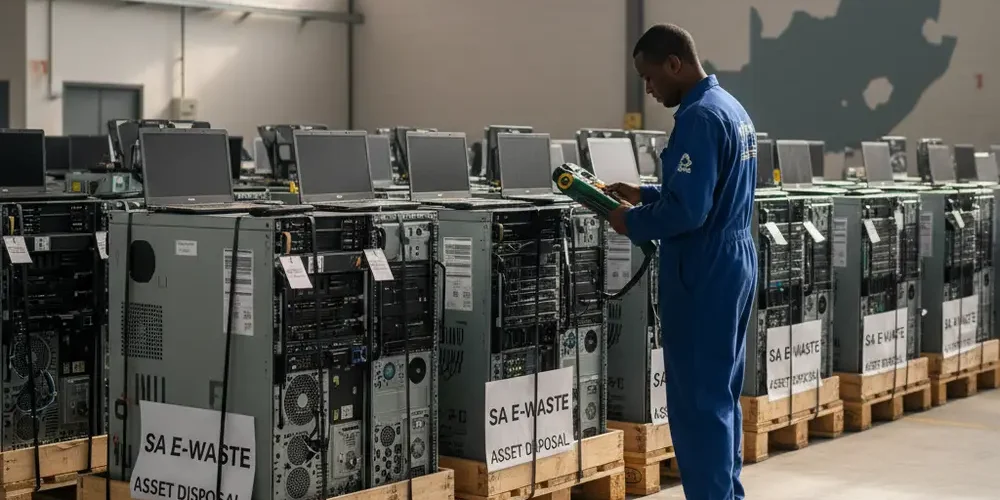
Managing the end of life for corporate IT equipment is no longer a simple skip-and-forget exercise. In South Africa, the combination of data protection law, environmental regulation, and internal audit requirements means that an unstructured disposal approach carries real legal and reputational risk.
This guide will help you understand how a structured IT asset disposition (ITAD) programme works, what the compliance landscape looks like across POPIA, NEMWA, and the PFMA, and what to look for when selecting a vendor capable of servicing your organisation nationwide. By the end, you will have a practical checklist you can use to brief an ITAD provider.
Note for South Africa:
- POPIA has been fully in force since 1 July 2021. Disposing of data-bearing hardware without certified destruction is a compliance risk under Sections 19 and 21 of the Act.
- South Africa's e-waste regulatory environment is evolving. Extended Producer Responsibility regulations for electrical and electronic equipment were gazetted in 2021 and are worth verifying with your vendor for current status.
- Public sector organisations must layer PFMA and Municipal Finance Management Act (MFMA) asset disposal requirements on top of environmental and data protection obligations. Non-compliance can expose accounting officers to personal liability.
At a glance:
- A structured ITAD programme covers collection, data sanitisation, chain-of-custody documentation, environmental compliance, and residual value recovery.
- POPIA requires documented destruction of personal information on end-of-life devices. Certificates of data destruction are your audit evidence.
- NEMWA and the 2021 EPR regulations require that e-waste flows through licensed, compliant channels. Verify your vendor's credentials before signing.
- Nationwide collection across SA's provinces requires a vendor with proven logistics for secondary cities and remote sites, not just Gauteng and Cape Town.
Key takeaways:
- Ad hoc IT disposal creates compliance gaps. A structured programme closes them.
- Data destruction standards such as NIST SP 800-88 give you a vendor-neutral benchmark to specify in your brief.
- Residual asset value from a buyback programme can partially offset your disposal costs.
What Is Corporate IT Asset Disposal and Why It Matters in South Africa
IT asset disposition (ITAD) is the structured process of retiring end-of-life IT equipment in a way that protects data, meets environmental obligations, and recovers whatever residual value remains. It covers everything from laptops and desktops through to servers, networking equipment, mobile devices, and storage arrays.
In South Africa, the stakes are higher than many organisations realise. A device disposed of informally, handed to an unvetted recycler or left in a storeroom indefinitely, can expose the organisation to a POPIA breach, an environmental compliance failure, and an audit finding all at once. The risk is not theoretical. The Information Regulator has enforcement powers under POPIA, and penalties are real.
The Difference Between Ad Hoc Disposal and a Structured ITAD Programme
Ad hoc disposal typically means handing old equipment to an IT technician to "sort out", donating devices without wiping them, or using an informal recycler with no documentation. A structured ITAD programme, by contrast, follows a defined process with audit trails at every step.
| Approach | Data risk | Environmental risk | Audit trail | Residual value |
|---|---|---|---|---|
| Ad hoc disposal | High. No certified destruction. | High. Likely unlicensed recycler. | None. | Lost. No assessment done. |
| Structured ITAD programme | Low. Certified sanitisation or destruction. | Low. Licensed, compliant vendor. | Full chain-of-custody and certificates. | Recovered via buyback or remarketing. |
The table above captures why the structured approach is the only defensible option for a mid-to-large organisation operating under South African law.
The Legal and Compliance Landscape for IT Disposal in South Africa
Three distinct regulatory frameworks intersect when a South African organisation disposes of IT equipment. Understanding all three is essential before you brief a vendor.
POPIA, Data Destruction Obligations, and What IT Managers Must Document
The Protection of Personal Information Act (POPIA), Act 4 of 2013, requires responsible parties to take appropriate technical and organisational measures to prevent loss, damage, or unauthorised destruction of personal information (Section 19). Section 21 goes further, requiring that records of personal information be destroyed or deleted when they are no longer needed for the purpose for which they were collected.
For IT asset disposal, this means any device that has held personal information, employee records, customer data, financial records, health information, must be sanitised or destroyed in a documented, verifiable way before it leaves your custody. A certificate of data destruction from your ITAD vendor is the evidence your compliance team and the Information Regulator will expect to see.
- POPIA applies to both private and public bodies processing personal information in South Africa.
- Non-compliance can result in enforcement action, fines, or imprisonment.
- The Act covers both digital storage and physical media, so printed records and physical drives are both in scope.
- Documented destruction certificates create the accountability trail required under POPIA's accountability condition.
E-Waste Regulations Under the National Environmental Management: Waste Act
The National Environmental Management: Waste Act (NEMWA), No. 59 of 2008, is the primary framework governing waste management in South Africa. It classifies e-waste as a regulated waste stream, prohibits unlicensed disposal, and establishes the waste hierarchy (reduce, reuse, recycle, recover, dispose) as the guiding principle.
Under NEMWA, Extended Producer Responsibility (EPR) regulations for electrical and electronic equipment were gazetted in November 2021. These regulations require producers and importers to register with a government-approved Producer Responsibility Organisation (PRO) and meet collection and recycling targets. While the direct EPR obligations fall on producers and importers, the regulations shape the ecosystem your ITAD vendor must operate within. Verify that your vendor works within this framework and can demonstrate it.
Public sector bodies face an additional layer. The Public Finance Management Act (PFMA) and its Treasury Regulations require that state assets, including IT equipment classified as moveable assets, are disposed of through prescribed procedures: public auction, tender, trade-in, or destruction, each with specific authorisation and recording requirements. Chapter 10 of the Treasury Regulations is the relevant reference for government departments and public entities.
How Nationwide Collection Logistics Actually Work Across SA
South Africa's geography is one of the most underestimated challenges in corporate IT asset disposal. An organisation with offices in Johannesburg, Cape Town, Durban, and a regional site in Limpopo or the Northern Cape cannot rely on a single depot-based collection model.
Coordinating Multi-Site Pickups Across Provinces
A credible nationwide ITAD provider will offer a coordinated collection service that covers major metros and secondary cities. The key questions to ask are whether they can service your specific sites, what their lead times are for remote locations, and how they handle load shedding disruptions to scheduling.
- Confirm coverage for your specific provinces before signing any agreement.
- Ask how the vendor handles sites in secondary cities such as Polokwane, Kimberley, East London, or Rustenburg.
- Establish a clear collection schedule with confirmed dates, not open-ended collection windows.
- Factor in load shedding when planning on-site data destruction activities, as power availability affects equipment operation.
- Ensure the vendor provides a dedicated point of contact for logistics coordination across all sites.
Chain-of-Custody Documentation From Collection to Final Disposition
Chain-of-custody documentation is the backbone of a defensible ITAD programme. It records every handoff from the moment an asset is collected at your premises through to its final destination, whether that is data sanitisation and resale, recycling, or physical destruction.
Each asset should be individually tagged and recorded at collection, with serial numbers, asset tags, and device descriptions captured. A collection manifest, signed by both the collection team and your representative, is the starting document. From there, every stage of the process should generate a record: sanitisation logs, destruction certificates, recycling receipts, and a final disposition report. This is the audit trail your finance, legal, and compliance teams need. For more on our corporate IT asset disposal service, including how we manage chain-of-custody across SA, visit our professional services page.
Data Sanitisation and Destruction Standards to Specify in Your ITAD Brief
Not all data destruction is equal. When briefing an ITAD vendor, you should specify the sanitisation standard you require, not leave it to the vendor's discretion. The internationally recognised benchmark is NIST Special Publication 800-88 Rev. 1, which defines three sanitisation categories.
- Clear – logical overwrite using software tools. Suitable for lower-sensitivity data and functioning drives.
- Purge – cryptographic erase, degaussing, or firmware-level commands. Required for higher-sensitivity data and recommended for SSDs and flash storage.
- Destroy – physical destruction of the media (shredding, disintegration). Used when the device is not being remarketed and the data classification demands it.
SSDs and flash storage require specific approaches that differ from traditional HDD overwriting. Overwriting alone is not reliable for NAND flash. Specify whether you require on-site destruction (the vendor brings equipment to your premises) or off-site destruction at a secure facility, and confirm that a numbered, asset-level certificate of destruction will be provided for every device.
Asset Valuation, Buyback, and Offsetting Disposal Costs
End-of-life IT equipment still has market value in many cases. Laptops, desktops, servers, and networking hardware that are a few years old can be assessed, refurbished, and resold, with a portion of that value returned to your organisation as a buyback credit against disposal costs.
South African corporate IT fleets often include older hardware due to extended budget cycles. The residual value will vary significantly depending on age, specification, and condition, and you should not expect European or US-level buyback prices. However, even modest residual value recovered across a large fleet can meaningfully offset the cost of a compliant disposal programme.
- Request a pre-collection asset valuation from your vendor so you understand the likely offset before committing.
- Clarify how buyback proceeds are structured: credit note, payment, or offset against service fees.
- Confirm the VAT and SARS treatment of any proceeds received with your finance team before finalising the arrangement.
- Data centre and server room decommissioning projects often yield higher residual values. Flag these separately in your brief.
If your organisation is also looking to source refurbished equipment or explore what used IT hardware is available, you can browse our online shop or use our sell your items process for a quick valuation.
How to Evaluate and Select a Corporate ITAD Vendor in South Africa
Vendor selection is where many disposal programmes go wrong. A low-cost provider with no documentation trail creates more risk than it saves in fees. The e-Waste Association of South Africa (eWASA) represents accredited e-waste recyclers and ITAD service providers, and checking whether a vendor is affiliated with eWASA is a useful starting filter.
Key Questions to Ask Before Signing a Service Agreement
- Are you licensed under NEMWA to handle e-waste, and can you provide proof of that licence?
- Do you work with a registered Producer Responsibility Organisation (PRO) under the EPR regulations?
- What data sanitisation standard do you apply, and will you provide asset-level certificates of destruction?
- Can you service all of our sites nationally, including secondary cities and remote locations?
- What chain-of-custody documentation will we receive, and in what format?
- Do you carry adequate liability insurance for the transport of data-bearing assets?
- Can you provide a final disposition report suitable for our audit file?
For public sector bodies, also confirm that the vendor's process is compatible with PFMA disposal procedures, including the requirement for proper authorisation, asset register write-off, and reporting of proceeds.
Corporate IT Asset Disposal Readiness Checklist
Use this checklist when briefing an ITAD vendor or preparing an internal disposal project. It covers the key steps an IT Manager or Procurement Officer should complete before and during a collection engagement.
- Asset audit and tagging. Confirm all devices to be disposed of are identified, tagged, and recorded in your asset register before collection day.
- Data sanitisation standard selection. Specify whether you require Clear, Purge, or Destroy (per NIST SP 800-88) and confirm which standard applies to each device category based on data classification.
- Chain-of-custody documentation requirements. Confirm that the vendor will provide a signed collection manifest, per-device serial number records, and a final disposition report.
- POPIA-aligned data destruction certificates. Require asset-level certificates of data destruction for every data-bearing device. These are your POPIA compliance evidence.
- E-waste compliance verification. Confirm the vendor holds a NEMWA waste management licence and works within the EPR regulatory framework via a registered PRO.
- Multi-site logistics coordination. Confirm collection coverage for all your sites, agree on dates and lead times, and establish a single point of contact for coordination.
- Buyback or residual value assessment. Request a pre-collection valuation for devices that may have residual market value. Clarify payment terms and VAT treatment with your finance team.
- Final disposal reporting for audit trail. Confirm you will receive a complete disposal report suitable for your internal audit file, finance records, and PFMA or MFMA compliance documentation if applicable.
Common Mistakes to Avoid
- Handing devices to informal recyclers or IT technicians with no documentation or chain-of-custody record.
- Assuming a factory reset or simple format is sufficient to meet POPIA data destruction obligations. It is not.
- Selecting a vendor based on price alone, without verifying NEMWA licensing or EPR compliance.
- Failing to request asset-level certificates of destruction. A single blanket certificate for a batch of devices is not adequate evidence for a POPIA audit.
- Overlooking public sector PFMA and MFMA disposal requirements when briefing a vendor. Environmental and data protection compliance alone is not enough for state entities.
- Leaving data centre decommissioning or server room clearances out of the ITAD scope. These often carry higher data risk and higher residual value than desktop fleets.
If You Are New to Structured ITAD
- Start with a full asset audit. You cannot plan a disposal programme if you do not know what you have.
- Read POPIA Sections 19 and 21 or the IAPP's POPIA summary to understand your data destruction obligations before engaging a vendor.
- Ask your ITAD vendor for a sample chain-of-custody pack before signing. If they cannot produce one, move on.
- Treat the first disposal project as a pilot. Document every step so you can improve the process for future refresh cycles.
If You Have Run an ITAD Programme Before
- Review your current vendor's EPR compliance status. The 2021 EPR regulations introduced new requirements and your vendor's credentials may need updating.
- Check whether your data destruction certificates are asset-level or batch-level. Upgrade to asset-level if you are not already there.
- Assess whether your current vendor can genuinely service all your provincial sites, or whether you have been accepting gaps for convenience.
- Explore whether a buyback or remarketing element can be added to your next refresh cycle to offset costs. For large fleets, this can be material.
- Ensure your disposal reporting feeds directly into your asset register write-off process to keep finance records clean.
How Sell Your PC Supports Corporate IT Asset Collection Nationwide
Sell Your PC provides corporate IT asset disposal services for South African businesses, covering collection, data sanitisation, buyback assessment, and compliance documentation. Our approach is built around the chain-of-custody and certification requirements that IT Managers and procurement teams need to satisfy POPIA and internal audit obligations.
We work with organisations across multiple provinces and can coordinate multi-site collections. If your organisation is planning a hardware refresh, a data centre decommissioning, or a routine end-of-life cycle, we can provide a structured service that returns residual value where it exists and documents everything your compliance team requires. You can also explore our broader professional services offering or contact us to discuss your specific requirements.
Frequently asked questions
Does POPIA require us to get a certificate of data destruction when disposing of IT hardware?
POPIA does not prescribe a specific certificate format, but Sections 19 and 21 require that personal information be protected and destroyed in a documented, verifiable way. A data destruction certificate from your ITAD vendor is the practical evidence that demonstrates compliance. The Information Regulator expects responsible parties to be able to show how they met their security safeguard obligations.
Which South African law governs e-waste disposal for corporate IT equipment?
The primary framework is the National Environmental Management: Waste Act (NEMWA), No. 59 of 2008. Extended Producer Responsibility regulations for electrical and electronic equipment, gazetted in November 2021, introduced additional obligations primarily for producers and importers, but these regulations shape the ecosystem that corporate ITAD vendors operate within. Verify your vendor's compliance status against current regulations at the time of engagement.
What data sanitisation standard should we specify in our ITAD brief?
NIST Special Publication 800-88 Rev. 1 is the internationally recognised benchmark and is widely referenced by South African IT security professionals. It defines three categories: Clear, Purge, and Destroy. The appropriate category depends on your data classification and the type of media involved. SSDs and flash storage require different treatment from traditional hard drives.
How does a nationwide ITAD collection work for organisations with sites outside major cities?
A credible nationwide provider will have logistics capability covering secondary cities and remote provincial locations, not just Gauteng, Cape Town, and Durban. Before signing, confirm that your specific sites are covered, agree on lead times for remote collections, and establish a clear schedule. Load shedding can affect on-site activities, so build flexibility into your collection calendar.
Do public sector organisations have additional disposal requirements beyond POPIA and NEMWA?
Yes. Government departments, public entities, and state-owned enterprises must also comply with the PFMA and its Treasury Regulations, specifically Chapter 10, which governs the disposal of moveable assets including IT equipment. Disposal must follow prescribed procedures (auction, tender, trade-in, or destruction), be properly authorised, recorded in the asset register, and reported. Non-compliance can expose accounting officers to personal liability.
Summary
- A structured ITAD programme is the only compliant way to retire IT equipment in South Africa, covering data destruction, environmental compliance, chain-of-custody, and residual value recovery.
- POPIA requires documented data destruction for all devices that have held personal information. Asset-level certificates of destruction are your compliance evidence.
- NEMWA and the 2021 EPR regulations require that e-waste flows through licensed, compliant channels. Verify vendor credentials before signing.
- Nationwide collection across SA requires a vendor with genuine provincial coverage, not just metro capability.
- Use the readiness checklist in this article to structure your vendor brief and ensure nothing is missed before collection day.
This is educational content, not financial advice.

