
The True Cost of a Data Breach from Improperly Disposed IT Equipment
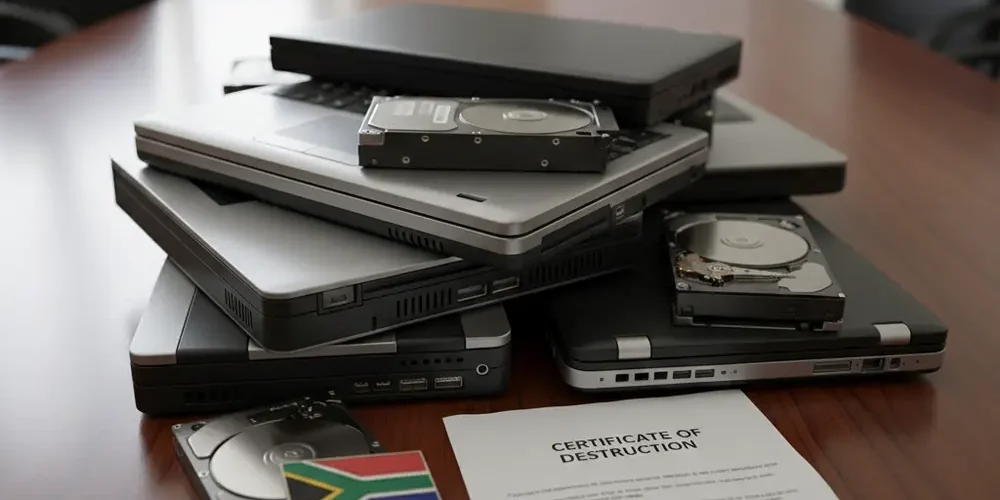
Every decommissioned laptop, server, or hard drive that leaves your organisation without verified data destruction is a potential liability waiting to surface. In South Africa, where POPIA is fully enforceable and the Information Regulator of South Africa holds statutory authority to investigate and sanction, improper IT disposal is not an IT housekeeping issue – it is a board-level risk.
This article unpacks the direct and indirect costs of a disposal-related data breach, explains what POPIA actually requires, and gives you a practical governance checklist your organisation can act on today. By the end, you will be able to assess your current disposal process against a compliance benchmark and build an internal business case for fixing gaps before a breach forces the issue.
Note for South Africa:
- POPIA (Protection of Personal Information Act 4 of 2013) is the governing legislation – not GDPR. These are different regimes with different penalty structures.
- The Information Regulator is the sole statutory enforcement body. Their enforcement notices and annual reports are publicly available and worth reviewing.
- Many South African organisations, including large corporates, still rely on informal or unvetted IT disposal channels. This is a realistic and documented local risk.
At a glance:
- POPIA Section 19 extends your data protection obligations through to the point of physical destruction of IT equipment.
- A single disposal-related breach can trigger regulatory fines, civil claims, reputational damage, and elevated cyber insurance premiums simultaneously.
- Using an unvetted disposal vendor does not transfer liability – your organisation remains the responsible party under POPIA.
- A certificate of destruction and documented chain of custody are the minimum evidence required to demonstrate compliance.
Key takeaways:
- POPIA-compliant IT disposal is a legal obligation, not a best-practice option.
- The total cost of a breach almost always exceeds the cost of a proper disposal programme.
- Board-level accountability under King IV means IT disposal governance belongs on the audit committee agenda.
Why Improper IT Disposal Is a POPIA Liability, Not Just an IT Problem
South African organisations often treat IT disposal as an end-of-budget-cycle operational task. Equipment is handed to a third-party vendor, donated, or simply stored in a storeroom indefinitely. None of these approaches, without verified data destruction, satisfies your obligations under POPIA.
The Protection of Personal Information Act is unambiguous: the responsible party – your organisation – carries the obligation to protect personal information throughout its entire lifecycle. That lifecycle does not end at decommission. It ends at verified, documented destruction.
What POPIA Actually Requires When Disposing of IT Assets
Section 19 of POPIA requires responsible parties to take appropriate, reasonable technical and organisational measures to prevent loss of, damage to, or unauthorised access to personal information. Legal commentary from South African POPIA specialists, including analysis published by Michalsons Law on POPIA security safeguards, confirms that this obligation explicitly extends to decommissioned equipment.
Section 22 requires notification to the Information Regulator and affected data subjects when a security compromise occurs or is reasonably suspected. This means a disposal-related breach triggers a formal notification obligation – not an internal memo. Ignorance of what happened to disposed equipment is not a recognised defence.
Under POPIA, if you appoint a third-party disposal vendor – classified as an operator – you remain the responsible party. The vendor must be bound by contractual obligations that mirror your own POPIA duties. If the vendor causes a breach, your organisation still faces primary regulatory exposure.
| POPIA Section | Obligation | Disposal Relevance |
|---|---|---|
| Section 19 | Implement reasonable security safeguards for personal information | Applies through the full lifecycle, including physical disposal |
| Section 22 | Notify the regulator and data subjects of a security compromise | A disposal-related data exposure triggers this obligation |
| Section 107 | Administrative fines for non-compliance | Regulator can issue fines for failure to secure personal information |
| Operator liability | Third-party vendors must be contractually bound to your POPIA obligations | Using an unvetted ITAD vendor does not transfer your liability |
The Real Costs of a Data Breach Traced Back to Disposed Equipment
The financial impact of a breach is rarely limited to a single line item. Organisations that have experienced disposal-related breaches typically absorb costs across multiple categories simultaneously. Understanding the full exposure is essential for building an accurate risk budget.
Direct Financial Exposure – Fines, Penalties, and Legal Fees
Under Section 107 of POPIA, the Information Regulator has authority to impose administrative fines for non-compliance. The exact maximum fine amounts are set out in the Act and should be verified directly from the published legislation, as these figures carry legal weight and must not be approximated. What is clear is that regulatory fines represent only one layer of direct exposure.
Legal fees for regulatory response, internal investigations, and potential civil claims from affected data subjects add significantly to the direct cost. South African organisations also face the cost of forensic investigation to determine the scope of a breach – a process that is rarely quick or inexpensive.
The IBM Cost of a Data Breach Report tracks average breach costs across regions and industries annually. The report has included South African and broader African regional data in recent editions, providing credible benchmarks for financial planning. Readers should consult the most current edition for verified, ZAR-equivalent figures, as costs shift year on year.
Indirect Costs – Reputational Damage, Customer Churn, and Recovery Spend
Indirect costs are harder to quantify but often exceed direct financial penalties over a two-to-three-year horizon. Key indirect cost categories include:
- Reputational damage – loss of client trust, negative media coverage, and brand erosion that affects new business pipeline.
- Customer churn – data subjects whose information was exposed may terminate relationships, particularly in financial services, healthcare, and professional services sectors.
- Cyber insurance premium increases – a notified breach almost always triggers policy reviews and premium hikes at renewal.
- Increased regulatory scrutiny – a single enforcement action often invites broader compliance audits across your data processing activities.
- Staff time and opportunity cost – incident response, regulator correspondence, and legal proceedings consume senior management and IT team capacity for months.
How Breaches Happen Through Discarded IT Equipment
Data recovery from improperly disposed devices is more accessible than most executives realise. Commercially available forensic tools can recover significant volumes of data from devices that were simply deleted, factory-reset, or formatted before disposal. Encryption alone is not sufficient if the encryption keys remain accessible or if the device is handed over before encryption was ever applied.
Common Disposal Failure Points – Resale, Landfill, and Unvetted Third Parties
The most common points of failure in corporate IT disposal in South Africa include:
- Resale without data sanitisation – equipment sold through informal channels or online marketplaces without verified data wiping, exposing residual personal information to buyers.
- Landfill and skip disposal – physical disposal without destruction, leaving intact storage media accessible to third parties.
- Unvetted third-party disposal vendors – using vendors who lack documented data destruction processes, certifications, or the ability to issue a certificate of destruction.
- Internal "repurposing" without data clearing – devices moved between departments or donated to staff without formal sanitisation against the relevant data classification.
- SSD and flash storage oversight – applying HDD-era overwrite processes to SSDs, which require different sanitisation methods to achieve the same result. NIST SP 800-88 guidelines for media sanitisation address this distinction explicitly.
The South African enterprise context adds a local dimension. Budget pressure, thin IT teams, and reliance on informal disposal channels are documented realities in the local market. These factors increase the probability of disposal failures for organisations that do not have a formalised ITAD (IT Asset Disposal) process in place.
What a POPIA-Compliant IT Disposal Process Looks Like
A compliant disposal process is documented, auditable, and defensible. It is not sufficient to believe data was destroyed – you must be able to demonstrate it. The following elements form the baseline for a compliant programme. For a full-service approach to corporate IT asset disposal, review our corporate IT asset disposal service.
Certificates of Destruction and Chain of Custody Documentation
A certificate of destruction is the primary documentary evidence that data on a disposed device has been destroyed to an acceptable standard. While POPIA does not prescribe a specific format, the certificate should record, at minimum: the asset serial number, the destruction method used, the date of destruction, and the identity of the party that performed the destruction.
Chain of custody documentation tracks the device from the moment it is decommissioned to the point of verified destruction. Any gap in this chain represents a potential liability window. Reputable ITAD vendors operating in South Africa will provide both documents as a standard deliverable.
Standards such as NIST SP 800-88 define three sanitisation categories – Clear, Purge, and Destroy – and provide a decision matrix for selecting the appropriate method based on media type and data sensitivity. While NIST 800-88 is a US federal standard, it is widely referenced by ITAD vendors, auditors, and enterprise procurement teams globally, including in South Africa. The South African Bureau of Standards adopts ISO/IEC 27001, which includes controls relevant to secure media disposal – adherence to recognised standards can serve as a mitigating factor in regulatory proceedings.
Building the Business Case – Disposal Compliance vs. Breach Cost
The conversation between a CIO and CFO about IT disposal investment is often framed around cost. The correct framing is risk-adjusted cost. A structured POPIA-compliant disposal programme carries a predictable, budgetable cost. A breach carries unpredictable, compounding costs that typically run significantly higher – and arrive with regulatory, legal, and reputational consequences attached.
Under King IV Principle 12, the governing body is responsible for technology and information governance in a way that supports the organisation’s strategic objectives. For JSE-listed entities, non-compliance with King IV principles carries investor confidence and listing implications. For all organisations, it places data governance squarely on the audit committee agenda – including how IT assets are disposed of at end of life.
IT Disposal Compliance Checklist – Board-Ready Governance
Use this checklist as a governance reference for your next audit committee review or IT disposal policy update. Each item should have a documented owner and evidence trail.
- Asset audit and inventory logging – maintain an up-to-date register of all IT assets, including storage media type, data classification of information stored, and custodian details.
- Data classification review before disposal – confirm what categories of personal information are stored on each asset before selecting a destruction method. Higher sensitivity requires a higher sanitisation standard.
- Approved sanitisation or destruction method per asset class – define and document the acceptable destruction method for each media type (HDD, SSD, mobile device, tape). Reference a recognised standard such as NIST 800-88 or ISO 27001 controls.
- Vetted ITAD vendor selection – select vendors based on documented process, relevant certifications (such as R2 or e-Stewards), ability to issue certificates of destruction, and a contractual commitment to POPIA operator obligations.
- Certificate of destruction requirements – require a certificate per asset (or per batch with individual asset serials listed) as a non-negotiable contractual deliverable from your disposal vendor.
- POPIA breach notification readiness – maintain a documented response procedure for disposal-related incidents, including the obligation under Section 22 to notify the Information Regulator and affected data subjects promptly.
- Record retention for disposal documentation – retain all disposal records, certificates, and chain of custody documentation for a period consistent with your data retention policy and legal advice. These records are your primary defence in a regulatory investigation.
Common Mistakes in Corporate IT Disposal
Even well-resourced organisations make avoidable errors. The following are the most frequently observed failure points:
- Treating a factory reset or format as equivalent to data destruction – it is not, for most media types.
- Disposing of equipment through the same general waste or recycling channels as non-sensitive office assets.
- Assuming liability transfers to the disposal vendor without a written contract that meets POPIA operator requirements.
- Skipping asset inventory before disposal, leaving unknown devices – and unknown data – unaccounted for.
- Applying a one-size-fits-all sanitisation method across all media types, particularly failing to account for SSD behaviour.
- Not retaining certificates of destruction or chain of custody records after disposal is complete.
If You Are New to POPIA-Compliant IT Disposal
If your organisation does not yet have a formal IT disposal policy, start here:
- Read the Information Regulator of South Africa guidance on security safeguards and breach notification – it is publicly available and sets the baseline expectation.
- Conduct a quick audit of how end-of-life IT equipment is currently handled in your organisation. Who approves disposal? Is there a vendor? Is there any documentation?
- Identify the categories of personal information your organisation processes – employee records, customer data, financial information – and map which device types carry that data.
- Brief your legal or compliance team on Section 19 and Section 22 of POPIA as they apply to IT disposal. Consider seeking independent legal counsel for a formal gap assessment.
- Engage a vetted ITAD vendor for an initial scoping conversation. Review our corporate IT asset disposal service as a starting point.
If You Already Have an IT Disposal Process in Place
If a disposal process exists, validate whether it meets the current POPIA standard:
- Review your ITAD vendor contract – does it explicitly bind the vendor to POPIA operator obligations? If not, it needs updating.
- Confirm that certificates of destruction are being issued per asset (or per documented batch) and that these are being retained in your compliance records.
- Test your SSD sanitisation method against NIST 800-88 or ISO 27001 controls – SSD destruction requirements differ from HDD overwrite processes.
- Check that your disposal process is reflected in your POPIA compliance documentation and that the audit committee has visibility of it as an information governance risk item.
- Review whether your breach notification procedure includes a scenario for disposal-related incidents, with clear timelines for regulator notification under Section 22.
Frequently asked questions
Does POPIA specifically require data destruction before IT equipment is disposed of?
POPIA Section 19 requires responsible parties to implement appropriate, reasonable technical and organisational measures to prevent unauthorised access to personal information throughout its lifecycle. Legal commentary in South Africa consistently interprets this as extending to the disposal phase. While POPIA does not prescribe a specific destruction method, the obligation to prevent data exposure through disposed equipment is well established. Seek independent legal advice for a formal interpretation applied to your organisation’s specific context.
What happens if a third-party disposal vendor causes a breach – is my organisation still liable?
Under POPIA, your organisation remains the responsible party regardless of which vendor handles the physical disposal. The vendor is classified as an operator and must be bound by a written contract that mirrors your POPIA obligations. If the vendor causes a breach and that contractual obligation was not in place, or was not enforced, your organisation faces primary regulatory exposure. This is a critical distinction from other liability frameworks and should be reviewed with legal counsel.
What is the maximum fine the Information Regulator can impose under POPIA?
Section 107 of POPIA sets out the administrative penalty regime. The maximum fine amounts are specified in the Act and should be verified directly from the current published legislation, as quoting an incorrect figure carries significant risk in a compliance context. What is clear is that administrative fines can be imposed for failures to implement adequate security safeguards – which includes disposal-related data exposure.
Is NIST 800-88 a legally recognised standard in South Africa?
NIST SP 800-88 is a US federal standard and is not formally legislated in South Africa. However, it is widely used as a technical benchmark by ITAD vendors, enterprise procurement teams, and auditors in the South African market. The South African Bureau of Standards adopts ISO/IEC 27001, which includes relevant media disposal controls. Alignment with NIST 800-88 can demonstrate due diligence and may serve as a mitigating factor in a regulatory investigation, but its formal status in South African law should be confirmed with legal or compliance counsel.
Does the Cybercrimes Act apply to disposal-related data exposure?
South Africa’s Cybercrimes Act 19 of 2020 operates alongside POPIA and creates criminal liability for unlawful access to and exposure of data. Where personal data is recovered from improperly disposed equipment and used maliciously, the originating organisation may face scrutiny under both statutes. This means a single disposal incident could trigger administrative fines under POPIA and potential criminal liability exposure under the Cybercrimes Act. The interaction between the two statutes is still being interpreted by South African courts – specialist legal advice is recommended.
Summary
- POPIA Section 19 extends your data protection obligations to the physical disposal of IT equipment – decommission is not the end of your liability.
- A disposal-related breach carries direct costs (fines, legal fees, forensic investigation) and indirect costs (reputational damage, customer churn, insurance increases) that compound over time.
- Using an unvetted vendor without a POPIA-compliant operator contract does not transfer liability – it increases your risk exposure.
- A certificate of destruction and documented chain of custody are the minimum evidence required to demonstrate compliance in a regulatory investigation.
- Board-level accountability under King IV means IT disposal governance is a legitimate audit committee agenda item, not just an operational IT task.
If you have questions about POPIA-compliant disposal for your organisation’s IT equipment, contact our team or explore our professional services for more information.
This is educational content, not financial advice.

