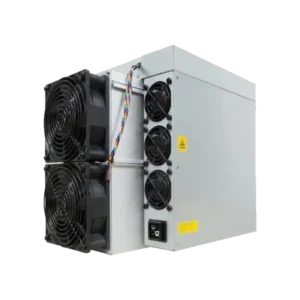
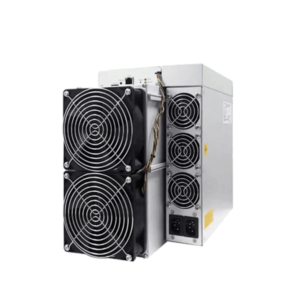
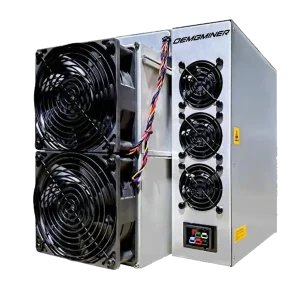
Bitmain Antminer T21 180Th
Original price was: R63000.R57500Current price is: R57500.
The Bitmain Antminer T21 180Th mines Bitcoin (BTC) on the SHA-256 algorithm at 180 TH/s, drawing about 3420W at roughly 19 J/TH from Bitmain’s 5nm platform. It is air-cooled with dual high-speed fans and needs a 380–415V three-phase supply, which in South Africa means a dedicated 400V three-phase connection.
Product Description
Product Overview
The Bitmain Antminer T21 180Th is the base variant in Bitmain’s T21 series, a commercial-grade SHA-256 miner in our Bitcoin (BTC) ASIC Miners range that delivers 180 terahashes per second at approximately 19 J/TH. The T21 series is Bitmain’s efficiency-optimised counterpart to the premium S21 lineup, offering improved performance over S19-era hardware at a more accessible cost than the flagship S21 Pro models.
The T21 180Th sits at the entry level of the T21 family, beneath the Bitmain Antminer T21 190T. At 180 TH/s and about 3420W, it uses the same 5nm-class chip architecture as its sibling at the same 19 J/TH, in a lower-binned configuration that draws less power. That makes it a practical choice for operators who want T21-generation efficiency without paying a premium for top-tier hashrate.
Compared with the previous T19 generation (37.5 J/TH), the T21 180Th’s 19 J/TH is a substantial efficiency improvement in the same air-cooled form factor. Bitmain builds the T21 for a 380–415V three-phase supply, so it suits South African commercial and industrial sites that already have three-phase power, where it offers excellent value within the current generation of Bitmain’s range.
Key Features
- 180 TH/s hashrate: Strong Bitcoin mining output from the base T21 variant, providing significant SHA-256 pool contribution per deployed unit.
- ~19 J/TH efficiency: At approximately 3420W, the T21 180Th operates at about 19 J/TH, a major improvement over T19-era hardware (37.5 J/TH) and ahead of S19k Pro-class machines at about 23 J/TH.
- Air-cooled dual fan design: Standard industrial ASIC enclosure with dual high-speed fans. No specialist cooling is required, and it suits standard mining farm rack deployment.
- Three-phase power input: Bitmain specifies a 380–415V AC three-phase input, which matches commercial and industrial supply rather than household circuits.
- SHA-256d algorithm: Mines Bitcoin (BTC), Bitcoin Cash (BCH) and Bitcoin SV (BSV). Bitcoin is the standard target for all SHA-256 hardware.
- T21-generation chip architecture: Built on the same 5nm platform as the T21 190T, delivering the same 19 J/TH efficiency at a lower hashrate bin and a lower power draw.
- Ethernet (RJ-45) connectivity: Wired network connection for pool communication. Standard Antminer web interface for configuration and monitoring.
- Bitmain ecosystem: Standard Antminer firmware, pool support and management tooling. Compatible with Bitmain’s monitoring infrastructure and third-party mining management software.
Technical Specifications
- Algorithm: SHA-256d
- Supported coins: Bitcoin (BTC), Bitcoin Cash (BCH), Bitcoin SV (BSV)
- Hashrate: 180 TH/s (±3%)
- Power consumption: ~3420W (±5%) at 25°C ambient
- Power efficiency: ~19 J/TH (±5%)
- Cooling type: Air-cooled, dual high-speed fans
- Noise level: ~75 dB(A)
- Input voltage: 380–415V AC, three-phase
- Networking: Ethernet (RJ-45)
- Operating temperature: 5°C to 45°C
- Dimensions (L×W×H): 400 × 195 × 290 mm
- Net weight: ~16 kg
Power & Installation Notes
The T21 180Th takes a 380–415V AC three-phase input. South Africa’s standard three-phase supply of 400V between phases falls within that range, but a single-phase 230V household circuit does not, so the site needs a three-phase connection before the miner can run.
At approximately 3420W continuous draw, the T21 180Th needs a dedicated three-phase circuit with its own protection, installed and certified by a registered electrician in line with SANS 10142. Standard 16A domestic plugs and circuits are not suitable. For multi-unit commercial deployments, each unit requires individual circuit protection on a dedicated three-phase distribution board.
Load shedding at 3.42 kW means a 10kWh battery provides approximately 2.9 hours of operation, which is not enough for extended outages without generator or commercial backup power. Any backup system must also deliver three-phase power, so plan for this if continuous operation is required.
The T21’s dual fans need clear airflow at both inlet and exhaust faces. Keep ambient temperature below 45°C, and use active air extraction in enclosed mining rooms, particularly in South Africa’s warmer summer climates.
Electricity Cost Context (South Africa)
Running the T21 180Th at 3420W continuously consumes approximately 82.1 kWh per day, or roughly 2 462 kWh per month. At R2.80/kWh (reference residential tariff, municipal rates vary), the estimated monthly electricity cost is approximately R6 895 per month.
Calculation: (3420 ÷ 1000) × 24 × 30 × R2.80 = ~R6 895/month.
The T21 180Th’s 19 J/TH efficiency means it produces more Bitcoin per rand of electricity than older T19 or S19 Pro hardware, and it runs at the same cost per terahash as the T21 190T. Commercial or industrial power access is strongly preferable to standard South African residential tariffs. This is a cost estimate only and not a profitability projection.
Ideal Use Cases
- Commercial Bitcoin mining operations with three-phase power: Purpose-built facilities with a three-phase supply seeking T21-generation efficiency at a lower unit cost than the 190T.
- Hardware refresh from T19 or S19 Pro: Operators replacing first-generation T19 (37.5 J/TH) or S19 Pro hardware with meaningfully more efficient T21-generation equipment.
- Cost-conscious fleet building: When per-unit cost matters more than maximum per-unit hashrate, the T21 180Th provides T21-generation efficiency at a lower upfront investment than the T21 190T.
- Pool mining participants: Works with all major SHA-256 Bitcoin pools. Reliable and straightforward to configure for pool-based income.
- Mixed T21 fleet operators: Can be deployed alongside T21 190T units without infrastructure changes, with the same form factor, three-phase input and rack requirements across the T21 range. The 180Th draws about 190W less per unit.
Frequently Asked Questions
Does the Antminer T21 180Th work on South African power?
Yes, on a three-phase supply. Its 380–415V AC input matches South Africa’s 400V three-phase standard, so it needs a three-phase connection rather than a single-phase 230V household circuit. A registered electrician should install a dedicated circuit for safe continuous operation.
What is the difference between the T21 180Th and T21 190T?
Both use the same T21-generation 5nm chip architecture and share an identical chassis and the same 19 J/TH efficiency. The Bitmain Antminer T21 190T delivers 190 TH/s at about 3610W, while the 180Th delivers 180 TH/s at about 3420W. The 180Th is the more cost-accessible entry into the T21 platform.
What Bitcoin pools are compatible with the T21 180Th?
All major SHA-256 pools work, including Foundry USA Pool, AntPool, F2Pool, ViaBTC and Braiins Pool. Configuration uses the standard Antminer web interface.
How does the T21 180Th compare to the S21 Pro series?
The S21 Pro operates at 15 to 15.5 J/TH, which makes it more efficient than the T21’s 19 J/TH, and it runs on a single-phase 200–240V supply. The S21 Pro is premium-tier hardware at a higher unit cost, as the Bitmain Antminer S21 Pro 234Th shows. The T21 180Th is the value-oriented T-series option for operators where upfront cost is a constraint.
Which newer models are worth comparing?
The Bitmain Antminer S21+ 216Th Bitcoin Miner runs at about 16.5 J/TH, and the MicroBT Whatsminer M60S+ Bitcoin Miner offers 200–210 TH/s. Both are air-cooled Bitcoin miners a step up in hashrate from the T21 180Th.
Can I undervolt the T21 180Th to reduce power costs?
Yes. The Antminer T21 supports power tuning via its web interface. A lower power mode reduces both hashrate and electricity consumption, which can improve economics at higher electricity tariffs.
What’s Included
- 1× Bitmain Antminer T21 180Th ASIC miner unit
- Integrated or bundled PSU (confirm with order)
- Power cable (region-specific; a three-phase connection must be wired by an electrician)
- Ethernet cable not included
- Quick-start guide