
Garage mining cooling and ducting
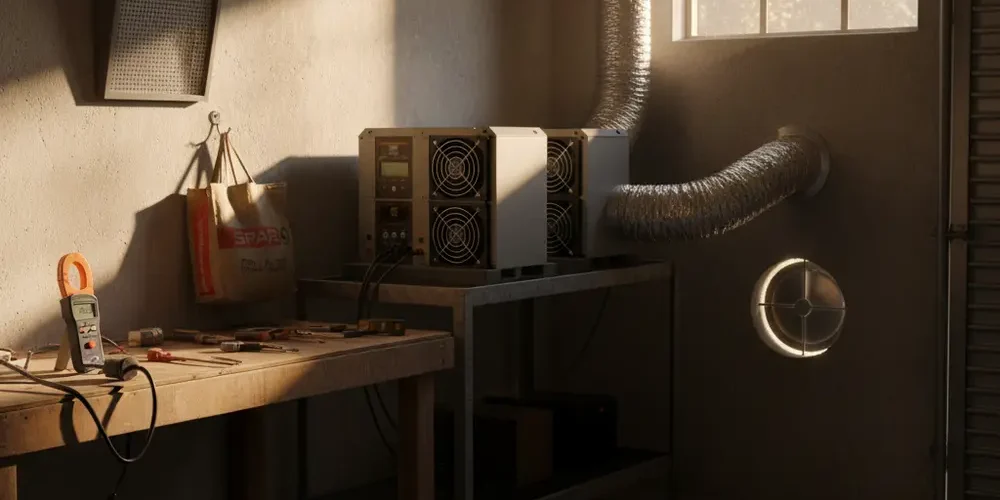
The most common garage mining failure mode is hot exhaust air getting pulled straight back into the miner intake, causing thermal throttling, shutdowns, and noisy fans running flat out. In a garage this can happen even when the door is open, because airflow follows the easiest path, not the one you intended.
By the end of this guide you will be able to sketch an intake and exhaust path that does not recirculate, choose ducting that does not choke airflow, and set up basic monitoring that tells you when the design is working. You will also have a printable checklist you can use to audit your current install and decide what to fix first.
Note for South Africa:
- Do not assume a single electricity price, tariffs change and differ by municipality and meter type, check your latest bill before you add extra fans or cooling.
- Plan for load shedding and inverter limits, a miner plus an inline fan can overload circuits or inverters, build in safe shutdown and restart routines.
- Garages are often dusty, and coastal air can be corrosive, prioritise filtration, sealing, and keeping miners off the floor.
At a glance:
- Separate intake and exhaust so hot air cannot loop back, distance and barriers matter more than a bigger fan.
- Size ducting for low restriction, short runs, large diameter, gentle bends, sealed joints.
- Choose fans by pressure curve, not only free air flow, and place them to avoid backdrafting.
- Control dust and noise without starving airflow, use filtration and vibration isolation.
Key takeaways:
- Measure intake air temperature at the miner, not only garage ambient.
- Every bend and metre of duct adds resistance, rigid duct usually performs better than flex.
- Safety comes first, electrical loading, fumes, and fire risk are part of ventilation design.
What a garage mining setup is fighting, heat, dust, humidity, noise, and power constraints
A garage is an awkward space for ASICs because it swings between hot and cold, it stores dusty items, and it often shares air with the house. Your miner does not care that the garage feels cool, it cares about the temperature and quality of the air at its intake.
Heat is predictable, almost all the electrical power ends up as heat in the room. If that heat cannot leave the garage fast enough, the miner will raise fan speed, then throttle, then eventually protect itself by reducing hash rate or stopping.
Dust is the slow killer. It blocks heatsinks, increases temperature at the same power level, and can turn humid air into grime that sticks to everything. Bitmain explicitly warns that environmental contamination like dust and corrosive gases matters for reliability, so treat a garage as high risk unless you control it. Bitmain environmental requirements for Antminer
Humidity is about condensation risk, not comfort. If you pull in cool night air and then the miner warms ducting, or you pull in warm humid coastal air and cool it in a duct, you can create a condensation point where water meets dust and electronics. Bitmain also highlights humidity, coastal salinity, and moisture as risk factors, so avoid any cooling approach that introduces water vapour or mist into the airstream. Antminer do's and don'ts for safe operation
Noise is not only an annoyance, it is feedback. When noise climbs, it often means the miner is fighting restriction, recirculation, or dust buildup. Your goal is steady, predictable airflow so the fans do not surge.
Power constraints in South Africa add a twist. Extra cooling might look cheap in isolation, but it is also extra load, extra heat inside the garage, and extra stress on circuits, plugs, and inverters. If you are adding miners or upgrading models, consider sourcing proper hardware and power accessories via our shop so you can build around known components.
Plan your airflow first, intake path, exhaust path, and how to avoid recirculation
Start with a simple drawing. Mark where the miner pulls air in, where it pushes air out, and where that hot air will go next. If the answer is anywhere near the intake, you have a recirculation problem waiting to happen.
A workable garage plan usually has one of these patterns: exhaust to outdoors and draw intake from outdoors, exhaust to outdoors and draw intake from a clean internal zone, or exhaust to a dedicated duct plenum and bring filtered air from a separate intake. What you should avoid is exhausting into the same space you are using as intake, unless you have a very high airflow rate and clear separation.
Think like air. Air will short-circuit from exhaust to intake if there is a pressure difference and an open path, even a small one around a rack, under a bench, or through a gap in a curtain. Distance helps, but physical barriers help more.
- Keep intake and exhaust on opposite sides of the garage where possible.
- Do not point exhaust at a wall and hope it mixes, it will roll along surfaces and loop back.
- Do not vent hot air into a roof space or ceiling void, heat will return and it adds fire and moisture risks.
- Keep miners off the floor, dust layers are worst near ground level.
If the garage is attached to the house, treat the connecting door as a boundary. You do not want negative pressure pulling garage air, fumes, or dust into the home.
Positive vs negative pressure, what changes in a dusty South African garage
Positive pressure means you push more air in than you pull out, so air leaks out through gaps. Negative pressure means you pull more air out than you push in, so air leaks in through gaps. Neither is automatically right, it depends on what you are trying to keep out.
In a dusty garage, mild positive pressure with a filtered intake can reduce dust ingress, because the leaks push air outward. The trade-off is that you must provide enough controlled exhaust so heat still leaves efficiently.
Negative pressure setups are common because they are simple, you just add an exhaust fan and let air find a way in. The downside is that the make-up air can come from the worst places, under doors, from roof voids, or from the car bay with fumes and fine dust.
Pressure changes can also affect indoor air risks in semi-enclosed spaces. If you run strong extraction in an attached structure, be cautious about what air you might draw in from soil or adjacent areas, and keep garage air from being pulled into living spaces. Indoor air safety when changing ventilation
Ducting design basics, diameter, length, bends, and why static pressure matters
Ducting is where good garage setups fail quietly. A miner can have powerful fans, but if you add small duct, long runs, and sharp bends, you create static pressure that the fans cannot overcome efficiently.
Static pressure is basically how hard the fan must work to push air through restrictions. Every metre of duct, every bend, every crushed section of flexible duct adds resistance. When resistance rises, airflow drops, and temperature rises.
A practical rule is to treat ducting like plumbing. Larger diameter and smoother interior means lower losses. Shorter runs and gentler bends mean lower losses.
- Keep duct runs as short as your layout allows.
- Use the largest practical duct diameter that matches your miner outlet or shroud strategy.
- Prefer two gentle 45 degree bends over a single sharp 90 degree bend.
- Seal joints so you are not dumping heat back into the garage.
| Choice | Best for | Watch out for |
|---|---|---|
| Exhaust-only, open intake | Quick fixes, mild climates, temporary testing | Dust ingress, fumes, unpredictable intake path |
| Filtered intake, passive exhaust | Dust control, stable intake quality | Heat buildup if exhaust path is weak |
| Dedicated intake plus dedicated exhaust | Most garages, predictable performance | More parts, more sealing and mounting work |
| Rigid duct main run | Low restriction, durable, easy to seal | Needs planning, harder to route around obstacles |
| Flexible duct short section | Vibration isolation, tight turns | Crush risk, high losses if long or sagging |
If you want help choosing duct diameters, fan types, or a layout that fits your garage shape, use our contact page and include your miner count, garage size, and a few photos.
Rigid vs flexible duct, insulation, sealing, and condensation risk
Rigid duct generally wins on airflow because it stays round and smooth. Flexible duct is useful in short sections to reduce vibration transfer or to make a final connection, but it becomes a problem when it is long, sagging, or squeezed behind shelves.
Insulation can help in two different ways. It can reduce heat radiating into the garage from hot exhaust ducting, and it can reduce condensation risk on ducts that carry cooler intake air through warm humid spaces.
Sealing matters because leaks waste your fan effort and reintroduce hot air into the garage. Use proper tape and clamps intended for ducting, and avoid improvised solutions that fail with heat.
- Support ducting so it cannot sag and narrow over time.
- Keep intake ducting away from exhaust ducting to avoid heat soak.
- Inspect for condensation points in winter or during coastal humidity spikes.
Fan selection and placement, inline duct fans, shrouds, and backdraft dampers
Fans are where many home miners overspend and still lose. The key is to match the fan to the resistance of your ducting, not only to buy the biggest flow number on the box.
Most fan marketing uses a free-air flow figure, which is what the fan moves with no duct attached. Once you add ducting, bends, filters, and an exterior grille, the real flow can drop a lot. Look for a pressure curve, or at least performance data that includes static pressure.
Placement matters. If you place a fan in a way that it fights the miner fans, or it pulls air from the wrong gaps, you can make temperatures worse even though you added more hardware.
- For exhaust ducting, place the inline fan where it pulls hot air out smoothly and does not create strong turbulence at the miner outlet.
- For intake ducting, place the fan so it pushes clean air toward the miner intake, and keep the filter accessible for cleaning.
- Add a backdraft damper where wind could push air backwards through the duct when the system is off.
Backdrafting is a real issue in garages with prevailing wind, especially when an exterior vent faces wind pressure. A damper helps stop hot air, dust, or insects moving the wrong way when fans stop during load shedding.
Shrouds are often underrated. A simple, well-sealed transition from miner outlet to duct can reduce recirculation and reduce the amount of hot air that spills into the room. If you are buying purpose-made accessories, start from a known category like Bitcoin ASIC mining gear and build the ducting plan around that form factor.
Controlling noise and vibration without choking airflow
Noise control should not come from making the airflow path smaller. If you restrict airflow to reduce noise, temperatures rise, fan speed rises, and the system gets louder again.
Start with vibration and structure-borne noise. A fan bolted to a thin wall panel can turn the whole garage into a speaker.
- Use rubber isolation mounts for inline fans where possible.
- Add a short flexible duct section between rigid duct and the fan to reduce vibration transfer.
- Keep the miner rack solid and avoid metal-on-metal rattles.
- Consider a lined duct silencer only if you can confirm it does not add too much restriction for your fan.
Also check the simple stuff. Loose duct clamps, flapping backdraft dampers, and vibrating grilles can add a lot of harsh noise.
Cooling strategies that actually work in garages, exhaust-only, push-pull, and filtered intake
There is no single best strategy for every South African garage. The right approach depends on your summer ambient, dust level, whether the garage is attached to the house, and whether you can cut vents through walls legally and safely.
Exhaust-only can work if you have a reliable source of make-up air and you accept that the air will be dusty. It is often the fastest way to test whether heat removal is your primary problem.
Push-pull means you have both controlled intake and controlled exhaust. This is usually the most stable for garage miners because you decide where air comes from and where it goes.
Filtered intake is the best lever for dust and long-term reliability. The risk is filter neglect, a clogged filter can starve the miner, raise temperatures, and cause sudden fan spikes.
- Start with a simple baseline, one miner, clean intake path, clear exhaust to outdoors.
- Add filtration once you can keep temperatures stable without it.
- If temperatures are still high, reduce duct restriction before adding more fan power.
- Only consider air conditioning if you have measured intake temperature and proved ventilation cannot keep up.
When you set targets, prefer manufacturer guidance and on-device monitoring. Bitmain notes that intake temperature is the key metric to watch, and model limits differ, so set alerts based on your miner documentation rather than generic internet numbers. Miner intake temperature matters
Common mistakes
- Exhausting hot air into the same garage volume used as intake, then wondering why temperatures climb.
- Using long flexible duct runs that sag or get crushed, creating high resistance and low flow.
- Mounting an inline fan directly to a thin wall or roof sheet, amplifying noise and vibration.
- Adding a filter with no plan for cleaning, then starving the miner as it loads with dust.
- Pulling intake air from the car bay or near chemicals, paint, fuel, or solvents.
If you're new
- Run one miner first and treat it as a test rig, measure intake temperature before you scale.
- Keep the airflow path simple, short exhaust to outdoors and a clean, obvious intake route.
- Put the miner on a shelf or rack, not on the floor, and keep the area around it clear.
- Use basic monitoring, a cheap temperature and humidity sensor near the intake helps.
- Plan where the noise goes, your neighbour line and bedroom wall matter.
If you already run rigs
- Audit your ducting for restriction, count bends, check for crushed flex, and seal leaks.
- Log intake temperature during the hottest part of the day, do not tune only at night.
- Check fan behaviour, sudden surges usually mean restriction, recirculation, or dust buildup.
- Review your maintenance rhythm, filters and heatsinks need scheduled attention.
- Consider discreet exterior venting, but do not hide heat in a way that traps it.
Safety and compliance checklist for South Africa, electrical loading, fire risk, and fumes
Garage mining problems often look like cooling problems, but end up being electrical or air quality problems. Treat this section as non-negotiable.
Electrical loading is the first risk. ASICs are sustained high loads, and garages often have older wiring, shared circuits, or long extension leads. If you are unsure, use a qualified electrician and reference the correct South African wiring code for your installation.
Fire risk is not only about the miner, it is also about plugs, adapters, cable heating, and dust. Keep clearances around miners and do not store cardboard, paint, or solvents near hot exhaust paths.
Fumes and contaminants are a real concern in garages. Do not draw intake air from areas where vehicles idle, or where you store petrol, thinners, or pesticides. If the garage is attached, keep the door to the house sealed and avoid creating strong negative pressure.
- Use dedicated circuits where required, avoid daisy-chained multiplugs and long coiled extensions.
- Ensure ventilation keeps hot air out of roof voids and ceiling spaces.
- Keep a clear path to shut down safely during load shedding and power restoration.
- If you use an inverter, confirm continuous load capacity and cable ratings, not only peak ratings.
Also plan your operating cost assumptions carefully. Eskom tariff structures and adjustments can change over time, so use current bills and meter details rather than old online figures. NERSA-approved Eskom tariffs effective 1 April 2025
Validation and maintenance, what to measure weekly, what to clean monthly, and when to redesign
Do not guess whether your design works. Validate it with a few simple measurements and repeat them, especially when seasons change.
Weekly, focus on conditions at the miner intake. Intake temperature is the number that drives stability, and it can differ from garage ambient if your ducting is leaking or recirculating.
- Weekly checks: intake temperature, exhaust temperature feel at the outlet, fan speed behaviour, unusual noise changes.
- Monthly checks: filter condition, dust on heatsinks, duct joints for leaks, backdraft damper movement.
- Seasonal checks: summer peak day test, winter night condensation check, wind direction changes at the exterior vent.
Redesign triggers are simple. If you cannot keep intake temperature stable without extreme fan noise, or if filters clog unusually fast, your airflow path is wrong or your intake location is too dusty.
If you want a second set of eyes on your measurements and photos, use contact us and include your duct length, number of bends, and where the exhaust terminates.
Printable garage ASIC cooling and ducting checklist
Use this as a pass or fail audit. Fix the red flags first, they usually deliver the biggest improvement.
- Layout: Miner intakes face a clean zone, exhaust points directly into a controlled exhaust path, miners are off the floor.
- Intake path: Intake air source is known, not from the car bay, not from chemical storage, and not from a roof void.
- Exhaust path: Hot air exits outdoors, not into the garage, not into the ceiling, and not into another enclosed cavity.
- Recirculation test: With miners running, feel for hot air near the intake, if it is warm, you have a loop to fix.
- Ducting: Duct is short, appropriately sized, minimal sharp bends, no crushed flex, joints sealed.
- Fan choice: Fan is selected for duct resistance, mounted securely with vibration isolation, not fighting miner fans.
- Backdrafting: A damper or other solution prevents wind reversing flow when the system is off.
- Filtration: Filter is sized so it does not choke flow, it is accessible, and you have a cleaning schedule.
- Noise: Vibration is isolated, panels are not rattling, airflow is not restricted to reduce noise.
- Monitoring: You measure intake temperature at the miner, and you track changes after each ducting change.
- Safety: Cables and plugs do not run hot, no overloaded multiplugs, no combustibles near exhaust, shutdown routine is clear.
- Fix first red flags: Exhaust dumps into roof space, intake draws from car bay, visible recirculation, melted plugs, or strong negative pressure pulling air from the house.
Frequently asked questions
Do I need to duct both intake and exhaust?
Not always, but it is usually the most controllable approach in a garage. If you can only do one, duct the exhaust to outdoors first, then confirm the intake air source is clean and not recirculating.
Can I use flexible duct for the whole run?
You can, but long flexible runs often reduce airflow because they sag and create extra resistance. If you must use flex, keep it short, fully stretched, and well supported, then monitor intake temperature to confirm it is not choking the miner.
Where should I place my temperature sensor?
Place a sensor near the miner intake, not on the opposite wall of the garage. The intake value is what matters for stability, and it will reveal leaks and recirculation that ambient readings hide.
Is negative pressure safe in an attached garage?
It can be risky if it pulls air from the house or from contaminated areas. Aim for controlled make-up air and avoid strong extraction that changes airflow through the door to the home.
How often should I clean filters and miners?
It depends on your dust load, which varies a lot by area and season. Start by inspecting weekly, set a cleaning interval based on how fast filters load, and increase frequency during dry, dusty periods or nearby construction.
Summary
- Stop recirculation first, separate intake and exhaust and use barriers where needed.
- Reduce duct restriction before buying more fan power, short runs, big diameter, gentle bends.
- Use filtration for dust, but treat filter maintenance as part of uptime.
- Measure intake temperature at the miner and validate changes with repeatable tests.
- Keep safety central, electrical loading, fumes, and fire clearances are part of the design.
This is educational content, not financial advice.

