
Buying a Bitcoin Miner in SA: 2026 Guide
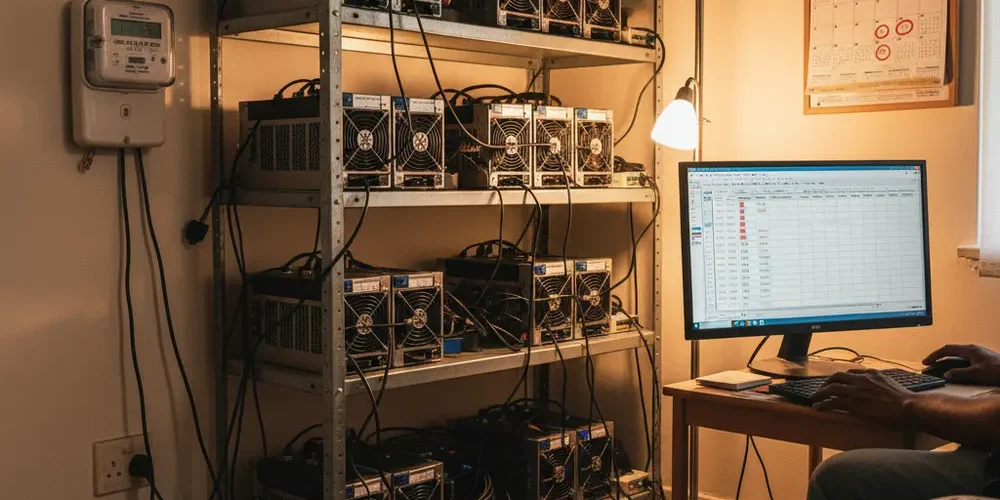
Buying a Bitcoin miner in South Africa in 2026 is a different conversation to what it was three years ago. Local pricing has dropped sharply, the hardware mix has shifted, and Eskom tariffs are the variable that decides whether you’re running a profit machine or a slow-bleed hobby.
By the end of this guide you’ll know exactly what current SA pricing looks like, what the realistic payback maths are at proper rand-per-kWh tariffs, and how the three power scenarios (pure Eskom, hybrid solar, full off-grid) change the answer. We’ve shipped, repaired, and resold hundreds of units from our Bedfordview office, so the numbers and warnings here are first-hand.
Note for South Africa:
- 220V single-phase is the default in most homes. Anything more than two S21+ units on a single DB circuit will trip your main breaker.
- Eskom residential block 3 sits between R3.80 and R4.50 per kWh in 2026 in most metros. A small-scale business connection can come in around R2.20 per kWh. Cross-check your own band against Eskom’s tariff schedules.
- Load shedding still costs you uptime. Budget for hybrid power or a hosted slot before you put cash on a miner.
At a glance:
- Four numbers tell you whether a miner is worth buying: TH/s, J/TH, watts at the wall, and rand-per-TH.
- Used S19 miners (around 100 TH/s) currently sit at R10 000 each in our office.
- A new S19K Pro 120Th starts at R19 500 VAT inclusive. A new S21+ 235Th starts at R75 000 VAT inclusive.
- On pure Eskom residential rates the cashflow is negative. Hybrid or off-grid solar is what makes mining work in 2026.
Key takeaways:
- Never pay before you see hashrate logs from the actual unit.
- Calculate payback at your real tariff (typically R2.50 to R4.50 per kWh on Eskom residential), not US-style cent-per-kWh figures.
- A used S19 100Th at R10 000 has the lowest rand-per-TH, but you’re betting on resale and BTC appreciation more than ongoing cashflow.
Quick checklist before you buy any Bitcoin miner
Before you transfer a cent, run through these five checks. Skipping any one of them is how buyers end up with a brick.
- Does the seller have a physical SA address you can visit, or at least confirm on CIPC.
- Do they ship with a written warranty, typically 30 to 90 days on used hardware, longer on new.
- Will they let you see the miner running with a current hashrate log.
- Is the original PSU included, and is it rated for SA single-phase 220V.
- Does the model fit what your mining room can actually cool and power.
If a seller hesitates on any of those, walk away. We’ve had too many customers ring our Bedfordview line in tears after sending R40 000 to a Telegram contact.
The four numbers that matter on a 2026 ASIC
Strip away the marketing and four numbers tell you everything. TH/s is hashing power. J/TH is efficiency, lower is better. Watts at the wall is your electricity bill driver. Rand-per-TH is the comparison metric that strips out hype.
For a current-generation unit you can verify the headline figures on the Bitmain Antminer S21 specifications. The S21+ pushes 235 TH/s at around 16.5 J/TH. A used S19 from 2021 still moves around 100 TH/s but burns closer to 34 J/TH, more than double the energy per unit of work.
Here is how the maths plays out on current SA pricing in 2026:
| Model | Hashrate | Efficiency | Wall power | Current SA price | Rand per TH |
|---|---|---|---|---|---|
| Used S19 | ~100 TH/s | ~34 J/TH | 3 250 W | R10 000 | R100 |
| New S19K Pro 120Th | 120 TH/s | ~23 J/TH | 2 760 W | R19 500 | R163 |
| New S21+ 235Th | 235 TH/s | ~16.5 J/TH | 3 880 W | R75 000 | R319 |
Prices verified April 2026.
The used S19 wins on rand-per-TH. The S21+ wins on efficiency. Your power scenario decides which trade-off you can afford. Read more on the J/TH efficiency basics to see why this matters past year two, especially when difficulty drifts up.
For live profitability and global price benchmarks, AsicMinerValue’s live profitability dashboard is the cleanest free reference.
New, used, or refurbished: what each really costs
New means full warranty, latest efficiency, biggest capital outlay. The new S21+ 235Th at R75 000 is the flagship in stock and the long-term play if you have hybrid or off-grid solar. For tighter budgets, the new S19K Pro 120Th at R19 500 hits a sweet spot on rand-per-TH for new hardware with full manufacturer warranty.
Used means cheapest entry, shortest warranty, and requires real due diligence on hashrate logs. Working used S19 units around 100 TH/s currently sit at R10 000 each in our office. At that price the rand-per-TH is unbeatable, but expect a 30 to 60 day warranty, not 12 months.
Refurbished sits in the middle. Hashboards tested, fans replaced, PSU re-capped, full bench burn-in before shipping. Expect a 60 to 90 day warranty. We unpack new vs used ASIC trade-offs in detail in a separate piece.
Where to legally buy in South Africa
Two categories of seller exist locally:
- Specialist resellers operating out of registered SA premises with VAT certificates and a physical address you can visit. Stock is visible on sites like our Bitcoin ASIC stock.
- Private peer-to-peer. Highest risk. No warranty, no recourse if the unit fails after 48 hours.
At current SA retail pricing, importing yourself doesn’t make sense. By the time you’ve paid freight, clearing, and currency conversion, the landed cost would exceed local retail. Verified resellers carry that risk so you don’t have to. We get one or two enquiries a week at the Sell Your PC crypto mining hub from buyers who took a Telegram deal and ended up with a non-functional unit shipped from Shenzhen with no return address.
How to verify a seller before transferring money
Five steps. Don’t skip them.
- Check the registered company name on CIPC’s free public search.
- Ask for the VAT number and verify it on the SARS e-filing portal.
- Ask for a video call showing the actual unit running with the pool dashboard visible.
- Pay via EFT to a registered company account, never to a personal account.
- Confirm the warranty terms in writing before you transfer.
Red flags: WhatsApp-only contact, prices 30 percent below the local market, urgency phrases like ‘limited stock today’, and no physical address. If you have an existing miner you want to verify pre-purchase, our piece on how to verify a used miner’s hashrate before paying walks through the test logs.
Payback maths across three power scenarios
This is where the SA reality starts to bite. The numbers on US YouTube channels assume 5c-per-kWh industrial power, which doesn’t exist here. Eskom residential tariffs in 2026 sit between R2.50 and R4.50 per kWh once you account for blocks, fixed charges, and municipal markup. The only way to get below that is to bring solar into the picture.
We work through full scenarios in the Eskom vs solar vs generator cost-per-kWh breakdown. Here is the short version for a new S21+ 235Th at R75 000 capex, drawing 3 880 W continuous (93 kWh per day), with BTC at R1.2 million and current network difficulty giving roughly R190 per day in revenue. Cross-check live revenue numbers on WhatToMine’s BTC SHA-256 calculator.
| Power scenario | Effective tariff | Daily power cost | Daily revenue | Net per day | Payback (R75 000 capex) |
|---|---|---|---|---|---|
| Pure Eskom residential | R2.80/kWh | R260 | R190 | -R70 | Loss-making |
| Hybrid (solar 10-12 hrs, grid for nights) | R1.50/kWh blended | R140 | R190 | R50 | ~4 years |
| Full off-grid solar | R0.80/kWh amortised | R74 | R190 | R116 | ~1.8 years* |
*Excludes solar system capex. A properly sized solar plus battery setup capable of running an S21+ 24/7 adds R150 000 to R280 000 in upfront cost, which extends the total payback by roughly 4 to 6 years.
Pricing and payback maths verified April 2026 against current Eskom tariffs and BTC network difficulty.
The HODL angle
If you treat the miner as a Bitcoin accumulator rather than a monthly cashflow business, the maths flips. At R190 per day in BTC at R1.2 million, you’re accumulating roughly 0.058 BTC per year. If BTC reaches R2 million in two years, that BTC pile is worth materially more in nominal terms, recovering both ongoing power costs and the original capex with margin. The risk is asymmetric. You’re betting on BTC appreciation against rand-denominated electricity costs. Plenty of SA miners run negative monthly cashflow at Eskom rates because they’re playing the long game on BTC.
Build scenarios at three BTC prices before you commit, and use a real measured tariff including all the line items on your municipal invoice. A recent MyBroadband piece on SA mining costs tracks how this has moved through 2025 and into 2026, including the impact of the latest Eskom NERSA increase.
Common mistakes
- Paying full price for a used unit without verified hashrate logs.
- Modelling payback at US-style cents-per-kWh tariffs instead of SA reality (rands per kWh).
- Buying an S21+ without realising your DB board cannot supply 17A continuous on a single circuit.
- Underestimating noise, which sits at 75 to 85 dB on the front fans.
- Skipping the difficulty trend check before committing capital.
- Trusting a Telegram price that’s 30 percent below market.
If you are new to mining
- Start with one used S19 at R10 000 before you commit to a multi-rig farm.
- Read up on efficiency before you read up on profitability.
- Test your room cooling before the miner arrives. A garage in Johannesburg can hit 38 degrees in summer.
- Set up Slush Pool, F2Pool, or Foundry before plugging in.
- Plan for noise complaints. Neighbours will hear an S21+ through brick.
If you have bought miners before
- Lock in your firmware version with the supplier so you don’t lose hashrate on a forced update.
- Negotiate spare hashboards into the deal, especially on used units.
- Confirm PSU revision. Some 240V-only PSUs marginally fail on SA single-phase under load.
- For multi-unit orders, ask about volume pricing or staged delivery to spread cashflow.
- Plan your resale exit ahead of the next halving, not after it.
- If you need a sanity check on a unit you already own, just contact our team for a bench test.
Frequently asked questions
Is buying a used Antminer in SA safe?
Yes if you verify hashrate logs, confirm the original PSU is included, and use a reseller with a physical address and a written warranty. We see roughly one S19 a week come through our Bedfordview office with PSU damage from a supply spike or a poorly earthed garage circuit. That’s a real risk on private deals where buyers have no recourse. Specialist resellers run condition grading and offer 30 to 90 day warranties on most used units. Skip Telegram deals and unverified Facebook listings.
How much does a Bitcoin miner cost in South Africa in 2026?
Current 2026 SA pricing has come down materially from earlier years. A used S19 around 100 TH/s sits at R10 000 in our office. A new S19K Pro 120Th starts at R19 500 VAT inclusive. A new S21+ 235Th starts at R75 000 VAT inclusive. All these are local retail prices including VAT, so there’s no realistic case for self-importing at these levels. Verified SA resellers carry the import risk so you don’t have to.
Will I make money mining Bitcoin in SA at Eskom prices?
On a pure Eskom residential connection, almost certainly not on cashflow. At R2.80 per kWh on a standard block your S21+ burns roughly R260 a day in power against around R190 a day in BTC revenue at current difficulty and a R1.2 million BTC price. That’s an R70 daily loss before any other cost. Block 3 residential at R4.20 per kWh makes it materially worse. Hybrid solar (10 to 12 hours of daytime solar with grid for nights) brings effective tariffs to around R1.50 per kWh, which gets you to roughly R1 500 net per month per S21+ and a 4-year payback. Full off-grid solar drops the effective tariff to around R0.80 per kWh, but the solar capex itself adds significant upfront cost. The third option is to treat mining as a HODL play: accept negative cashflow on Eskom in exchange for accumulating BTC at a known rand cost, betting on BTC appreciation over the next 2 to 4 years.
Do I need to register with SARS to mine Bitcoin?
Mining income is taxable in SA. SARS treats Bitcoin earned from mining as gross income at the rand value on receipt. The latest interpretation is documented in the SARS crypto-asset tax guidance. When you later sell the BTC, capital gains tax applies on any further appreciation above that initial value. Keep daily records of payouts and rand values. A small operator running one or two miners typically does not need a separate company structure, but talk to a tax practitioner before you scale to a farm. Records matter more than structure at this stage.
Can I mine Bitcoin during load shedding?
Not without a hybrid power plan. ASICs cannot ride out an Eskom dip safely. Repeated cold restarts from load shedding kill PSUs and hashboards. The realistic options are solar plus a battery bank sized for your draw, or move the miner to a hosting facility on a generator-backed line. We’ve seen too many burned PSUs from customers who tried to ride it out on a UPS rated for a fridge. A 3 880W S21+ needs a 5 kVA inverter minimum.
Summary
- Four numbers run the show: TH/s, J/TH, wall watts, and rand-per-TH.
- Verify the seller before you transfer. CIPC, VAT registration, hashrate logs.
- Used S19 100Th at R10 000 is the cheapest entry for cashflow-conscious buyers.
- The new S21+ 235Th at R75 000 is the long-term play if you have hybrid or off-grid solar.
- On pure Eskom residential rates, mining is a HODL play, not a cashflow business.
This is educational content, not financial advice.

