
Eskom vs Solar vs Generator: Cost per kWh
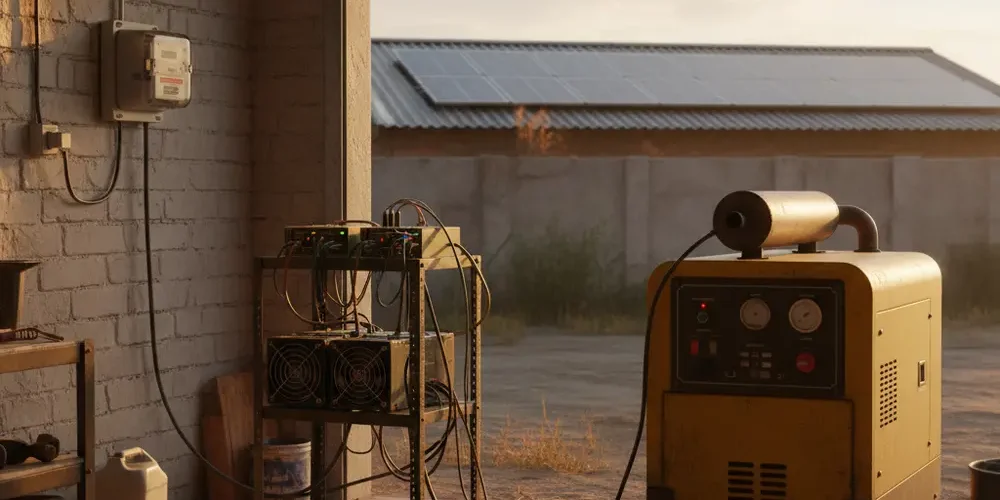
For crypto mining, your real profitability is often decided by one number, your all-in cost per kWh at the miner. In South Africa, that number can swing wildly depending on Eskom tariff structure, solar design choices, and diesel generator realities.
In this post you will learn a simple, repeatable way to calculate a fair apples-to-apples R/kWh for Eskom vs solar vs generator power. By the end you should be able to build a basic worksheet, stress-test it with a few sensitivities, and pick a power strategy that matches your uptime goals.
Note for South Africa:
- Eskom direct supply and municipal supply tariffs differ, and fixed charges can change your blended R/kWh a lot.
- Load shedding, theft risk, and security costs can materially change the real cost of generators and batteries.
- Fuel prices are adjusted monthly in South Africa, so generator costs need regular updates.
At a glance:
- Compute a blended Eskom R/kWh by adding fixed charges and demand or capacity charges, then dividing by your monthly kWh.
- For solar, separate LCOE-like cost from the effective cost for the share of your mining load the system can actually cover.
- For generators, use litres per kWh at your real load factor, then add servicing, wear, and downtime costs.
- Run three scenarios, 24/7 mining, daytime-only mining, and load-shedding-only backup, then compare outcomes.
Key takeaways:
- Headline c/kWh is rarely your true mining cost, fixed charges and losses matter.
- Solar can look cheap on paper but expensive for 24/7 mining if batteries are undersized or replaced often.
- Generators are simple to model but harsh on margins when diesel rises or load factor is poor.
What cost per kWh really means for mining, and why it is easy to get wrong
When miners talk about cost per kWh, they usually mean the number that should go into a profitability calculator. For decision-making, you want the cost per kWh delivered to your miners, not just the tariff energy rate on a bill.
The most common mistake is mixing levels, for example comparing Eskom energy charge to solar LCOE, or comparing generator fuel-only cost to Eskom all-in cost. You need one consistent boundary, from power source to miner input.
Use this definition in your worksheet: All-in R/kWh at the miner = (all monthly costs attributable to energy) divided by (kWh actually consumed by miners).
Common mistakes
- Using only the energy c/kWh line and ignoring service, network, or capacity charges.
- Ignoring time-of-use and assuming your mining load sits in the cheapest period.
- Assuming solar covers 100% of a 24/7 load without modelling night-time energy.
- Using a generator brochure fuel number instead of litres per kWh at your actual load factor.
- Forgetting conversion losses, inverter losses, and PSU efficiency, which change kWh at the miner.
If you are new
- Start by measuring a stable mining load in kW, even if it is just one rig.
- Build the model for one month first, then extend to annual totals.
- Track uptime separately from cost, a cheaper kWh is useless if your rigs are down.
- Keep inputs editable, you will update tariffs, diesel, and assumptions often.
If you have done this before
- Re-check your boundary, make sure all options include losses to the miner.
- Add a fixed charge allocation method so you can compare low-usage and high-usage months.
- Split solar into direct PV hours and battery hours, and model battery replacement explicitly.
- Run a sensitivity on diesel price and Eskom increases, do not rely on one-point estimates.
Eskom grid power for miners, tariffs, time-of-use, and the impact of fixed charges
Eskom pricing is not only about the per-kWh energy rate. Many customers pay a mix of energy charges and fixed charges, and some tariffs include demand or capacity-related charges.
Eskom has also highlighted tariff structure changes and time-of-use updates in recent years, which is a reminder that you should model what you actually pay, not what you remember from a previous bill. For context on the structural changes and effective dates, see Eskom communications on FY2026 implementation and distribution tariff updates.
Two practical points for miners, first, fixed charges punish low utilisation. Second, time-of-use can reward flexible mining, but only if you can safely shift load without causing hardware stress.
| Option | Best fit | What breaks the model | What to measure |
|---|---|---|---|
| Eskom only | 24/7 mining where uptime is critical | High fixed charges, peak TOU exposure | Monthly bill breakdown and kWh by period |
| Solar plus Eskom | Daytime mining or peak shaving | Overbuilding PV, curtailment, cheap batteries replaced early | PV yield, self-consumption rate, battery cycles |
| Generator backup | Load shedding resilience, short runtime | High runtime, poor load factor, diesel spikes | Litres per hour at your load, service costs |
How to estimate an all-in blended Eskom R/kWh for your actual mining load profile
Start with your mining load and hours, then map it to your Eskom periods. If you cannot get half-hourly data, a reasonable approach is to approximate with your operating schedule, for example 24/7, nights only, or off-peak only.
- Measure your mining load in kW. Use a meter, a smart plug, or a sub-meter, do not rely on nameplate ratings.
- Calculate monthly kWh. kWh per month = kW x hours per month.
- Collect your bill lines. Separate energy charges, fixed monthly charges, and any demand or capacity charges.
- Allocate fixed charges. If the site has other loads, decide how much of the fixed charges the mining activity should carry, then be consistent.
- Compute blended cost. (Energy charges + allocated fixed charges + demand or capacity charges) divided by mining kWh.
For time-of-use, repeat the calculation by period if you can, then blend them. If your municipality uses inclining block tariffs, your marginal kWh might cost more than your average, so model both.
Useful primary references when you are checking whether TOU periods or charge structures changed are Eskom tariff announcements and Eskom Distribution tariff update pages. Use them as a structural guide, then use your bill for the numbers.
Internal next step, if you are not sure how to read your bill or you want help building a metering plan, use our contact form and include a photo of your tariff page and your mining load.
Solar PV for mining, capital cost, LCOE, curtailment, and battery trade-offs
Solar PV is attractive because the sun does not send a bill, but your system does. Your real cost per kWh comes from capex, financing, maintenance, degradation, losses, and the share of the PV energy you can actually use for mining.
Solar comparisons often misuse LCOE. LCOE is a helpful concept, but utility-scale benchmarks are not the same as a rooftop hybrid system running sensitive electronics and possibly batteries.
If you want a clean definition and why people use it, the IRENA methodology and reporting around renewable generation costs is a useful reference point. Use it for concepts, not for a direct South Africa rooftop mining number.
Step-by-step: build a simple mining energy cost worksheet
This is a practical way to compare Eskom vs solar vs generator without pretending one number fits every site. Build it in a spreadsheet and keep every input as a cell you can change.
- Define your mining load. Enter kW at the wall and target hours per month for three scenarios, 24/7, daytime-only, and load-shedding-only backup.
- Calculate kWh. kWh = kW x hours, do this per scenario.
- Eskom module. Enter energy charges by period if applicable, then add fixed charges and any demand or capacity charges, compute blended R/kWh.
- Solar module, capex. Enter PV, inverter, wiring, protection, installation, and compliance costs you will actually pay.
- Solar module, yield. Enter expected annual kWh at your site, then apply degradation assumptions and an availability factor.
- Battery module, optional. Enter usable kWh, expected round-trip efficiency, expected cycle life under your profile, and a replacement timeline, then allocate a monthly replacement fund.
- Effective solar cost. Compute an LCOE-like R/kWh for PV energy produced, then compute an effective R/kWh for the kWh that actually serve mining load after losses and curtailment.
- Generator module. Enter diesel price per litre, litres per kWh at your load factor, service cost per hour, and a replacement fund.
- Sensitivity table. Change diesel price, Eskom blended R/kWh, and battery replacement cost, and watch your break-even move.
If you want hardware options for metering, surge protection, or mining power distribution upgrades, start at our shop and shortlist what fits your load.
When solar looks cheap on paper but expensive in practice for 24/7 mining
Solar is at its best when your load lines up with the sun. Mining is often 24/7, which means you either accept downtime at night or you pay for storage or grid supply.
In practice, solar gets expensive for 24/7 mining when you overbuild panels, underbuild batteries, or cycle batteries harder than the warranty profile. Your model should treat batteries as a consumable asset in high-cycling use, not a once-off purchase.
- Curtailment risk: if PV produces when miners are off, or when batteries are full, that kWh does not help your cost at the miner.
- Round-trip losses: battery charging and discharging wastes energy, so the kWh delivered is less than the kWh generated.
- Replacement timing: a cheap battery that fails early can double your effective R/kWh.
- Compliance and grid rules: registration and metering requirements can add time and cost, especially across different municipalities.
For external context on LCOE benchmarks and the role of methodology, see reporting on IRENA renewable generation cost data and the underlying report hosting. Treat those numbers as context only, then use your own capex and yield for your site.
Internal next step, if you have an inverter already and you are unsure whether it is worth repairing or upgrading for a mining load, see professional inverter repairs.
Generator power for mining, diesel price risk, maintenance, and derating
Generators are the fastest way to buy uptime during load shedding. They are also one of the easiest ways to destroy mining margins if you run them too often or at the wrong load factor.
For South Africa, you should treat diesel price as a monthly-updated input, not a fixed assumption. A good habit is to record the price you used, the date, and your local zone or supplier terms.
Beyond fuel, you must account for servicing, filters, oil, call-out fees, and the reality that constant high duty cycle operation shortens lifespan. Also plan for derating due to altitude, temperature, and ventilation constraints, which can force you to run fewer miners than you expected.
A practical diesel generator R/kWh method using litres per kWh plus servicing and runtime assumptions
This method keeps you honest because it separates what you can measure from what you are guessing. If you cannot measure litres per kWh yet, start with a rule-of-thumb, then replace it with real data within the first week.
- Pick your load factor. Decide what fraction of generator rated output you will run, and keep it stable for the test.
- Measure fuel use. Run a timed test, record litres consumed, and record kWh delivered if you have a meter.
- Convert to litres per kWh. litres per kWh = litres consumed divided by kWh delivered.
- Fuel-only cost. Fuel R/kWh = diesel R/litre x litres per kWh.
- Add servicing per kWh. Convert service costs to R per running hour, then divide by kWh per hour at your mining load.
- Add a replacement fund. Allocate a monthly amount based on expected generator lifespan hours and replacement cost.
- Add logistics and security. Fuel delivery, storage, theft risk controls, and noise mitigation can be real line items.
For an official reference point on monthly fuel price adjustments, use the government statement on fuel price changes effective 4 February 2026, then plug your current retail or wholesale price into your sheet. For a practical explanation of why load factor and sizing matter to consumption, a local sizing guide can help you understand why small overloads or light loading distort litres per kWh.
If you are sourcing mining gear that will be sensitive to power quality, or you want to standardise on reliable PSUs and cabling, browse Bitcoin ASIC miners and plan power properly before you buy.
Non-price factors that change ROI, uptime, and hardware lifespan
Mining is not only an electricity price game. Power quality, uptime, and thermal stability all affect hashrate, error rates, and hardware lifespan, and those effects show up as money.
When you compare options, include a line in your worksheet for uptime impact. A slightly higher R/kWh with higher uptime can beat a cheap kWh that causes resets, pool disconnects, or thermal throttling.
- Restart behaviour: frequent hard power cuts can stress PSUs and controllers, and can create long recovery windows.
- Voltage and frequency stability: some generator sets drift under step loads, miners do not like it.
- Cooling continuity: fans and extraction stopping during outages can create heat soak and shorten component life.
- Noise and security: generators need theft mitigation and can cause neighbour issues, which can force reduced runtime.
- Insurance and compliance: insurers may require certificates, safe fuel storage, and approved electrical work.
For larger operations, also consider whether emissions-related reporting or taxes might be relevant over time. If you want a starting point for what carbon tax is and where to verify the latest rules, use the SARS carbon tax guidance and then confirm applicability for your specific capacity and use case with a qualified professional.
If you need help planning airflow, ducting, or a safer power distribution layout for a mining room, use our professional services to scope the job.
On the BTC side, the Avalon Q 90T is the unit that most efficiently pairs with hybrid solar in SA conditions, with the Bitmain Antminer S21 Pro 245TH taking the workhorse slot on Eskom-blended tariffs.
Decision summary, scenarios, and what to measure before you switch your power source
You will get better decisions if you stop asking which option is cheapest, and start asking which option is cheapest for your scenario. Most South African miners end up with a hybrid, grid when available, solar where it fits the load, and generator for resilience.
Scenario 1: 24/7 mining
- Start with Eskom blended R/kWh, including fixed charges, then see what fraction solar can displace without batteries.
- If you need 24/7 uptime, treat batteries and generator runtime as explicit costs, not hidden extras.
- Only use generator for short windows unless your spreadsheet still works at high diesel prices.
Scenario 2: Daytime-only mining
- Solar can be very competitive if your miners run mostly during PV hours and you avoid deep battery cycling.
- Watch for curtailment, if PV is oversized relative to your mining load, your effective cost rises.
- Confirm that your mining strategy and pool settings tolerate scheduled downtime.
Scenario 3: Load-shedding-only backup
- Generators often win on capex for backup, but only if runtime stays limited.
- A small battery can cover short cuts and reduce generator start cycles, which can reduce maintenance.
- Measure your real monthly outage hours, then model generator fuel and service cost for that runtime.
What to measure before you change anything
- kW at the wall for miners, plus any cooling and networking loads.
- Monthly kWh and a copy of your bill lines, including fixed charges.
- Outage frequency and duration, including how often you see short interruptions.
- For generators, litres per hour at your chosen mining load, not at idle and not at full rated output.
- For solar, expected yield and realistic self-consumption rate for your mining schedule.
If you want to sell older rigs, redundant UPS units, or spare GPUs to fund an efficiency upgrade, see sell your items.
For higher-density operators where the kWh maths really compounds, the Bitmain Antminer S21 XP Hydro 473T shifts the cost-per-TH curve on three-phase builds.
Frequently asked questions
Is Eskom always cheaper than a generator for mining?
Not always, but for sustained runtime it often is once you include fuel, servicing, and replacement wear on the generator. The only safe answer is to compute your generator R/kWh using measured litres per kWh and your current diesel price.
Can solar run ASIC miners directly without batteries?
Yes, if your inverter and protections are correctly sized and you accept that mining will follow available PV, unless the grid covers the gaps. The key is to model the share of miner kWh that solar can actually supply, and to include conversion losses.
Should I compare solar LCOE to my Eskom tariff c/kWh?
Use LCOE as a concept, but be careful with direct comparisons. Your bill may include fixed charges, and your solar system may not cover night-time mining without batteries, so compare effective cost per delivered kWh for the same operating schedule.
How do fixed charges change my cost per kWh?
Fixed charges get spread across your kWh, so if you mine fewer hours or use fewer kWh, your blended R/kWh rises. This is why part-time mining can look expensive on a blended basis, even if the energy rate is not high.
Do I need to worry about carbon tax if I run a diesel generator?
For small backup use it may not be relevant, but larger and more continuous combustion use can raise compliance questions. Use SARS guidance as a starting point, then verify thresholds and obligations for your specific operation with a qualified advisor.
Short summary
- Use one consistent boundary, all-in monthly cost divided by miner kWh delivered.
- Eskom needs a blended model that includes fixed charges and any TOU periods.
- Solar needs an effective cost model that accounts for coverage share, losses, and battery replacement.
- Generators need litres per kWh at your load factor plus servicing and replacement funds.
- Run sensitivities, diesel price, Eskom increases, and battery replacement timing.
This is educational content, not financial advice.

