
Hydro and Immersion Cooling for Bitcoin Miners in SA
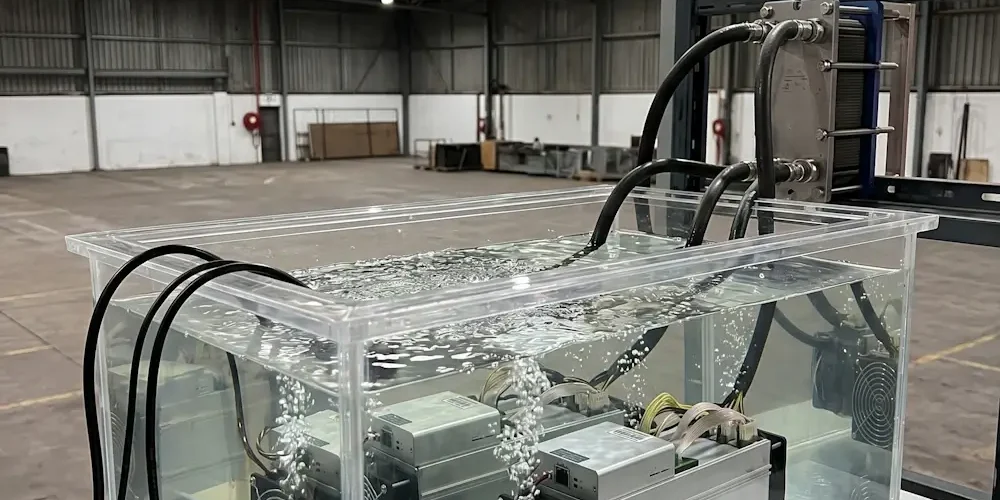
Hydro and immersion cooling get talked about like they’re the answer to every mining problem. They’re not. We see this in our Bedfordview office regularly: customers chasing a 25 percent efficiency gain who haven’t done the maintenance maths. They solve specific problems, badly suit others, and add a maintenance overhead that doesn’t show up in the YouTube videos.
This guide is the SA reality. We’ll walk through what each cooling method actually does, where the efficiency gains come from, what a 5-rig setup costs to build, and the maintenance reality that gets glossed over. By the end you’ll know whether liquid cooling fits your operation or whether better air-cooled ducting solves the same problem at 5 percent of the capex.
Note for South Africa:
- Hydro and immersion setups need three-phase power for the heat exchanger pumps. Not a single-phase home install.
- Coolant costs in SA are 20 to 40 percent higher than US prices because of import freight.
- Most SA dielectric fluid suppliers are concentrated in Gauteng. Plan logistics for Cape Town or Durban setups.
At a glance:
- Hydro miners use a sealed water-to-coolant loop. Immersion submerges the entire miner in dielectric fluid.
- Hydro: 12 to 18 percent efficiency gain. Immersion: 25 to 35 percent.
- 5-rig immersion capex: R280 000 to R420 000 excluding the miners themselves.
- Pays off above 8 to 10 miners or in noise-sensitive locations. Rarely worth it for 1 to 4 units.
Key takeaways:
- Don’t immersion-cool because it’s cool. Do it because the maths works for your scale.
- Maintenance reality includes coolant top-ups, seal inspections, and sediment cleaning every 12 to 18 months.
- Hydro is easier to retrofit. Immersion needs a new tank and full rebuild.
What hydro and immersion cooling actually do
Both methods replace fan-driven air cooling with a liquid that can absorb and transfer heat much more efficiently. The difference is in how.
Hydro cooling
The miner has built-in coolant channels through the hashboards. Water (or a glycol mix) flows through these channels, picks up heat, and exits to a heat exchanger that dumps the heat outside via a radiator or evaporator. The miner stays sealed and dry. The Bitmain S21 Hydro spec page shows the integrated cooling block.
Immersion cooling
The entire miner is submerged in a non-conductive dielectric fluid. The fluid absorbs heat directly from the silicon and PCB. A pump moves the warm fluid through an external heat exchanger and back. The fans inside the miner can usually be removed entirely.
Both reduce the chip operating temperature, which lifts achievable hashrate and extends silicon lifespan. The mechanism is the same physical principle: water or oil moves heat 23 to 25 times more efficiently than air per unit volume. The Sell Your PC crypto mining hub covers the broader SA mining context.
Where the efficiency gains come from
Three places. Lower chip temps allow factory or overclocked profiles to run stable. The miner runs at higher hashrate without thermal throttling. And the auxiliary fan power (200 to 400W per unit on air-cooled) drops to nearly zero on immersion.
| Method | Hashrate uplift | Aux fan saving | Net efficiency gain |
|---|---|---|---|
| Air-cooled (baseline) | 0% | 0 W | 0% |
| Hydro (Bitmain S21 Hyd) | 10-15% | 200-300 W | 12-18% |
| Immersion (full submersion) | 15-25% | 300-400 W | 25-35% |
Cross-reference current hydro miner specs on AsicMinerValue’s hydro miner index. For SA buyers comparing units in this tier, the Bitdeer SealMiner A2 Pro Hydro 500TH sits alongside the Bitmain S21 hydro range on most SA build sheets we quote. For the underlying chip thermal logic, see fan curves and chip temps.
The current SA stock leader for hydro-cooled Bitcoin mining is the Bitmain Antminer S21 XP Hydro 473T, which gives you the efficiency lift without the home-fabricated tank route some operators try first.
Capex breakdown for a 5-rig immersion setup
A real 5-rig immersion install in SA in 2026, excluding the miners themselves:
| Item | Notes | Cost (ZAR) |
|---|---|---|
| Immersion tank (5-rig) | Steel and acrylic, locally fabricated | R85 000 |
| Dielectric fluid (200 litres) | 3M Novec or equivalent mineral oil | R65 000 to R140 000 |
| Heat exchanger plus pumps | Plate heat exchanger, redundant pumps | R45 000 |
| Three-phase power install | 40A breaker, dedicated DB sub-board | R28 000 |
| Coolant manifold and piping | Stainless flexible, 25mm bore | R18 000 |
| Filtration and monitoring | Inline filters, flow meters, temp sensors | R22 000 |
| Civil and bunding | Containment trays, drip pans | R15 000 |
| Total (excluding miners) | R278 000 to R353 000 |
Capex verified April 2026 against current SA fabrication and import costs.
Mineral oil is the cheapest fluid option. Engineered fluids like 3M Novec are far more efficient and don’t degrade as fast. See the 3M Novec dielectric coolant info for thermal performance specs. The trade-off is roughly 2x the upfront fluid cost. For dedicated facilities the engineered fluid pays back through reduced maintenance and better thermal stability.
For SA stock and imported hydro units pre-tested in our office, browse our hydro and immersion miner stock. Cross-check live BTC revenue per TH/s on WhatToMine’s BTC SHA-256 calculator when modelling the immersion uplift against your current air-cooled baseline.
Operating costs and maintenance reality
This is where the YouTube videos go quiet. Liquid cooling has real ongoing costs:
- Fluid top-up every 6 to 12 months. Mineral oil evaporates slightly. Engineered fluids less so.
- Pump maintenance every 18 to 24 months. Bearings degrade in continuous duty.
- Filter replacement every 3 to 6 months. Sediment from PCB residues accumulates.
- Seal inspection annually. Tank gaskets fatigue from thermal cycling.
- Heat exchanger cleaning yearly. Mineral deposits in the water side, dust on the fin side.
- Power use for pumps adds 100 to 250W per tank, even when miners are off.
For three-phase power and Eskom commercial tariff context, cross-check Eskom’s three-phase tariff guidance. A Coindesk article on immersion mining at scale documented the operational reality at large facilities, where staff costs for fluid management alone run to roughly R0.06 per kWh of mining output.
Noise reduction compared to air-cooled
This is where immersion shines, especially for SA mining at home. Submerging an S21+ in oil drops noise from 78 dB to 42 dB. That’s the difference between a vacuum cleaner and a dishwasher.
Hydro is quieter than standard air-cooled but not by as much. The integrated cooling reduces fan RPM, dropping noise from 78 dB to 65 dB. Still louder than a quiet office.
Noise alone doesn’t justify the capex unless your situation is unusual (residential complex, neighbour complaints, indoor city setup). For most home miners, acoustic ducting plus a properly designed mining room handles noise for 5 percent of the immersion capex. See mining room ventilation layouts.
For SA operators who have already committed to a three-phase build and want maximum hashrate density per tank, the Bitmain Antminer S21e XP U3 Hydro 860T is the unit currently doing the heaviest lifting on the highest-end immersion setups we ship into Gauteng.
When immersion does not pay off
Five scenarios where immersion is the wrong answer:
- You have 1 to 4 miners. The capex doesn’t amortise.
- You’re on single-phase residential power. The pumps need three-phase.
- Your tariff is over R3.50 per kWh. The efficiency gain doesn’t recover the capex within useful life.
- You’re planning to upgrade to next-gen miners within 18 months. Pulling units out of fluid for sale is messy.
- You have humidity or dust constraints that make sealing difficult.
For most SA home miners, fan curve tuning plus through-flow ducting beats the immersion route. J/TH efficiency basics covers the per-unit thermal logic.
Common mistakes
- Underestimating coolant volume. A 5-rig tank needs 180 to 220 litres, not 100.
- Skipping bunding. Mineral oil leaks are an environmental issue.
- Forgetting redundant pumps. One pump failure shuts down five miners. The cost of 1 percent downtime applies double here.
- Mixing fluid types. Switching from mineral oil to engineered fluid mid-life destabilises the system.
- Sealing immersion tanks too tightly. Trapped air pockets cause hotspots.
- Ignoring filtration. Solder residues from new boards clog flow paths within 60 days.
If you are new to liquid cooling
- Start with hydro before immersion. Easier to retrofit, simpler maintenance.
- Don’t DIY a tank from a fish-pond liner. Industrial fabricators charge R30 000 to R40 000 and the result is reliable.
- Plan for 18 percent additional capex contingency. Tank issues, plumbing rework, sensor calibration.
- Run dual monitoring on chip temp and fluid temp from day one.
- Budget pump replacement parts upfront. Spare bearings and seals are slow imports if the pump fails.
If you already run air-cooled rigs
- Calculate the noise constraint specifically. If noise is the binding issue, consider acoustic ducting before immersion.
- Run a single-rig immersion test for 90 days before committing to a 5-rig setup. The maintenance learning curve is real.
- Plan the 18 to 24 month upgrade path. Are next-gen miners going to be immersion-compatible.
- Insurance changes. Some home insurers won’t cover oil-tank installations. Get this in writing.
- Considering a hydro purchase or a custom immersion build? Just contact our team for a bench-tested unit and a sanity check on the install.
Frequently asked questions
Can I run an immersion mining setup in a residential garage in SA?
Technically yes, but most homes lack the three-phase power needed for the heat exchanger pumps and don’t have the space for a properly bunded tank. A 5-rig immersion setup occupies roughly 2 metres by 1.5 metres of floor space and weighs 600 to 800 kg with fluid. Heat dissipation needs an outdoor heat exchanger or a glycol loop to a wet wall outlet. For most home miners, retrofitting an existing single-phase garage with three-phase power costs R28 000 to R55 000 alone. The capex usually only makes sense for dedicated mining outbuildings.
What’s the difference between mineral oil and engineered dielectric fluids?
Mineral oil is cheap (R150 to R350 per litre in SA) but evaporates over time, degrades silicon at the seals on long-term contact, and has lower thermal conductivity. Engineered fluids like 3M Novec or Solvay Galden are 4 to 8 times more expensive but don’t evaporate, don’t degrade rubber seals, and transfer heat more efficiently. For commercial farms running 50-plus miners, engineered fluids pay back through reduced maintenance. For 5-rig home setups, mineral oil is usually fine if you accept the maintenance overhead. Don’t mix the two.
Does immersion cooling void the manufacturer warranty?
Yes, almost universally for Bitmain and IceRiver units unless you buy the dedicated immersion variant from the manufacturer. Submerging a standard S21+ voids its warranty immediately. The S21 Hyd, conversely, ships with the cooling block integrated and carries a manufacturer warranty for that use case. If warranty matters, buy the hydro variant rather than retrofitting an air-cooled unit. Resale value also drops significantly on immersion-modified units in the secondary market.
How much faster is the payback on immersion vs air-cooled at SA tariffs?
Roughly 22 to 28 percent faster on a 5-rig setup at R1.50 per kWh hybrid solar, accounting for the immersion capex. The efficiency gain is real, but the maintenance overhead and three-phase power install eat about 40 percent of the gain. Below 5 miners the payback is slower than air-cooled because of fixed costs. Above 10 miners the payback gap widens to 35 to 45 percent. The break-even is around 6 to 8 miners for most SA scenarios. Run your own numbers with realistic maintenance costs included.
What’s the lifespan of an immersion-cooled ASIC vs an air-cooled one?
Immersion-cooled silicon typically lasts 25 to 40 percent longer because chip operating temperatures stay 30 to 50 degrees lower. Hashboard solder joints fatigue less from thermal cycling. PCB substrates degrade slower. In practical terms, an air-cooled S19 Pro shows reliability issues by year 3 to 4. An immersion-cooled equivalent often runs cleanly through year 5 to 6. The flip side is that the rest of the system (pumps, seals, fluid) needs maintenance that doesn’t apply to air-cooled. Net useful life is typically 18 to 30 percent longer overall.
Summary
- Hydro is easier and cheaper to retrofit. Immersion needs a full rebuild and three-phase power.
- Efficiency gain is real (12-35 percent) but maintenance costs eat 30-40 percent of the benefit.
- Capex on a 5-rig immersion setup runs R280 000 to R420 000 excluding miners.
- Below 5 miners, immersion rarely pays off. Above 10, the maths gets compelling.
- Noise reduction is the strongest non-financial reason to immersion-cool.
This is educational content, not financial advice.

