
Litecoin and Dogecoin Merge Mining in SA
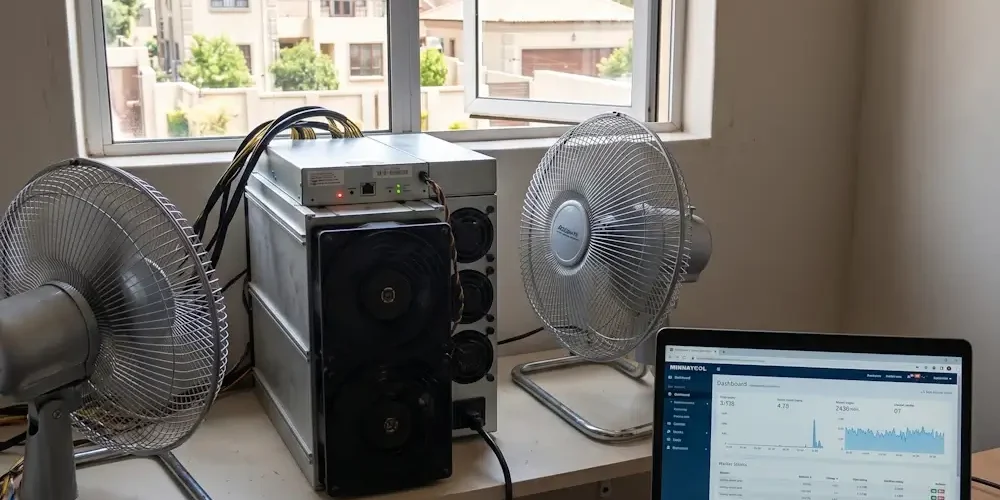
Merge-mining Litecoin and Dogecoin has been one of the more interesting plays through the 2024 to 2026 cycle for SA miners. You hash once on the Scrypt algorithm and earn both LTC and DOGE at the same time, which is structurally different from Bitcoin’s single-coin economics.
This guide covers what merge mining actually means, the L7 vs L9 trade-off, SA-specific power and noise considerations, and the pools that pay out both coins cleanly. By the end you’ll know whether Scrypt mining fits your tariff and whether a used L7 or a new L9 makes more sense.
Note for South Africa:
- Scrypt ASICs are louder than BTC miners. The L7 hits 80 to 85 dB at one metre.
- Heat output per unit is similar to a BTC miner. Don’t underestimate cooling needs in Joburg summer.
- LTC is more liquid in ZAR than DOGE on local exchanges. Plan your conversion path.
At a glance:
- Merge mining means earning LTC and DOGE simultaneously from one Scrypt unit.
- The Antminer L7 and L9 are the two units worth considering in 2026.
- L7 used pricing has come down materially. Browse current stock on our Litecoin and Dogecoin ASIC stock.
- Pure Eskom is loss-making. Hybrid solar is marginal. Off-grid solar makes the maths work.
Key takeaways:
- Merge mining doesn’t double your work, it doubles your reward streams from the same hashrate.
- L7 wins on rand-per-MH at SA used prices. L9 wins on long-term efficiency.
- Pool selection matters because not all pools pay out DOGE alongside LTC.
What merge mining means in plain English
Both Litecoin and Dogecoin use the Scrypt proof-of-work algorithm. Dogecoin allows merge-mining with Litecoin, meaning the same hash submitted to the Litecoin network can also satisfy a Dogecoin block. Miners receive both LTC and DOGE rewards proportional to their hashrate, with no additional electricity cost.
The mechanism is well-documented in the Litecoin Foundation overview. See the Litecoin Foundation’s mining overview for the protocol-level explanation. Our deeper SA take lives in merged mining explained in detail.
Practical impact: a Scrypt miner earning, say, R85 a day from LTC also earns R25 to R35 from DOGE on the same hashrate. The DOGE side has higher price volatility, but the dual-stream structure smooths total revenue versus a single-coin BTC setup. The Sell Your PC crypto mining hub covers the broader SA mining picture.
The Scrypt ASIC lineup for 2026
Three units dominate the SA Scrypt market in 2026. The L7 is still the workhorse despite its 2022 release. The L9 is the current flagship. The older L3+ is only worth it as a hobby setup at very low tariffs.
| Model | Hashrate | Power | Efficiency | Notes |
|---|---|---|---|---|
| Antminer L3+ (2018) | 504 MH/s | 800 W | 1.59 J/MH | Hobby tier, used market only |
| Antminer L7 9.5 GH/s (2022) | 9 500 MH/s | 3 425 W | 0.36 J/MH | Current SA workhorse, used pricing |
| Antminer L9 16 GH/s (2024) | 16 000 MH/s | 3 360 W | 0.21 J/MH | Premium efficiency, higher capex |
Pricing on these models shifts with availability and the broader Scrypt market. Browse live stock and pricing on our Litecoin and Dogecoin ASIC stock. Cross-reference global pricing on AsicMinerValue’s Scrypt miner index. Pricing verified April 2026.
You can verify L7 specs on the Antminer L7 spec page. For the underlying efficiency principles, see J/TH efficiency basics (the same logic applies to J/MH on Scrypt).
L7 vs L9: which to pick at what budget
The L7 wins on capex and rand-per-MH. The L9 wins on efficiency and longer profitable life.
| Buyer profile | Pick | Rationale |
|---|---|---|
| Tariff over R3.00, capex tight | L7 used | Lower capex risk, but expect modest payback |
| Hybrid solar at R1.50, R150k+ free | L9 new | Efficiency wins long-term |
| Multiple miners across one site | Mix of L7s | Lower per-unit risk, better resale liquidity |
| Hosted facility at fixed R2.20 | L9 new | Capex per MH justified at scale |
The L9 holds its hashrate floor better as Scrypt difficulty climbs. The L7 has been profitable on hybrid solar in SA since 2022 but its margin has narrowed every quarter as difficulty has compounded. The next Litecoin halving in roughly 2027 compresses revenue further. Plan for that.
For SA miners currently sizing a new Scrypt rig, the Bitmain Antminer L11 20G is the current-generation step up from the L9 and offers a meaningfully better J/MH on a hybrid solar tariff.
Power, heat, and noise reality
Both L7 and L9 pull around 3 400W at the wall on 220V single-phase. Heat output is roughly 11 500 BTU/hr per unit. Noise is the variable that catches new buyers off-guard.
- L7 measures 80 to 85 dB at one metre on phone meters. Louder than an S21+.
- L9 is slightly quieter, 78 to 82 dB.
- The Scrypt fans run at higher RPM than BTC miners, hence the higher pitch.
For practical noise reduction without overheating the chips, see noise reduction without cooking the miner. Don’t seal a miner room. Use through-flow ducting and an inlet baffle instead.
Pools that pay out LTC plus DOGE
Not every pool merge-mines DOGE alongside LTC. Some pay LTC only, which leaves real money on the table. The pools that handle merge-mining cleanly in 2026 include ViaBTC, Litecoinpool.org, F2Pool, and Antpool. Each has slightly different fee and payout structures.
| Pool | Fee structure | DOGE payout | Notes |
|---|---|---|---|
| Litecoinpool.org | 0% PPS | Yes (separate) | Veteran pool, simple interface |
| ViaBTC | 2% PPS+ | Yes (combined) | Smooth variance, good dashboard |
| F2Pool | 2% PPS | Yes (separate) | Reliable, China-based |
| Antpool | 2.5% PPS | Yes (combined) | Bitmain-affiliated, decent uptime |
For a deeper take on pool selection logic, see how pool variance affects payouts. Scrypt pools have less variance than KAS pools because the Litecoin network is bigger, but PPS is still preferable to PPLNS for first-time miners.
Profitability across three power scenarios
Run an L7 9.5 GH/s at three SA scenarios. Assumptions: LTC at R1 800, DOGE at R1.40, current Scrypt difficulty per WhatToMine’s Litecoin calculator, 2 percent pool fee, 97 percent uptime, R45 000 representative capex on a used L7.
| Power scenario | Effective tariff | Daily power | LTC+DOGE revenue | Monthly net | Payback |
|---|---|---|---|---|---|
| Pure Eskom residential | R2.80/kWh | R230 | R110 | -R3 600 | Loss-making |
| Hybrid solar | R1.50/kWh blended | R123 | R110 | -R390 | Marginal loss |
| Full off-grid solar | R0.80/kWh amortised | R66 | R110 | R1 320 | ~2.8 years* |
*Excludes solar capex. Pricing and payback maths verified April 2026 against current Scrypt difficulty and LTC/DOGE prices.
The dual-coin payout helps but doesn’t rescue the maths on Eskom. A MyBroadband piece on Dogecoin tracked some of these dynamics through 2024.
Common mistakes
- Choosing a pool that doesn’t merge-mine DOGE. You’re leaving 25 to 30 percent of revenue on the table.
- Underestimating noise. The L7 will be heard through a brick wall.
- Skipping the difficulty trend check. Scrypt difficulty has compounded fast in 2024 to 2026.
- Buying an L3+ for hobby reasons. The W/MH is awful and the maths rarely works.
- Auto-converting all DOGE to ZAR immediately. The optionality of holding has historical value, but treat it as a separate decision.
- Modelling power costs in cents per kWh instead of rands per kWh.
If you are new to Scrypt
- Start with one L7 used, not a multi-rig L9 setup.
- Use a PPS pool for your first month. Less variance, easier to learn.
- Hold a portion of your LTC and DOGE rather than full conversion.
- Track LTC and DOGE separately on your dashboard.
- Test your room cooling before the miner arrives. Scrypt gets hot fast.
If you already run BTC ASICs
- L7s and L9s on the same site as S21+ units need separate breakers. Don’t share circuits.
- Don’t reuse your S21+ PSU on an L7. Different connector standards in some revisions.
- Add a separate worker name in your dashboard to track Scrypt vs SHA-256 separately.
- The dual-coin payout reduces variance in your monthly P&L significantly. Useful for cashflow planning.
- Need a bench test on a used L7 before buying or selling? Just contact our team.
Frequently asked questions
Is merge-mining LTC and DOGE actually free extra revenue?
Effectively yes. The same Scrypt hashrate satisfies both networks simultaneously, with no additional electricity or hardware cost. The pool just submits the hash to both Litecoin and Dogecoin chains. You earn LTC and DOGE rewards in parallel. Some pools combine the payout into a single feed, others pay them separately. The DOGE portion currently adds 25 to 35 percent on top of LTC revenue depending on price ratios. It’s not free money in a strict sense, but it’s structural extra reward for the same input cost.
Can I mine Litecoin without mining Dogecoin?
Yes, but you’d be giving up DOGE rewards for no reason. Most major LTC pools merge-mine DOGE by default and credit you automatically once you set a DOGE wallet address. There’s no electricity penalty for merge-mining. The only situation where pure LTC makes sense is if you can’t or won’t manage a DOGE wallet, which is a self-imposed limitation. Set up a DOGE wallet on a reputable exchange or hardware wallet, configure the pool, and accept the bonus rewards.
How does Scrypt mining compare to Bitcoin mining for SA conditions?
Scrypt has been more tolerant of higher SA tariffs through 2024 to 2026 because of the dual reward structure. An L7 stays profitable on hybrid solar where a used S19 would be losing money. The capex is lower per coin earned and the payback band is tighter when off-grid. The downsides are higher noise, more aggressive difficulty drift, and lower resale liquidity outside SA. For an existing BTC miner adding diversification, an L7 is the easiest second-coin entry. For a first-time miner with low tariffs, BTC is still the more familiar path.
What’s the resale value of an L7 in SA in 2026?
Working units sit between R20 000 and R32 000 depending on PSU condition and warranty remaining. Below R15 000 if it needs a hashboard replacement. The L7 secondary market is healthier than KAS units but thinner than S19 Pros. Demand has stayed reasonable because the L9 is significantly more expensive new, and many miners want to add Scrypt capacity without committing six figures. Sell within 24 months of purchase to retain the most value, and always include the original PSU.
If you are looking beyond Bitmain for Scrypt diversification, the Fluminer L1 Pro 6G has been a strong performer on hybrid solar setups in Gauteng through 2026.
Will Scrypt mining still be profitable after Litecoin’s next halving?
Probably yes for efficient units like the L9 on off-grid solar, possibly not for older L7s. Litecoin halves roughly every 4 years (next around 2027). LTC block reward drops 50 percent. Historically, LTC price has appreciated through halving cycles, partially offsetting the reward reduction. DOGE has no halving, which provides additional buffer. Plan business cases conservatively at 30 percent revenue reduction post-halving, not zero. If your unit’s payback period crosses the halving date, run that scenario explicitly.
Other Scrypt options worth a look in 2026 include the Volcminer D1 16G, which slots in between the L9 and L11 on price-per-MH and runs cooler than most of the L7-era hardware we still see traded.
Summary
- Merge mining LTC plus DOGE adds 25 to 35 percent revenue to the same Scrypt hashrate.
- L7 used is the SA workhorse. L9 new wins on long-term efficiency.
- Pool selection matters. Choose one that pays out DOGE alongside LTC.
- Pure Eskom is loss-making. Hybrid is marginal. Off-grid solar makes the maths work.
- Plan around the next LTC halving in your business case, not optimistically through it.
This is educational content, not financial advice.

