
Solar-Powered Bitcoin Mining in South Africa
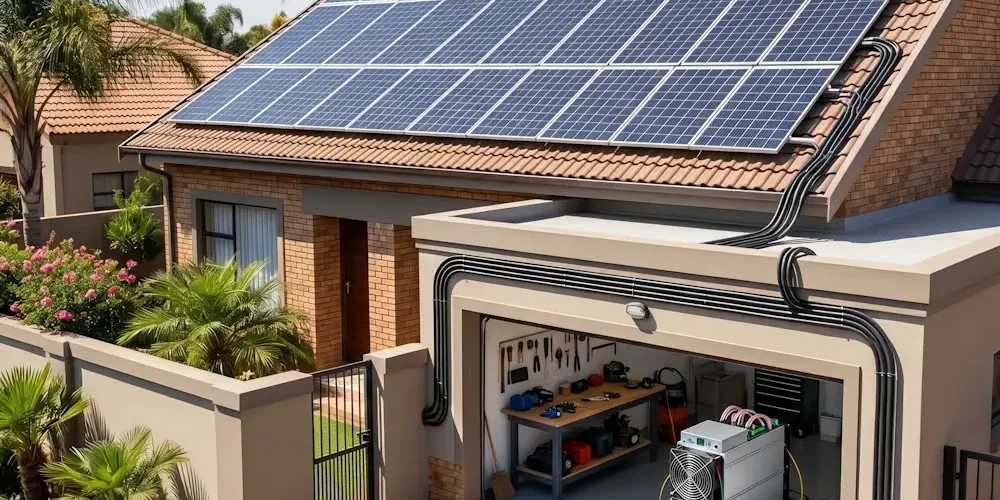
Solar mining looks magical on YouTube. Free electricity, sunny South Africa, no Eskom drama. The reality, which we see weekly at our Bedfordview office, involves array sizing maths, battery depreciation, and a 5-year total cost of ownership that often beats grid-only mining but rarely beats it as dramatically as the influencers suggest.
This guide is the SA reality check. We’ll cover how much solar one S21+ actually needs, why hybrid almost always beats off-grid, how battery sizing really works, and what your 5-year total cost looks like compared to running on Eskom alone. By the end you’ll know whether solar mining fits your site or whether you should put the same money into a hosted slot.
Note for South Africa:
- Solar irradiation in Gauteng averages 5.5 kWh per m2 per day across the year. Cape Town averages 5.2.
- Load shedding stages 2 to 4 cost SA miners an average of 6 to 9 percent uptime in 2025.
- Battery prices in SA have dropped 38 percent since 2023 but installation labour has risen.
At a glance:
- One S21+ (3 880W continuous) needs an 8 to 10 kW peak solar array to power it through daylight hours.
- Full off-grid 24/7 needs roughly 15 kW solar plus 30 kWh of battery.
- Hybrid (solar daytime, grid nighttime) cuts payback by 35 to 50 percent vs full off-grid.
- Realistic blended tariff on a hybrid setup: R1.50 per kWh effective.
Key takeaways:
- Hybrid almost always beats full off-grid on capex per kWh.
- Don’t size solar to peak load. Size for daily energy throughput.
- Battery cycle life is the variable that breaks bad solar mining setups.
Quick reality check before you wire up a panel
Five honest questions to answer before you spend a cent on solar:
- Can your roof or property handle 25 to 60 m2 of panels?
- Can your DB board accept a hybrid inverter and a tied-grid feed?
- Are you in a municipality that allows feed-in or net-metering?
- Do you have R150 000 to R280 000 capex available, or financing on reasonable terms?
- Are you committed to running mining for at least 4 years to amortise the solar capex?
If any answer is no, hybrid solar with battery backup makes more sense than full off-grid mining. The BusinessTech load shedding tracker has decent context on how Eskom outage frequency has shifted through 2024 to 2026. The Sell Your PC crypto mining hub covers the broader SA mining picture.
How much solar one S21+ actually needs
An S21+ pulls 3 880W continuous. To run it 24/7 from solar alone, you need to generate 93 kWh per day. To run it daytime-only (8 hours), you need around 31 kWh per day.
SA solar yield varies by location. Use NREL’s PVWatts calculator with your specific GPS coordinates and panel orientation. The rough rule of thumb for SA at optimal tilt:
| Setup goal | Solar array (peak kW) | Daily yield | Battery (kWh) | Capex range (ZAR) |
|---|---|---|---|---|
| Daytime mining only | 5 kW | 26 kWh | 0 (grid backup) | R85 000 to R125 000 |
| Daytime mining plus battery for evening peaks | 8 kW | 42 kWh | 10 kWh | R155 000 to R215 000 |
| Hybrid (solar day, grid night) | 10 kW | 52 kWh | 15 kWh | R195 000 to R275 000 |
| Full off-grid 24/7 | 15 kW | 78 kWh | 30 kWh | R380 000 to R520 000 |
Capex verified April 2026. Includes installation, hybrid inverter, and balance-of-system costs.
For full SA solar industry context, see SAPVIA’s solar industry overview. For the underlying mining efficiency math that determines how much your solar is actually worth, see J/TH efficiency basics.
If you are sizing capex around solar yield rather than peak hashrate, the Avalon Q 90T is the kind of low-watt-per-TH miner that pairs naturally with hybrid solar arrays in SA conditions.
Hybrid solar plus grid is usually the right answer
Off-grid mining sounds romantic. Mathematically it’s almost always wrong. The fundamental issue is that batteries cost roughly R7 500 per kWh of usable storage in 2026 SA prices. Storing one full S21+ day costs R697 500 in batteries alone.
Hybrid solves this. Mine on solar during the 8 to 10 productive daylight hours. Switch to grid for the rest. Eskom gets used at the cheapest off-peak rate. Solar handles the most expensive midday band.
Practical hybrid setup for one S21+:
- 10 kW solar array. Generates 50 to 55 kWh per good day.
- 5 to 10 kWh battery for late-afternoon and dawn smoothing.
- Hybrid inverter (Sunsynk, Deye, or similar) for 17A continuous.
- Grid-tied with anti-islanding protection.
Blended tariff outcome: roughly R1.50 per kWh, depending on solar yield. That’s a meaningful win over standard residential at R2.80 per kWh, and a huge win over Block 3 at R4.20. Cross-check daily mining revenue at your effective tariff on WhatToMine’s BTC SHA-256 calculator.
Cross-check this against the Eskom vs solar vs generator cost breakdown for the full per-kWh maths. A MyBroadband solar guide tracks the recent price drops in SA panels and inverters through 2024 to 2026.
Battery sizing and depth-of-discharge maths
Battery sizing has three traps that catch DIY solar miners.
Usable vs nameplate capacity
A 10 kWh lithium battery has roughly 8 to 9 kWh usable, depending on depth of discharge (DoD) limits. Lead-acid batteries are worse, with usable capacity at 50 percent of nameplate. Always size on usable kWh.
Cycle life vs daily DoD
Lithium-iron-phosphate (LiFePO4) batteries are rated for 5 000 to 8 000 cycles at 80 percent DoD. Push them harder and lifespan drops. A bank cycled 100 percent daily lasts 1 800 to 2 500 cycles. The difference is 7-plus years vs 4 years of useful life.
Inverter compatibility
Hybrid inverters have specific battery brand and chemistry compatibility. Mixing brands or chemistries voids warranty and often reduces output. Stick to one ecosystem (Sunsynk plus Pylontech, or BlueNova’s full stack, etc.).
| Battery type | Cycles at 80% DoD | SA price per usable kWh | Cost per cycle |
|---|---|---|---|
| Flooded lead-acid | 800-1 200 | R3 500 | R3.50 |
| AGM/Gel | 1 200-1 800 | R5 200 | R3.45 |
| LiFePO4 (LFP) | 5 000-8 000 | R7 500 | R1.10 |
Lithium wins on lifetime cost despite higher upfront. Don’t be tempted by lead-acid for daily-cycled mining loads. The replacement cycle eats your savings.
5-year total cost of ownership
Real numbers. One S21+ over 5 years at three power scenarios. Eskom tariff assumed at R2.80 per kWh average across the period.
| Scenario | Power capex | 5-year power opex | Total 5-year power cost |
|---|---|---|---|
| Pure grid (Eskom) | R0 | R475 720 | R475 720 |
| Hybrid solar (10 kW + 10 kWh) | R195 000 | R254 770 | R449 770 |
| Full off-grid (15 kW + 30 kWh) | R450 000 | R8 000 (maintenance) | R458 000 |
Pricing and maths verified April 2026. Mining revenue at R190/day = R346 750 over 5 years.
On pure Eskom, you pay R475k in power and earn R346k in BTC. Net loss of R129k before capex. Hybrid solar turns the equation positive. Full off-grid is the best per-unit economics but the highest capex commitment.
Where hybrid wins decisively: above 3 miners, where solar capex amortises across more units. At 5-plus miners on a hybrid solar setup, the per-unit power cost drops to roughly R1.20 per kWh blended, and the savings over 5 years exceed Eskom-only by R150 000 plus per miner. Workhorse picks for this scale tend to be the Bitmain Antminer S21 Pro 245TH, where the efficiency-per-TH does the heavy lifting on your blended tariff. Browse mining hardware that fits this approach at our Bitcoin ASIC stock.
Don’t forget uptime. The cost of 1 percent downtime applies whether your power source is solar or grid.
Common mistakes SA solar miners make
- Sizing the array to peak load instead of daily kWh throughput. You need throughput, not peak.
- Underestimating battery cycle wear. Daily 100 percent DoD halves lifespan.
- Going full off-grid when hybrid is cheaper. Don’t romanticise the maths.
- Skipping the inverter heat dissipation. Cheap inverters fail in summer at full mining load.
- Forgetting panel cleaning. Soiling drops yield 5 to 12 percent in dusty SA conditions.
- Mixing battery chemistries on the same bus.
- Using a residential UPS instead of a proper hybrid inverter for mining loads. Professional inverter repairs see the consequences of this regularly.
If you are new to solar
- Start with a hybrid 5 kW system before going bigger.
- Use a SAPVIA-registered installer. Free verification on the SAPVIA website.
- Get the hybrid inverter sized for 1.5x your peak load. Headroom matters.
- Don’t DIY the DB board work. Get a qualified electrician for the certificate of compliance.
- Track daily kWh production for the first 3 months. Recalibrate scaling decisions on real data.
If you already run a solar home
- Add a dedicated DB sub-board for the miners. Keeps mining loads isolated.
- Don’t add the miner to your existing battery bank without recalculating cycle life.
- Consider a separate, dedicated battery bank for mining. Different cycle pattern from house loads.
- If you are looking at higher-density setups where solar plus battery efficiency really matters, hydro-cooled options like the Bitmain Antminer S21 XP Hydro 473T keep thermals and inverter draw more predictable than air-cooled alternatives.
- Cross-check the load profile against Eskom’s tariff schedule to maximise off-peak grid use.
- Plan for 18-month inverter capacity reviews. Mining loads are continuous, which stresses inverters more than typical residential.
- For variance in payouts when uptime is solar-dependent, see how pool variance affects payouts.
Frequently asked questions
Can I mine Bitcoin entirely off-grid in SA?
Yes, but it’s rarely the right answer financially. Full off-grid 24/7 needs about 15 kW of solar plus 30 kWh of battery to run one S21+. That’s R380 000 to R520 000 in capex, which is more than the miner itself costs. Battery cycle life becomes the binding constraint. Hybrid solar plus grid almost always beats full off-grid on lifetime cost. The only real case for full off-grid is in remote locations with no grid access, or for owners with strong philosophical preferences regardless of maths.
How long do solar panels last in South African conditions?
Quality panels (tier-1 manufacturer) last 25 to 30 years with 20 to 25 percent output degradation by year 25. SA conditions are favourable for solar (high irradiation, low extreme cold). The main local degraders are dust accumulation, hail damage, and mounting failures rather than the panels themselves. Inverters typically need replacement at year 8 to 12. Batteries need replacement at year 7 to 10 for lithium, sooner for lead-acid. Plan capex refresh around inverter and battery cycles, not panels.
What’s the cheapest way to start mining with solar in SA?
Add a 5 kW solar array to your existing house with a hybrid inverter, then run one S21+ daytime-only on solar with a grid fallback. Capex: R85 000 to R125 000 plus the miner. The miner runs 8 to 10 hours a day on solar, then can either idle or run on grid the rest of the time. This isn’t fully optimised, but it gets you mining at a blended R1.80 per kWh without committing to a full off-grid build. Scale up as you learn your actual yield and load profile.
Will load shedding still affect my mining if I have solar?
Depends on your setup. Pure grid-tied solar shuts off during Eskom outages because of anti-islanding protection. Hybrid solar with battery backup keeps the miner running through outages, up to your battery capacity. Off-grid setups are immune to load shedding entirely. Most SA solar miners use hybrid setups specifically to ride out Stage 4 to 6 load shedding without dropping uptime. The downside is that battery cycling on outage events accelerates wear. Plan replacement schedules around realistic outage frequency.
Can I sell excess solar power back to the grid in SA?
Depends on your municipality. Cape Town, Joburg metro, and several smaller municipalities have small-scale embedded generator (SSEG) programmes that allow feed-in. Tariff for feed-in is typically 60 to 75 percent of the import tariff, so it’s not a high-margin opportunity. Many municipalities still don’t have working feed-in programmes. The more practical play is to size your solar to consume what you generate, not to feed back. For mining specifically, this means right-sizing the array against the miner’s draw profile.
Summary
- Hybrid solar plus grid almost always beats full off-grid on lifetime cost.
- One S21+ needs 8 to 10 kW peak array for daytime mining, 15 kW for full off-grid.
- Battery cycle life is the variable that breaks bad solar mining setups.
- 5-year total cost: pure grid R475k, hybrid R450k, off-grid R458k per miner.
- Solar wins decisively at 3-plus miners on a properly sized hybrid setup.
This is educational content, not financial advice.

