
Hosted Mining vs Home Mining in South Africa
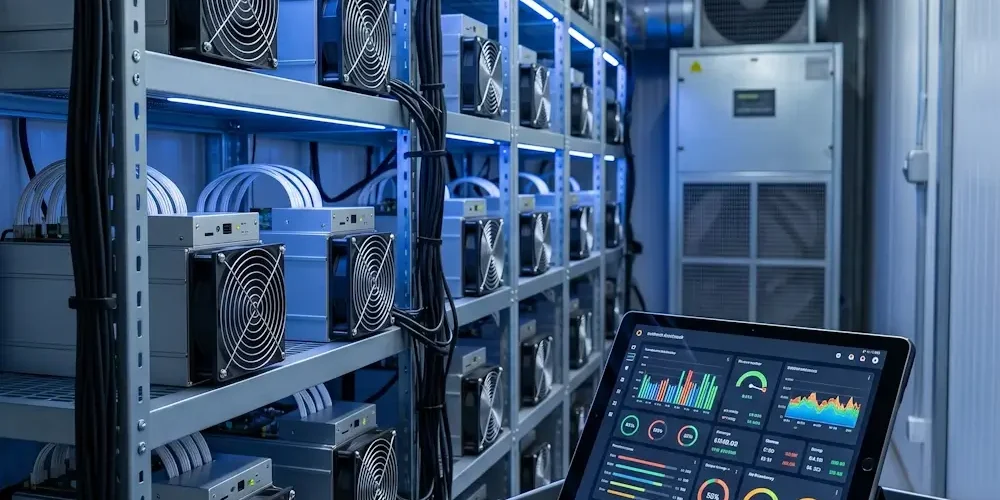
Most SA miners get the host vs home decision wrong in the same direction. We see this often at our Bedfordview office: customers home-host for too long, then over-correct and put everything in a facility. The right answer almost always involves both, with a clear threshold for when each makes sense.
This guide breaks down the real all-in cost per TH at an SA hosting facility versus running at home, the risks each side carries, and the threshold where most miners cross over. By the end you’ll know whether your specific setup belongs in your garage or in a Joburg-area data centre.
Note for South Africa:
- SA hosting facilities cluster around Gauteng (Centurion, Midrand, Olifantsfontein) and Western Cape. Rates and SLAs differ.
- Hosting fees in SA average R0.27 to R0.34 per TH per day all-in, including security, internet, and backup power.
- Home mining adds your own time costs (maintenance, troubleshooting, alert response) that hosting eliminates.
At a glance:
- SA hosting all-in: roughly R0.27 to R0.34 per TH per day.
- Home all-in (factoring time, downtime, depreciation): R0.22 to R0.66 per TH per day, with high variance.
- Threshold is roughly 3 miners. Below that, home wins on capex. Above that, hosting wins on operational efficiency.
- Noise-sensitive locations or neighbour issues flip the calculation regardless of count.
Key takeaways:
- Get the hosting agreement in writing, including SLAs and out-clauses.
- Don’t underestimate your own time cost on home mining. R200 to R500 per hour adds up.
- Hybrid (some at home, some hosted) is often the sweet spot above 4 miners.
The short version: when to host, when to home-run
Run at home if you have one or two miners, your tariff is below R1.50 per kWh effective (so hybrid solar at minimum), you have a properly designed mining room, and noise isn’t a problem. Host them if you have three-plus miners, your tariff is above R2.50 per kWh, you don’t want to deal with hardware failures personally, or your neighbours are within earshot.
Borderline cases: a single S21+ in a noise-sensitive neighbourhood, or a small farm in load-shedding-heavy areas. Both of those usually flip to hosting once you account for total cost of ownership including time and uptime losses. The Sell Your PC crypto mining hub covers the full SA mining context.
What a hosting agreement should cover
Get every one of these in writing. If a facility hesitates on any, walk away.
- All-in fee structure (per kWh, per miner, or hybrid). Fixed or pass-through tariff increases.
- Uptime SLA. 98 percent is standard. 99.5 percent costs 10 to 20 percent more.
- Power source mix (grid, solar, generator backup). Generator-backed sites cost more but ride out load shedding.
- Security. CCTV, access logs, dedicated locked cabinets vs shared racks.
- Internet redundancy. Dual fibre, public IP, port forwarding rules.
- Hardware response time. Hands-on remediation within 4 hours vs next business day.
- Pool routing flexibility. Can you change pools, or is the host pool-locked.
- Out-clause. 30-day notice on either side, no early-termination penalty.
- Insurance. Whose covers what (theft, fire, water damage, transit).
- Exit terms. How quickly do you get the unit back if you terminate.
For broader context on hosting models globally, a Coindesk overview of mining hosting models documented how the SLA structures evolved through 2024 to 2026.
Real all-in cost per TH at an SA host
An SA hosting deal in 2026 typically blends to R0.27 to R0.34 per TH per day, all-in. That includes power, security, internet, basic hands-on, and a 98 to 99 percent uptime SLA. Cross-reference against AsicMinerValue’s profitability tracker for the global benchmark range.
| Cost layer | Per S21+ monthly | Per TH per day |
|---|---|---|
| Power (3 880W at R2.20-R2.50/kWh blended) | R6 150 to R6 980 | R0.87 to R0.99 |
| Hosting fee margin | R350 to R650 | R0.05 to R0.09 |
| Security and internet | R150 to R300 | R0.02 to R0.04 |
| Hands-on incident response | R100 to R250 | R0.01 to R0.04 |
| Total all-in | R6 750 to R8 180 | R0.96 to R1.16 |
Hosting rates verified against industry-typical SA quotes April 2026. Pricing models vary by facility.
Note: pricing models vary. Some hosts quote a flat per-kWh figure, others quote a fixed monthly rental. Always normalise to per-TH-per-day to compare apples to apples.
For SA data centre power context, a BusinessTech piece on data centre power in SA covered the broader infrastructure landscape and how SA’s power crunch has affected hosting economics.
Real all-in cost per TH at home
Home mining looks cheaper on the surface. The full picture includes time, downtime, depreciation, and infrastructure costs that often get omitted.
| Cost layer | Per S21+ monthly | Per TH per day |
|---|---|---|
| Power (Eskom R2.80/kWh) | R7 815 | R1.11 |
| Mining room build (amortised over 5 years) | R150 | R0.02 |
| Cooling auxiliary (fans, AC) | R180 | R0.03 |
| Time cost (4 hours/month at R300/hour) | R1 200 | R0.17 |
| Downtime cost (3% lost uptime) | R171 | R0.02 |
| Insurance and miscellaneous | R75 | R0.01 |
| Total all-in | R9 591 | R1.36 |
If your tariff is R1.50 (hybrid solar) and you don’t include time cost, home drops to R0.85 per TH per day. If you include realistic time cost and your tariff is R4.20 (Block 3 residential), home climbs to R1.85. The variance is much wider than hosting.
Home mining cost layers verified April 2026 against current Eskom tariffs. Cross-check live revenue per TH/s on WhatToMine’s BTC SHA-256 calculator.
Cross-check tariff bands against Eskom’s tariff schedule. The full breakdown of Eskom vs alternatives lives in the Eskom vs solar cost-per-kWh breakdown.
Most of the new-unit deployments we ship into Gauteng hosting facilities right now are the Bitmain Antminer S21 Pro 245TH, with the Bitmain Antminer S21 XP Hydro 473T taking the higher-density slots where hosts offer hydro-cooled racks.
Risks at home you do not see at a host
- Load shedding kills uptime. Stage 4 to 6 takes you down 8 to 14 percent of the month.
- Hardware failures hit your own cashflow directly. PSU dies on Sunday, miner offline until Monday.
- Theft risk. ASICs are visible on AlertSA reports through 2024 to 2026.
- Insurance complexity. Most home policies don’t cover commercial mining equipment.
- Family and neighbour disputes. Noise and heat carry over walls.
- Power surge events. SA grid surges damage PSUs without surge protection.
- Dust and humidity. Garages and outbuildings often have neither filtration nor humidity control. Mining room ventilation layouts covers the basics.
Risks at a host you do not see at home
- Facility goes bust. Your hardware is in their warehouse. Recovery can take months.
- Tariff pass-through. If Eskom hikes 18 percent, your hosting bill follows. Read the contract.
- Hashrate underclocking. Some hosts quietly underclock to save power. Monitor your dashboard daily.
- Pool routing. Some hosts force you onto their preferred pool, taking a referral fee.
- Internet outages on shared facility ISP. Affects your uptime not theirs.
- Hardware mishandling during maintenance. Damaged hashboards, lost data on factory resets.
- SARS and FICA. The host’s compliance issues can affect your operation. Choose registered, audited facilities.
Browse our hardware at our Bitcoin ASIC stock with these trade-offs in mind.
Common mistakes
- Comparing hosting to a fantasy R0.30 per kWh home setup that you don’t actually have.
- Forgetting your own time cost. R300 per hour times monthly maintenance adds R1 000 to R3 500 per miner.
- Signing a 12-month hosting contract without an out-clause.
- Assuming uptime SLA means refund. Most SLAs only credit future bills.
- Hosting older S19s past their economic life because the contract was prepaid.
- Not monitoring your hosted miner’s dashboard daily. Underclocked or paused units can sit unnoticed for weeks.
- Ignoring the cost of 1 percent downtime on either side of the decision.
Solar-leaning home operators tend to start with the Avalon Q 90T before scaling beyond the home install threshold.
If you have never hosted
- Start with one miner at a hosting facility before you commit a farm.
- Visit the facility in person. Look for working CCTV, neat cabling, redundant cooling, fire suppression.
- Ask current customers for references. Real ones, not the host’s curated list.
- Read the SLA before you sign. Specifically look for force majeure clauses around load shedding.
- Set up dashboard monitoring with alerts before your unit ships. You should see hashrate within 24 hours of arrival.
If you already host
- Audit your monthly invoice against actual hashrate output. Some hosts overcharge or underclock without disclosure.
- Compare against the global hosting benchmark every 6 months. SA prices have drifted up and down.
- Renegotiate after 12 months on time. Your bargaining power as a known-good customer is real.
- Diversify across two facilities if you have 5-plus miners. Single-facility risk is asymmetric.
- For more on payout variance which compounds with uptime issues, see how pool variance affects payouts.
- Need a bench test on miners returning from hosting (or going to one)? Just contact our team.
Frequently asked questions
How much does ASIC hosting cost in South Africa in 2026?
Typical SA hosting all-in runs R0.96 to R1.16 per TH per day, blended. For an S21+ (235 TH/s) that’s R6 750 to R8 180 per month. Premium facilities with 99.5 percent SLA, generator backup, and dedicated locked cabinets charge slightly more. Bulk discounts kick in at 5-plus miners, dropping the per-unit cost by 8 to 15 percent. Always ask whether tariff increases pass through (most do) and whether the SLA includes credits or just future-bill discounts. The latter is much weaker than it sounds.
What’s the right size to switch from home to hosted in SA?
Three miners is the rough threshold for most SA buyers. Below three, home capex (one DB upgrade, one mining room) amortises across few enough units that home wins. Above three, the per-miner overhead at home (time, infrastructure, downtime) compounds faster than the hosting fee. Specific exceptions: noise-sensitive sites flip to hosting at one miner, hybrid solar setups extend home viability to four or five units. Run your own numbers using the all-in tables above with your actual tariff and time cost.
Are hosted miners covered by insurance?
Sometimes. Most reputable SA hosting facilities carry property insurance that covers fire, water damage, and theft on the premises. They typically don’t cover hardware failures (those are your responsibility) or losses from extended outages. Some hosts offer optional insurance for an additional 2 to 4 percent of monthly fee. Read the policy carefully. Coverage limits, deductibles, and exclusions matter more than the headline coverage. Your own household insurance probably won’t follow your hardware to a commercial facility.
Can I visit my miner at the hosting facility?
Most reputable SA facilities allow scheduled visits with 24 to 48 hours notice. Some restrict to specific time windows. Drop-ins are rarely allowed for security reasons. Use the visit to verify the unit is your serial number, running at expected hashrate, and physically intact. Take photos for your records. If a host refuses to let you visit at all, that’s a red flag. The legitimate exception is during commissioning weeks when the facility is closed to all visitors. Verify visit policy in writing before you sign.
Do I pay tax on hosted mining income differently from home mining?
The tax treatment is the same. SARS treats Bitcoin earned from mining as gross income at rand value on receipt, regardless of where the unit is physically located. The hosting fee is a deductible operating expense if you treat the activity as a trade. The SARS guidance on crypto-asset tax covers the underlying coin treatment. Talk to a tax practitioner if you’re scaling beyond hobby level. Hosted setups can sometimes be structured through a small business with different tax efficiency, depending on your income mix.
Summary
- Three miners is the rough threshold for switching from home to hosted in SA.
- SA hosting all-in: R0.96 to R1.16 per TH per day. Home varies wildly with tariff and time cost.
- Get the hosting SLA, out-clause, and tariff pass-through terms in writing.
- Home risks: load shedding, theft, insurance gaps. Host risks: facility failure, tariff pass-through, SLA weakness.
- Hybrid setups (some home, some hosted) often beat single-mode at scale.
This is educational content, not financial advice.

