
ASICs in a spare bedroom (2026): noise planning that neighbours can live with
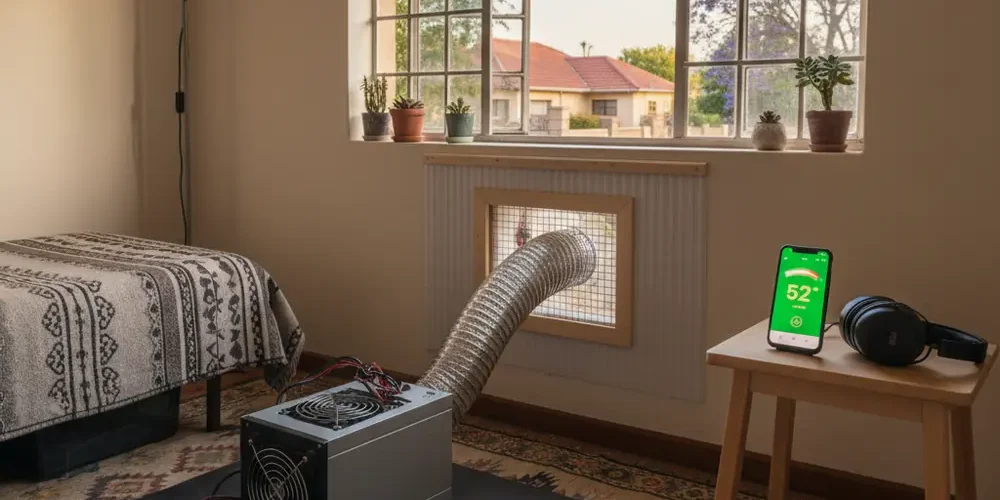
Bedroom ASIC mining fails most often because noise control is treated like decoration, not like an airflow and vibration problem. That leads to neighbour complaints, poor sleep, and miners that run hotter than they should.
By the end of this guide you will be able to measure your current noise, identify whether the problem is fan noise or vibration, and pick a plan that matches your room and budget. You will also have a safety checklist for power, heat, and load shedding realities.
Note for South Africa:
- Load shedding changes fan behaviour and restart cycles, plan staged restarts and monitoring after every outage.
- Townhouses and flats transmit vibration through slabs and shared walls more than freestanding homes, treat structure-borne noise early.
- Check your municipality noise by-laws and any body corporate or lease rules, do not assume universal quiet hours.
At a glance:
- Measure dB(A) at 1 m, at your bedroom door, and at the nearest neighbour-facing wall before you buy foam or build a box.
- Decide whether the dominant path is airborne fan noise or structure-borne vibration, the fixes are different.
- Use source control first, clean and restore airflow, then isolation and sealing, then consider a ducted enclosure to outside.
- If you cannot vent heat outdoors safely, your best neighbour plan is usually relocation, underclocking, or restricted run times.
Key takeaways:
- Foam reduces echo, not transmission, mass and sealing matter more for neighbour impact.
- Every change must be checked against temperatures, power draw, and safe cabling.
- A complaint plan and a night schedule can be as important as hardware changes.
First, set a realistic noise target for a bedroom and for neighbours
You are balancing two different goals, your comfort in the room, and what leaks into other spaces. Occupational limits are about hearing risk, but your neighbour problem is usually annoyance and sleep disruption.
Understanding dB(A), distance, and why small changes matter
Most people perceive a 3 dB change as noticeable in a quiet room, even though it is not a night and day difference. A useful rule of thumb is that doubling the distance from a source in open space can reduce level by about 6 dB, although rooms and walls change the result.
If you are working next to miners for long periods, also think about hearing risk, not only complaints. NIOSH explains why repeated exposure matters and why 85 dBA averaged over 8 hours is a common occupational reference point, but it is not a comfort target for a bedroom.
External reference: NIOSH noise-induced hearing loss basics
Sleep and annoyance basics, what guideline documents actually say (and what they do not)
Guidelines for night noise are usually written for population health and outdoor metrics, not for a single device in a home. WHO discusses targets like Lnight,outside 40 dB and an interim 55 dB approach, but you must translate carefully to your specific building and room.
Use guideline numbers as direction, not as a promise that you will be compliant everywhere. Your practical target should be, no audible vibration in adjacent rooms, and the lowest steady noise you can manage at night without overheating the miner.
External reference: WHO night noise guideline values
Measure your current setup before you change anything
If you do not measure, you will spend money on the wrong fix. Measure in a repeatable way so you can tell if an intervention helped or just changed the tone.
Simple measurement method using a phone app or sound level meter
A dedicated sound level meter is better, but a phone app can still help you compare before and after. The key is consistency, same phone, same settings, same positions, same miner load.
- Warm up the miner for at least 10 to 15 minutes so fan speed is stable.
- Measure dB(A) at 1 m from the intake side, then at your bedroom door with the door closed.
- Measure again on the neighbour-facing wall, and in the adjacent room if you can.
- Log time, fan speed, room temperature, and whether windows are open.
OSHA summarises common measurement tools like sound level meters and dosimeters, which is useful context if you want to take exposure more seriously.
External reference: OSHA guidance on noise exposure and tools
Identify the dominant noise paths, airborne vs structure-borne vibration
Airborne noise is the fan and airflow hiss that travels through gaps and walls. Structure-borne noise is vibration that turns a desk, shelf, wall, or floor into a speaker.
- If the sound is much worse when you touch the shelf, desk, or wall, suspect vibration.
- If closing a door changes the level a lot, suspect airborne leakage and gaps.
- If you hear a low hum or buzzing in another room but it is not loud in the miner room, suspect structure-borne transmission.
| What you observe | Likely path | Best first move |
|---|---|---|
| Loud hiss in the same room | Airborne fan and turbulence | Restore airflow, then duct or enclosure |
| Buzzing in a shared wall | Structure-borne vibration | Isolation mounts and decoupling |
| Noise spikes after cleaning | Turbulence or fan issue | Check shrouds, grills, bearings |
| Door closed helps a lot | Leakage paths | Seal gaps, add mass to door |
Reduce noise at the source (without cooking the miner)
Source control is usually the cheapest dB you will ever get. It also reduces the chance that your next step traps heat.
Fan curve, firmware, and when to consider fan swaps or external fans
Some miners allow fan targets or performance modes, but you should treat these as a stability trade-off. Lower fan speed can reduce noise, but you must verify temperatures and error rates on your own hardware.
- Start with modest changes and test for hours, not minutes.
- Do not disable safety limits, and avoid any tweak that hides rising chip temperatures.
- If you plan to buy parts, choose quality fans and ducting, and check availability on our shop before you design around a specific size.
Remember that occupational thresholds are not comfort targets, NIOSH also notes that duration matters and exposure adds up over time.
Maintenance that changes noise, dust, bearings, and airflow restrictions
Many bedroom noise issues are a maintenance issue with a side of resonance. Dust and clogged grills increase turbulence, which makes fans work harder and sound harsher.
- Clean intake filters and heatsinks carefully, avoid bending fins.
- Check for rubbing cables, loose fan screws, and cracked fan frames.
- Listen for bearing whine or clicking, that is often a fan replacement sign.
- Remove unnecessary restrictive meshes that cause whistling, but keep safe finger protection where needed.
Control the noise path inside the room
Once the miner is as smooth and clean as possible, work on what the sound touches. Your goal is to stop the room from amplifying the miner and to reduce leakage points.
Vibration isolation, shelf choice, and avoiding wall and floor coupling
In many SA flats, vibration is the neighbour issue, not raw fan noise. A heavy shelf that touches a shared wall can turn your whole wall into a panel speaker.
- Put the miner on a stable table, not a hollow cupboard that rattles.
- Use rubber isolation feet or a dense vibration mat, and add a rigid board between soft layers so the miner does not wobble.
- Keep the stand a few centimetres away from walls, especially shared walls.
- Route ducts and cables so they do not pull the miner against a wall or window frame.
Room treatment vs soundproofing, sealing gaps, adding mass, and why foam is not enough
Acoustic foam is for echo and voice clarity, not for stopping a noisy machine from bothering neighbours. If you can see light through a gap, sound will use it too.
- Seal door gaps with weatherstripping and a door sweep, then re-measure at the door.
- Add mass where practical, for example a solid-core door, or a temporary door panel that can be removed if you rent.
- Close unnecessary vents and gaps, but never block required ventilation for a gas appliance or bathroom extraction.
- Use curtains and soft furnishings to reduce harsh reflections, it helps comfort in the room even if it does not fully block transmission.
Enclosure options that can work in a spare bedroom
An enclosure only works if it is designed as a heat management system first. If you trap hot air, the miner will raise fan speed, get louder, and risk shutdown.
Acoustic box design principles, intake and exhaust ducting, and fire-safe materials
Think of an acoustic box as a sealed shell with controlled air paths that are long and lined, not as a tight box with a tiny hole. The practical goal is to move noise away from people and towards a safe exhaust point.
- Use non-combustible or fire-resistant materials where heat is present, and keep insulation away from moving fan blades.
- Build baffles into the intake and exhaust path so sound does not travel in a straight line.
- Size ducts for airflow, undersized ducting increases turbulence and noise.
- If you want help planning duct runs, window panels, or testing with your room layout, use contact us and include your measurements and photos.
Heat planning, avoid recirculation, add filtration, and plan for power cuts
The safest enclosure is one that exhausts heat outside, not into the same room. If you cannot vent outdoors, use a conservative plan, lower power modes, and short run windows.
- Prevent recirculation, keep exhaust and intake separated, and do not let hot exhaust pool near the intake.
- Add a simple filter on intake air, and keep spares, clogged filters raise noise and temps.
- During load shedding, miners may restart into a hot room, check fans and temperatures after power returns.
- Use remote monitoring so you can shut down fast if temperatures rise while you sleep.
Neighbour-friendly operating plan
Even a well-built setup can fail socially if it runs at the wrong times. Your objective is predictable quiet nights and a plan for complaints.
Time-of-day schedule, remote monitoring, and what to do when you get a complaint
If your measured door and wall levels are still high at night, schedule downtime or lower power operation during sensitive hours. This is often easier than chasing the last few dB with expensive builds.
- Pick a night policy you can stick to, and document it for yourself.
- When a complaint comes in, pause mining, measure again, and ask what the neighbour hears, hum, buzz, or hiss.
- Offer a follow-up after your next change, and avoid debating numbers, focus on reducing impact.
- If you are in a complex, read the body corporate rules early and adjust before it escalates.
Decision tree: choose your noise strategy
Use this decision tree after you have baseline measurements. The best plan is usually a combination of two or three small wins, not one dramatic fix.
- Start with your dB(A) at 1 m. If it feels painfully loud up close or you need to raise your voice, treat it as a personal exposure risk and prioritise distance and hearing protection when you work nearby. NIOSH explains why duration matters and why occupational numbers are not comfort targets.
- Check the door measurement. If closing the bedroom door drops the level a lot, focus on sealing gaps, door mass, and directing airflow noise away from the door.
- Check for vibration in adjacent rooms. If a buzz appears through a shared wall or slab, start with isolation mounts, decoupled shelving, and keeping the unit off walls.
- Do you have a safe ventilation path outside. If yes, a ducted enclosure or ducted exhaust is often the highest impact step. If no, prioritise underclocking, restricted run times, and relocation to a less sensitive room.
- Are you renting. If yes, prefer reversible steps, isolation pads, door seals, a removable window panel, and a freestanding enclosure. Avoid permanent wall changes.
- Budget and complexity. Low budget, maintenance plus isolation. Medium budget, sealing plus ducting. Higher budget, a properly ducted enclosure plus monitoring and safer power distribution.
Common mistakes
- Relying on acoustic foam alone, it treats reflections but does not stop transmission.
- Building a tight box with poor airflow, the miner gets hotter and louder.
- Mounting the miner on a wall shelf or on a desk that touches a shared wall.
- Ignoring tonal noise, a small whine can be more annoying than a higher dB broadband hiss.
- Changing three things at once, then you cannot tell what actually worked.
If you’re new
- Start with one miner and one room, then measure before scaling.
- Prioritise ventilation and safe power first, noise fixes come second.
- Buy a simple watt meter and log power draw, do not guess from online posts.
- Pick a room with the fewest shared walls, and avoid placing the miner against a boundary wall.
- Read your building rules early, a complaint is harder to fix than a plan.
If you already run rigs
- Standardise measurements across your machines so you can compare changes.
- Keep spare fans and filters, noisy bearings and clogged intakes are predictable failures.
- Separate miners from structural contact points, even a cable tied to a shelf can transmit buzz.
- Use monitoring alerts for fan failures and temperature spikes after outages.
- Review your power distribution, continuous loads reveal weak plugs and extension leads fast.
Safety and compliance checklist for SA homes
Noise planning fails if your power and heat plan is unsafe. Treat the miner like a continuous high load, and treat the enclosure like a hot appliance.
Electrical load, extension leads, ear protection, smoke detection, and insurance questions
- Confirm the circuit can handle the continuous load, and avoid daisy-chained extension leads.
- Use quality plugs and power boards rated for the load, and keep connections visible so you can inspect them.
- Add smoke detection near the room, and keep the miner area free of clutter and fabric.
- If you do maintenance while it is running, use hearing protection if the room is loud.
- Ask your insurer what they require for a high-load device in a bedroom, and document your precautions.
If you need help choosing safer power accessories, or you want a second opinion on a bedroom plan before you spend money, you can browse options in our shop and then contact us with your circuit and room details.
Frequently asked questions
How loud is an ASIC miner in dB(A)
It depends heavily on model, fan condition, and firmware mode, so measure your own unit at 1 m and at your door. Use your before and after measurements to judge improvements rather than relying on online numbers.
Do phone sound meter apps work well enough
They are not a lab instrument, but they are good for consistent comparisons if you keep the same phone, same positions, and similar background conditions. If you are making bigger decisions, a basic sound level meter can be worth it.
Will underclocking make my miner quiet enough for a bedroom
It can reduce fan speed and turbulence, but the result varies and you must confirm stability and temperatures on your hardware. Think of it as one lever, not a guarantee.
Is it safe to put an ASIC in a soundproof box
Only if the enclosure is designed for airflow and heat removal first, and you monitor temperatures and fan status. A poorly ventilated box is a common path to overheating and shutdown.
What should I do if a neighbour complains
Pause mining, measure again, and ask what they hear and when it is worst. Then tackle the dominant path, vibration isolation for buzz, sealing and ducting for hiss, and agree on a follow-up time to confirm improvement.
Next steps and sourcing
If you are deciding between adding ducting, replacing fans, or moving the unit, take measurements first and plan the ventilation path. For parts and practical accessories you can start at our shop, and if you want help sizing airflow or reviewing your room constraints use our contact page.
You can also browse more mining and hardware content in Insights, and if you want to offload unused gear rather than forcing a bedroom install, see sell your items.
Summary
- Measure first, at 1 m, at the door, and at the neighbour-facing boundary.
- Fix the dominant path, airborne noise needs sealing and ducting, vibration needs isolation and decoupling.
- Never trade noise for heat, enclosure changes must be checked against temperatures.
- Plan for SA realities, load shedding restarts, shared walls, and clear complaint handling.
This is educational content, not financial advice.

