
Bitcoin Merged Mining Explained
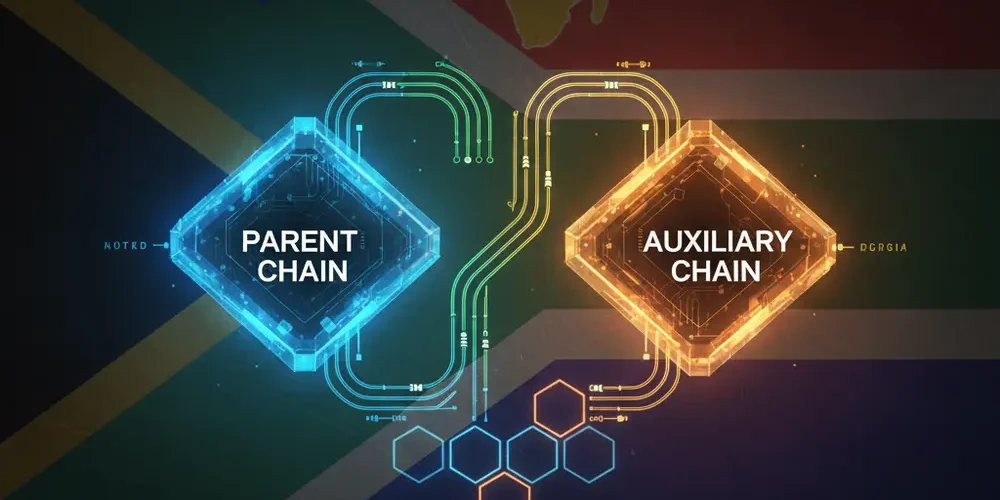
If you are already running a Bitcoin ASIC miner, you may be leaving free income on the table every single day. Merged mining lets you earn rewards from additional blockchains at the same time as you mine Bitcoin, without using a single extra watt of electricity.
By the end of this article, you will understand exactly how merged mining works, which coins support it, and how to enable it through your mining pool. No hardware changes required.
Note for South Africa:
- Eskom tariff increases make every efficiency gain matter. Merged mining is one of the few ways to increase your rand-denominated output without increasing your power draw.
- Load shedding already disrupts your uptime. Merged mining does not add to your power consumption, so it is a genuine benefit during the hours you are running.
- SARS treats crypto mining rewards as gross income. Additional coin payouts from merged mining are likely taxable events. Keep records and consult a tax professional. See the official SARS crypto asset tax guidance for more detail.
At a glance:
- Merged mining earns you rewards from a secondary blockchain while you mine Bitcoin, with no extra electricity cost.
- It works only with coins that share Bitcoin's SHA-256 algorithm and have opted into the AuxPoW protocol.
- Most of the setup happens at your mining pool, not on your ASIC hardware.
- You need to add a separate wallet address for each auxiliary coin on your pool dashboard to receive payouts.
Key takeaways:
- Merged mining is additive. You do not earn less Bitcoin by enabling it.
- Pool choice determines which auxiliary coins you can mine. Check your pool's documentation before expecting payouts.
- Auxiliary coin rewards are small but consistent. In ZAR terms, every little bit counts when electricity costs are high.
What Is Merged Mining and Why Should Home Miners Care?
Merged mining is the process of mining more than one cryptocurrency simultaneously without any additional computational effort. As Investopedia defines it, it allows a miner to submit the same proof of work to multiple blockchains at once, earning rewards from each chain where applicable.
For a home miner in South Africa, the appeal is straightforward. Your ASIC is already running, already drawing power, and already generating heat. Merged mining simply adds another income stream on top of your existing Bitcoin rewards without touching any of that.
The Core Idea – Mining Two Coins for the Price of One
When you mine Bitcoin, your ASIC is solving a SHA-256 hashing puzzle. With merged mining, that same solved puzzle is also submitted to a compatible auxiliary blockchain. If it meets that chain's difficulty target, you earn a block reward there too.
The key point is that your hardware does the same work it always did. There is no splitting of effort, no slowdown, and no increase in power consumption. The extra work is done at the software level, either by your pool or by the node running beneath it.
How Merged Mining Works – Auxiliary Proof of Work (AuxPoW) Explained
The technical mechanism behind merged mining is called Auxiliary Proof of Work, or AuxPoW. It is the protocol standard that allows an auxiliary chain to accept proof of work completed on Bitcoin's parent chain.
Here is the simplified version of how it works:
- Your mining pool embeds information about the auxiliary chain block into Bitcoin's coinbase transaction.
- Your ASIC mines as normal, targeting Bitcoin's difficulty.
- When a valid Bitcoin hash is found, the pool simultaneously checks whether it also satisfies the auxiliary chain's difficulty requirement.
- If it does, the pool submits the proof of work to the auxiliary chain as well.
- You receive a reward from both chains for the same piece of work.
Importantly, the auxiliary chain must be designed to accept AuxPoW. Not every coin can be merged-mined with Bitcoin. The coin's developers must have explicitly built this in at the protocol level.
The Role of the Parent Chain and the Auxiliary Chain
Bitcoin is always the parent chain in this relationship. It is the dominant chain and its difficulty sets the pace. The auxiliary chain is a secondary blockchain that has opted in to accept Bitcoin's proof of work as valid for its own block production.
The auxiliary chain benefits by inheriting a portion of Bitcoin's enormous hash rate security. As Bitcoin Magazine explains, smaller chains can secure their networks without needing to attract independent miners. For the miner, it is purely additive income.
Which Coins Support Merged Mining with Bitcoin?
Only SHA-256 coins that have implemented the AuxPoW standard can be merged-mined with Bitcoin. Below is a comparison of the most widely known options.
| Coin | Ticker | Use Case | Reward Token | Pool Support |
|---|---|---|---|---|
| Namecoin | NMC | Decentralised DNS (.bit domains) | NMC | Select pools – check pool docs |
| Rootstock (RSK) | RBTC | Bitcoin sidechain for smart contracts | RBTC (pegged to BTC) | F2Pool, AntPool, others |
| Syscoin | SYS | Tokenisation and Ethereum bridge | SYS | Select pools – check pool docs |
Namecoin was the first coin to implement merged mining with Bitcoin, dating back to 2011. It remains one of the most recognisable examples. RSK is arguably the most practically significant today, given its smart contract functionality and the fact that its RBTC token is pegged to Bitcoin.
Note that Dogecoin and Litecoin also use merged mining, but between each other using the Scrypt algorithm. That is a separate ecosystem from Bitcoin's SHA-256 merged mining. If you are running a Litecoin or Dogecoin ASIC, browse our Litecoin and Doge ASIC miner listings for compatible hardware options.
Does Merged Mining Affect Your Bitcoin Mining Performance or Rewards?
No. Your Bitcoin rewards and your hash rate are completely unaffected by enabling merged mining. You will not earn less BTC, you will not mine slower, and your ASIC will not run hotter or consume more electricity because of it.
The AuxPoW construction and submission happens at the pool or node level. Your hardware has no awareness that it is contributing to a second chain. From the ASIC's perspective, nothing has changed.
There is a marginal computational overhead at the pool or node level for constructing and submitting the auxiliary proof of work. However, this is negligible for the individual home miner. Your electricity bill will not move.
Step-by-Step: How to Enable Merged Mining on Your Pool
The good news for beginners is that most of the work happens at the pool level, not on your hardware. Your ASIC configuration file almost certainly does not need to change.
- Confirm your pool supports merged mining. Not all pools offer this feature. Check the pool's FAQ, dashboard, or documentation section for mentions of merged mining, AuxPoW, NMC, RBTC, or SYS payouts. Pools known to support RSK merged mining include F2Pool and AntPool, but always verify on their current documentation.
- Identify which auxiliary coins your pool supports. Each pool is different. Some support Namecoin payouts, others focus on RSK. Log into your pool account and look for a merged mining or auxiliary coins section in your account settings.
- Set up a wallet address for each auxiliary coin. You will need a separate wallet address for NMC, RBTC, or SYS depending on which coins your pool supports. Create wallets for each coin you want to receive, then paste those addresses into your pool account dashboard. Your Bitcoin address will not work for receiving NMC, for example.
- Enable merged mining in your pool account settings. Once your auxiliary wallet addresses are entered, look for a toggle or option to activate merged mining. Some pools enable it automatically when you add an auxiliary wallet address. Others require a manual opt-in.
- Verify your ASIC or miner config does not need changes. In most cases, your existing Stratum connection URL and worker credentials stay exactly the same. If your pool provides a separate merged mining Stratum URL, use that instead. Check the pool's setup guide to be sure.
- Monitor your auxiliary coin payouts separately. Your pool dashboard should show separate payout history for each auxiliary coin. Give it 24 to 48 hours after setup before expecting to see activity.
Understanding how Bitcoin mining pools work in general will help you navigate the settings above. If you are setting up a new mining machine or upgrading your hardware, browse our Bitcoin ASIC miner shop for locally available options.
Choosing a Pool That Supports Merged Mining
Your pool choice is the single most important decision for merged mining. A pool that does not support it means you cannot access auxiliary rewards at all, regardless of your hardware.
When evaluating pools, look for these specifics:
- Explicit mention of merged mining or AuxPoW in pool documentation
- A list of supported auxiliary coins and their payout minimums
- A payout address field for each auxiliary coin in your account dashboard
- Active community or support channels where you can verify the feature is working
Configuring Your Miner Software or ASIC for Merged Mining
For most home miners using a pool that handles merged mining, there is nothing to change in the ASIC configuration. Your miner connects to the pool via Stratum, and the pool does the rest.
If you are running older ASIC firmware, merged mining support is still managed at the pool level. The only scenario where your firmware matters is if your pool requires a specific Stratum extension or a different connection URL for merged mining. Check your pool's setup documentation to confirm.
For SA home miners weighing the merged-mining route, current-gen BTC ASICs like the Bitmain Antminer S21 Pro 245TH and the Bitmain Antminer S23 318TH are the units most worth pricing first.
Is Merged Mining Worth It for South African Home Miners?
Given the ongoing pressure of Eskom tariff increases and the reality of load shedding, South African home miners should look seriously at merged mining. The logic is simple: you are already spending the electricity, so any additional reward is pure efficiency gain.
As Hashrate Index notes on Bitcoin mining in South Africa, ZAR-denominated profitability is sensitive to both exchange rates and local electricity costs. Auxiliary coin payouts may seem small in USD terms, but converted to rand, small consistent additions matter when margins are tight.
A few things to keep in mind for SA miners specifically:
- Auxiliary coin values fluctuate. Do not mine merged coins on the assumption of a specific rand value. Check current rates yourself before factoring them into your profitability calculations.
- Load shedding does not change the equation here. Merged mining does not increase your power draw, so running on inverter or solar backup during outages costs you nothing extra to keep merged mining active.
- SARS requires you to declare all mining income. Auxiliary coin payouts are likely treated as gross income at their rand value on the date of receipt. Keep a record of every payout. For official guidance, refer to South African tax on mining income from SARS. Consult a tax professional for your specific situation.
- If you are considering upgrading or sourcing new hardware, visit the Sell Your PC shop for locally available ASIC options that are compatible with major merged mining pools.
Common Mistakes to Avoid
Common mistakes:
- Assuming all pools support merged mining. They do not. Always verify before expecting payouts.
- Using your Bitcoin wallet address for auxiliary coin payouts. Each coin needs its own wallet address.
- Expecting significant income from auxiliary coins. Treat it as a bonus, not a primary income stream.
- Forgetting to declare auxiliary coin payouts to SARS. All mining income is taxable in South Africa.
- Assuming merged mining will work on any SHA-256 coin. Only coins that have explicitly implemented AuxPoW are eligible.
- Not checking pool documentation after a pool update. Features and supported coins can change without much notice.
If You Are New to Mining
Start here if this is your first time:
- Make sure your Bitcoin ASIC is already set up and connected to a pool before worrying about merged mining.
- Choose a well-documented pool that explicitly lists merged mining as a supported feature.
- Create separate wallets for each auxiliary coin before touching your pool settings.
- Follow your pool's own step-by-step guide for enabling merged mining, as each pool has a slightly different interface.
- Check the insights section on Sell Your PC Insights for more beginner mining guides.
Solar-first SA operators tend to pair merged mining with low-watt units like the Avalon Q 90T to stretch hybrid-array yield without breaching DB-board limits.
If You Have Mined Bitcoin Before
What changes for experienced miners:
- You likely already have a pool account with saved settings. Add your auxiliary wallet addresses and check for a merged mining toggle in your dashboard.
- If your current pool does not support merged mining, evaluate whether switching to one that does makes sense based on other pool factors like fees and payout models.
- Consider tracking auxiliary coin payouts in a separate spreadsheet for SARS record-keeping purposes.
- RSK merged mining via RBTC is worth investigating if your pool supports it, given RBTC's Bitcoin peg.
- If you want to expand your setup or upgrade hardware, contact the Sell Your PC team for locally sourced ASIC advice.
Frequently asked questions
Does merged mining reduce my Bitcoin earnings?
No. Merged mining is additive. Your Bitcoin block rewards and transaction fee income remain exactly the same. You are simply also submitting your proof of work to one or more auxiliary chains at the same time, earning additional rewards from those chains on top of your BTC.
Do I need to change my ASIC hardware or firmware to use merged mining?
In almost all cases, no. Merged mining is configured at the pool level. Your ASIC connects to the pool via Stratum exactly as it does today. The pool handles the AuxPoW construction and submission to auxiliary chains. Check your pool's documentation to confirm whether any connection URL changes are needed.
Which South African-accessible pools support merged mining?
Pools including F2Pool and AntPool have documented support for RSK (Rootstock) merged mining. For Namecoin and Syscoin, support varies by pool and can change over time. Always check the current documentation on your pool's website before enabling merged mining, as features and supported coins are updated periodically.
Are auxiliary coin payouts from merged mining taxable in South Africa?
Based on SARS guidance, crypto mining rewards are generally treated as gross income at their rand value at the time of receipt. Auxiliary coin payouts from merged mining are likely treated the same way. You should keep detailed records of all payouts and consult a registered tax practitioner for advice specific to your situation.
Is merged mining only possible with Bitcoin, or can other coins be the parent chain?
Other coins can also act as parent chains in merged mining arrangements. The most well-known separate example is Litecoin and Dogecoin, which merged-mine with each other using the Scrypt algorithm. However, this article focuses specifically on Bitcoin as the parent chain using SHA-256, which is relevant to Bitcoin ASIC miners.
Summary
What to remember:
- Merged mining lets you earn rewards from auxiliary blockchains while mining Bitcoin, with no extra electricity cost.
- The setup happens at your pool, not on your ASIC hardware. Most miners do not need to change any config files.
- You need a separate wallet address for each auxiliary coin you want to receive payouts for.
- Auxiliary coin payouts are likely taxable under SARS rules. Keep records of all income received.
- Treat merged mining as a bonus income stream, not a replacement strategy. Check current coin values in ZAR before building it into your profitability projections.
This is educational content, not financial advice.

