
Crypto Mining Profitability in South Africa
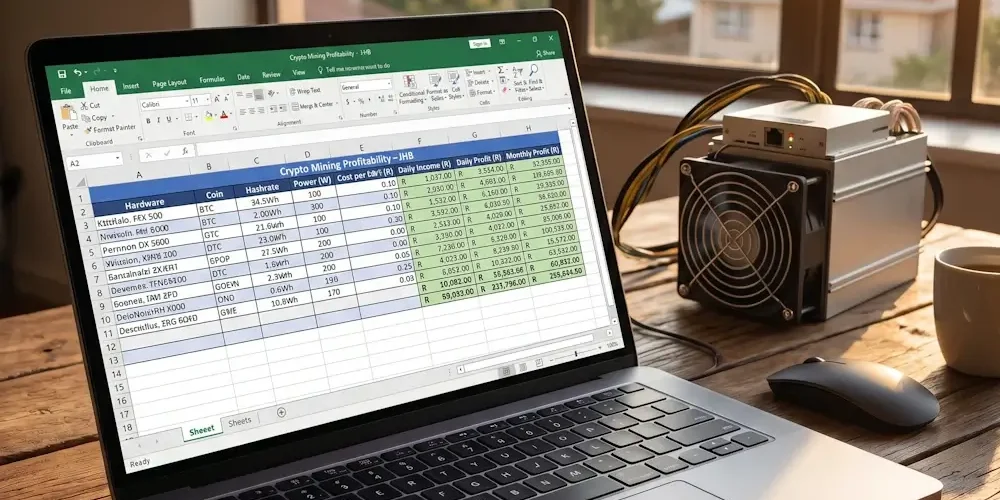
Most crypto mining profitability calculators were built for Texas or Quebec, not Bedfordview or Stellenbosch. Drop the same S21+ specs into a US calculator and your local reality will be off by 30 to 60 percent within six months.
This guide walks through what an honest SA mining profitability calculation actually needs, the five inputs that move the answer most, and a worked S21+ example across three power scenarios. By the end you’ll know how to build your own model instead of trusting someone else’s defaults.
Note for South Africa:
- Eskom tariffs run in rands per kWh, not the cents-per-kWh figures that dominate global mining content.
- Load shedding and weather-driven outages cost real uptime that calculators don’t model.
- ZAR-USD volatility moves both your revenue (BTC priced in USD) and your hardware replacement cost.
At a glance:
- Five inputs swing the answer: tariff, BTC price, difficulty, uptime, pool fees.
- An S21+ on pure Eskom residential at R2.80 per kWh runs at a daily loss.
- Hybrid solar (R1.50 per kWh blended) gets you to roughly R1 500 net per month.
- Full off-grid solar (R0.80 per kWh amortised) clears around R3 500 net per month.
Key takeaways:
- Always run scenarios at three BTC prices: bearish, current, bullish.
- Use your real measured tariff, not a generic figure.
- Subtract realistic uptime losses (5 to 8 percent in load-shedding-heavy areas).
What a real SA profitability calculation must include
A useful profitability model has six layers. Skip any of them and the answer drifts.
- Hardware specs (TH/s and J/TH).
- Real wall-power cost in rands per kWh, including connection fees if relevant.
- Live network difficulty and block reward.
- BTC-ZAR exchange rate at three scenario points.
- Pool fees and payout method (PPS, FPPS, PPLNS).
- Realistic uptime, accounting for load shedding and maintenance.
For more on pool variance and how it changes monthly payouts, see how pool variance affects payouts. The full SA mining context lives at the Sell Your PC crypto mining hub.
The five inputs that move the answer most
Of those six layers, five inputs move the bottom line by more than 5 percent on a small change. Get these right and the rest is rounding error.
| Input | Typical SA range | Sensitivity (1% change) |
|---|---|---|
| Electricity tariff | R0.80 to R4.50 per kWh | Roughly 2 to 3 percent change in net |
| BTC price | R900k to R1.6m | 1:1 change in revenue |
| Network difficulty | Drifts up 4 to 8 percent per quarter | 1:1 inverse change in revenue |
| Uptime | 92 to 99.5 percent | 1:1 change in monthly payout |
| Pool fees | 0 to 2.5 percent | 0.5 to 2.5 percent change in net |
Difficulty drift is the silent killer. Track it on the latest Bitcoin difficulty chart before you commit capex. A 6 percent quarterly increase compounds quickly.
Eskom tariff bands explained for miners
Eskom doesn’t have one tariff. It has a wall of them. The ones that matter for SA miners are Homepower, Homelight, Megaflex (TOU), and the small-scale business Businessrate. Local municipalities then layer their own markup, which is why Bellville, Bedfordview, and Stellenbosch can all differ by R0.50 to R1.20 per kWh on the same Eskom base.
Cross-check your actual band against Eskom’s tariff history rather than trusting the rand-per-kWh number on your last invoice without context. Block 3 residential kicks in around 600 kWh per month in most areas. One S21+ running 24/7 pulls roughly 2 800 kWh a month on its own, which forces you straight into the highest block.
For the full breakdown of Eskom vs solar vs generator cost per kWh, we covered it in the Eskom vs solar vs generator cost breakdown.
Worked example: S21+ 235Th across three power scenarios
Let’s run an S21+ at three real SA scenarios. Assumptions: 235 TH/s, 3 880W wall draw (93 kWh per day), BTC at R1.2 million, current network difficulty per AsicMinerValue’s revenue tracker, 2 percent pool fee, 97 percent uptime, R75 000 capex on a new S21+ 235Th.
Cross-check live revenue per TH/s on WhatToMine’s BTC SHA-256 calculator.
| Power scenario | Effective tariff | Daily power cost | Daily revenue | Monthly net | Payback |
|---|---|---|---|---|---|
| Pure Eskom residential | R2.80/kWh | R260 | R190 | -R2 100 | Loss-making |
| Hybrid solar (10-12 hrs solar, grid for nights) | R1.50/kWh blended | R140 | R190 | R1 500 | ~4 years |
| Full off-grid solar | R0.80/kWh amortised | R74 | R190 | R3 480 | ~1.8 years* |
*Excludes solar system capex. Pricing and payback maths verified April 2026 against current Eskom tariffs and BTC network difficulty.
Now stress-test by dropping BTC to R900 000 and adding 6 percent quarterly difficulty drift. The pure Eskom scenario stays loss-making. The hybrid scenario flips to a small loss within nine months. The off-grid scenario stays profitable but payback stretches to roughly 2.6 years on the miner alone.
This is why running scenarios matters more than a single calculator output. Browse our Bitcoin ASIC stock with these numbers in hand, not the other way around.
If you are running profitability scenarios against current SA stock, the Bitmain Antminer S21 Pro 245TH and the solar-friendly Avalon Q 90T are the two units to model first.
Why off-the-shelf calculators get SA wrong
WhatToMine’s calculator is excellent for global benchmarks. It’s not designed for SA reality. Five things it gets wrong by default:
- It assumes a flat per-kWh tariff. Eskom isn’t flat. Block 3 hits hard once you cross the threshold.
- It doesn’t model 220V single-phase efficiency losses (small but real, 1 to 2 percent).
- It assumes 100 percent uptime. SA load-shedding-affected sites lose 5 to 8 percent.
- It doesn’t account for ZAR-USD drift on hardware replacement.
- It uses USD pool payouts. Conversion fees and timing slip 1 to 3 percent.
The fix is to build your own spreadsheet using the five inputs above and update difficulty weekly. A MyBroadband article on SA Bitcoin mining from earlier this year documented exactly this kind of drift between calculator output and real ZAR payouts.
One more thing: most calculators ignore the question of whether to mine BTC or sell hashrate via NiceHash. We unpack that trade-off in whether to mine BTC or sell hashrate.
Common mistakes
- Using a single BTC price scenario instead of three.
- Modelling tariffs in cents per kWh instead of rands per kWh. SA isn’t Texas.
- Forgetting that 1 percent downtime costs real money. We covered this in the cost of 1 percent downtime.
- Plugging in the wrong tariff. Block 1 numbers won’t survive contact with a miner running 24/7.
- Ignoring difficulty drift. It’s not flat, and it’s not your friend.
- Forgetting pool fees and currency conversion slip on USD payouts.
- Comparing miners on TH/s alone instead of net rand per day after power.
If you are new to mining maths
- Build your model in a spreadsheet, not in your head.
- Use three BTC scenarios and three difficulty assumptions, then look at the median.
- Always pessimise uptime by 3 to 5 percent for a realistic floor.
- Track actual results weekly for the first month and recalibrate.
- Don’t compare yourself to YouTube farms in cheap-power countries. Different game.
For higher-density operators modelling per-tank economics, the Bitmain Antminer S21 XP Hydro 473T is the unit that most shifts the cost-per-TH on a fully hydro-cooled build.
If you already track profitability
- Add a difficulty drift column with weekly updates.
- Track your actual uptime, not your aspiration.
- Build a sensitivity table for BTC price and difficulty.
- Recalibrate ZAR-USD assumptions monthly.
- Build a parallel model that tracks net rand per TH per day, not just per miner.
Frequently asked questions
What’s the cheapest electricity tariff a SA miner can realistically get?
Around R0.80 per kWh on a hybrid solar setup with daytime mining priority. Pure grid is rarely below R2.50 per kWh on a residential connection in 2026. Some small-scale business connections in the Free State and Northern Cape have access to slightly lower municipal rates, but those are exceptions. Hosted facilities sometimes advertise R2.20 per kWh blended, but read the fine print on uptime guarantees and pass-through clauses. The realistic floor for a home miner is solar plus battery, not the grid.
How often should I update my profitability model?
Weekly for the first three months, then monthly once you have a baseline. The variables that matter most (BTC price, difficulty, ZAR-USD) all move on weekly cycles. Pool fees and your tariff change less often. If you have multiple miners across sites, build the model once and update inputs in a single sheet. Don’t trust calculator websites for ongoing tracking. They’re snapshots. Your model should compound week-on-week so you spot drift before it becomes a problem.
Do mining calculators include the cost of cooling and ventilation?
Almost none of them do. A miner that draws 3 880W at the wall might need an extra 200 to 400W of fans or air conditioning to keep inlet temps under 30 degrees in a SA summer. That’s another 5 to 10 percent on your power bill that calculators ignore. If you immerse-cool, your auxiliary load drops to almost zero but you have a capex line for the tank and coolant. Build cooling into your spreadsheet as a separate line, not as a bolt-on assumption.
Can I deduct mining losses on my SA tax return?
Possibly, depending on whether SARS treats your mining as a trade or a hobby. If it’s a trade (regular, profit-intent, business-like), losses can offset other income subject to ring-fencing rules. If it’s a hobby, the loss is yours to absorb. Most small SA miners running one or two ASICs from home fall in the grey zone. See the SARS crypto-asset tax guidance for context, and talk to a tax practitioner before you assume losses are deductible. Keep daily payout records in rand value, electricity invoices, and capex paperwork.
What’s the most common reason a profitability model is wrong by month three?
Difficulty drift, by a long way. The Bitcoin network adjusts every 2 016 blocks. Through 2024 to 2026 the trend has been 4 to 8 percent quarterly increases. If you modelled a flat difficulty number, your revenue forecast is already 12 to 20 percent too high by the end of quarter one. The other big offenders are unrealistic uptime assumptions and forgetting to recalibrate pool payout frequency, which affects PPLNS variance more than people expect.
Summary
- Five inputs run the model: tariff, BTC price, difficulty, uptime, pool fees.
- Build your own spreadsheet. Don’t trust a single calculator output.
- Run three BTC scenarios and add quarterly difficulty drift.
- SA’s tariff structure forces you into the highest block once you mine 24/7.
- Pure Eskom is loss-making. Hybrid solar is workable. Off-grid is best.
This is educational content, not financial advice.

