
Bitcoin Dominance vs Alt Season
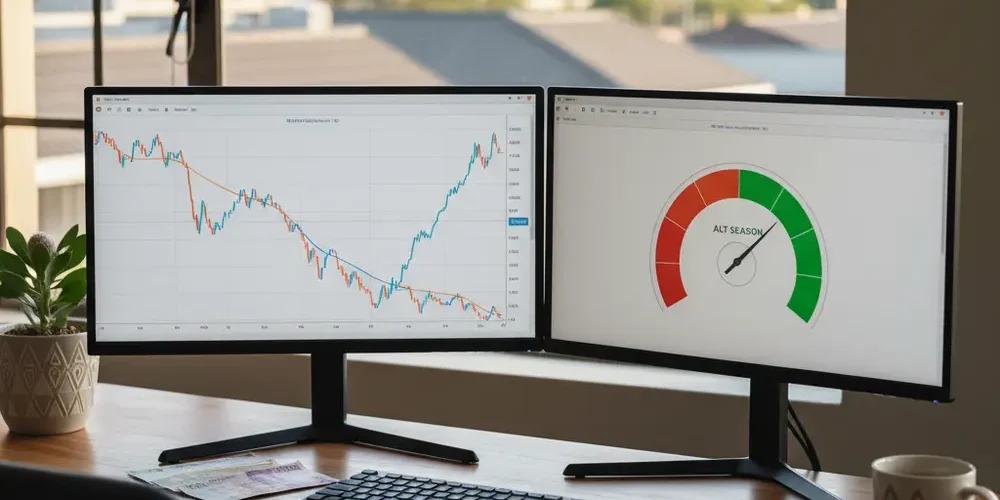
Bitcoin dominance and alt season talk can make traders feel late, even when the market is just rotating between risk levels. If you misread the shift, you can end up buying alts into a fakeout or sitting in BTC while a broad alt move is already underway.
In this article you will learn what BTC dominance really measures, how common alt season indices define outperformance, and how traders combine multiple signals into one decision. By the end you should be able to label the current regime as Bitcoin-led, neutral, or alt-led, and choose a posture that fits your risk.
Note for South Africa:
- ZAR pairs can have wider spreads than USD pairs, so confirm liquidity before sizing an alt position.
- Fees and slippage matter more in fast rotations, especially on small caps and during volatility spikes.
- Keep clean trade records and verify the latest SARS guidance with a tax practitioner, rather than relying on social media summaries.
At a glance:
- BTC dominance is a ratio, it can fall because alts rise or because BTC falls faster, and those are different regimes.
- Most alt season indices use a 90 day window and count how many top coins beat BTC, not whether one or two memes pumped.
- Use a multi-signal check, BTC.D trend (weekly), ETH/BTC strength, TOTAL2 momentum, stablecoin liquidity, and volume or leverage.
- When signals conflict, a do nothing posture is a valid decision, preserve capital for clearer conditions.
Key takeaways:
- Alt season is about breadth of outperformance, not headlines.
- Confirm rotation with cross-pairs like ETH/BTC and market cap charts like TOTAL2, not BTC.D alone.
- Risk management decides outcomes more than being right once, position size, stops, and liquidity checks are non-negotiable.
Bitcoin dominance explained, what BTC.D measures and what it does not
Bitcoin dominance is usually described as Bitcoin market cap as a share of the total crypto market cap. Traders track it because it often moves with market leadership, capital rotation, and risk appetite. But it is a ratio, not a price, and it is built on market cap, not a direct measure of capital inflows. A clear definition with caveats is worth reading before you build a strategy around it. Bitcoin dominance definition and limitations
BTC.D can rise in at least two common ways. BTC can outperform the rest of the market during risk-off periods, or alts can simply drop harder than BTC in drawdowns. In both cases dominance increases, but your trade decisions might be different.
- Dominance rising with BTC price strength, often aligns with Bitcoin-led trends and risk reduction in alts.
- Dominance rising during market stress, can happen when everything is red and alts bleed more than BTC.
- Dominance falling, can mean healthy rotation into alts, or it can mean BTC is dropping faster and dragging sentiment down.
One more nuance is methodology. Different providers use different coin universes and rules, so the BTC.D number and even the shape of the chart can differ slightly. TradingView, for example, describes dominance as BTC market cap divided by the cumulative market cap of the top 125 coins, multiplied by 100. BTC.D on TradingView and its calculation notes
Practical takeaway, treat BTC.D as a context indicator, not a standalone entry signal. Use it to ask, who is leading, and is risk appetite expanding or contracting.
Alt season explained, definitions, myths, and why outperformance matters more than headlines
Alt season is not simply, alts are going up. In most trader definitions it means a broad set of altcoins outperform Bitcoin over a defined window, usually measured by performance over a rolling period. That word broad is important, because one large cap or one meme coin can distort the vibe without changing the regime.
A useful mental model is that alt season is a breadth signal. It suggests that traders are moving out the risk curve, from BTC into majors like ETH, and then into a wider basket. That rotation tends to show up in cross-pairs like ETH/BTC and in market cap charts that exclude BTC.
Common mistakes
- Calling alt season because BTC.D dipped for a few days, without checking weekly trend.
- Confusing a BTC sell-off with a healthy rotation into alts.
- Using one coin pump as proof of broad participation.
- Ignoring liquidity, spreads, and order book depth, especially on ZAR pairs.
- Overusing leverage when volatility and open interest are already elevated.
If you’re new
- Start with BTC plus one major, rather than a wide alt basket.
- Track ETH/BTC weekly, it is often cleaner than looking at dozens of alt charts.
- Use small size until you can execute stops reliably in fast markets.
- Learn how to read market cap charts like TOTAL and TOTAL2 before hunting micro caps.
If you have done this before
- Define your alt basket rules in advance, include liquidity filters and max position sizes.
- Split entries, scale in as breadth improves, rather than going all-in on one signal.
- Plan exits first, take partial profits when the market goes euphoric.
- Reduce exposure when fakeouts show up in ETH/BTC or when funding and open interest spike.
Popular alt season indices and how they are calculated (CMC vs BlockchainCenter and others)
Because alt season is a fuzzy term, indices try to make it measurable. Most of them use the same idea, count how many top coins outperform BTC over a rolling time window. The details matter, which coins are included, whether stablecoins are excluded, and whether the index refreshes daily.
CoinMarketCap publishes an Altcoin Season Index that compares rolling 90 day performance of the top 100 coins against Bitcoin, with stablecoins and some pegged or wrapped assets excluded. It frames altcoin season when 75 percent or more of that universe outperforms BTC over the period. CoinMarketCap Altcoin Season Index methodology and live reading
BlockchainCenter publishes a similar Altcoin Season Index, commonly referenced as using a top 50 universe and the same rolling 90 day window idea. Because the universe is smaller, it can flip faster, and it can be more sensitive to large moves in bigger alts. BlockchainCenter Altcoin Season Index
| Tool or metric | What it measures | Best use | Main pitfall |
|---|---|---|---|
| BTC.D (dominance) | BTC market cap share | Leadership and risk context | Can move on BTC weakness |
| Alt season index | Breadth of alts beating BTC | Confirm broad participation | Depends on coin universe |
| ETH/BTC | Relative strength of ETH vs BTC | Early rotation confirmation | Can chop in transitions |
| TOTAL2 | Market cap excluding BTC | Alt market momentum | Large caps can dominate |
| Stablecoin signals | Liquidity conditions proxy | Risk-on fuel check | Data can be noisy per venue |
Do not treat any index value as an oracle. Use it as a consistent yardstick, and combine it with trend and risk signals you can act on.
How traders read the shift, a practical framework (BTC.D trend, ETH/BTC, TOTAL2, stablecoins, volume)
Traders look for alignment across timeframes. The weekly chart often tells you the regime, while the daily chart tells you timing and entries. If weekly is unclear, your best trade is often smaller size or no trade.
Here is the high-signal checklist traders tend to use. You do not need every box ticked, but you do want most of them pointing the same way.
- BTC.D trend, is it making lower highs on the weekly, or bouncing off support and breaking up?
- ETH/BTC, is ETH gaining relative strength, or failing at obvious resistance?
- TOTAL2 and OTHERS, are alt market caps breaking out, or just mean reverting?
- Stablecoin liquidity, is sidelined liquidity plausibly available, or is the market in a deleveraging phase?
- Volume and leverage, are spot volumes rising with participation, or is it mostly futures leverage spikes?
For a quick way to track market cap charts and compare them, you can keep a simple watchlist and avoid overcomplicating indicators. If you want a single place to organise charts and notes, start a routine and keep it consistent, you can also browse more trading and hardware related explainers in our Insights section.
A yes or no decision tree to classify the regime
Use this decision tree once per week, then only adjust mid-week if there is a major volatility event. Answer honestly, and do not force a bullish conclusion.
- Is BTC.D trending down on the weekly chart?
- If no, go to step 2.
- If yes, go to step 3.
- If BTC.D is flat or up, is ETH/BTC clearly trending up on weekly?
- If no, Posture: BTC core only, or stay in cash if you are risk sensitive.
- If yes, Posture: barbell, BTC plus 1 to 2 majors, avoid illiquid small caps.
- If BTC.D is trending down, is there breadth? Check an alt season index and ask, does it show broad outperformance over the last 90 days, based on its rules?
- If no, Posture: barbell, focus on majors and selective alts only.
- If yes, go to step 4.
- Is TOTAL2 breaking out and holding higher lows on weekly?
- If no, Posture: do nothing or very selective trades, this is often transitional chop.
- If yes, go to step 5.
- Are liquidity and risk conditions supportive? Stablecoin signals are not perfect, but you want signs of fresh risk appetite, not forced deleveraging.
- If no, Posture: smaller size, tighter risk, take profits sooner.
- If yes, Posture: diversified alt basket with strict stops and a clear exit plan.
Where does hardware fit in? If you are considering a small mining or node-related build, treat it as a separate decision from trading signals. If you need parts for a test rig, airflow planning, or a stable PSU choice, start with the shop and ask for guidance via contact before you overspend.
Confirmations vs fakeouts, what usually breaks first when rotation fails
Rotations fail when liquidity is not there or when leverage runs ahead of spot demand. In those cases alts can rally for a short window, then unwind fast. You want to know what to watch so you can cut risk early.
- ETH/BTC rolls over after failing at a clear level, often an early warning that risk appetite is fading.
- Alt breadth narrows, only a few coins keep making new highs while most alts stall.
- Funding and open interest spike while spot volume does not follow, fragility increases.
- BTC dominance falls for the wrong reason, BTC drops faster than alts, then everything follows down.
A balanced reminder from market coverage is that BTC.D falling is not automatically alt season, it can happen during deleveraging and broad weakness. Use cross-pairs and breadth to avoid buying a narrative. Analysis on dominance falling while alt season remains on hold
Common market regimes, Bitcoin season, transitional chop, broad alt season, and selective alt season
Most traders experience the market as a handful of repeating regimes. Naming the regime helps you pick tactics and avoid forcing trades. The same indicators can mean different things depending on whether the market is trending or chopping.
- Bitcoin season, BTC leads, BTC.D often trends up, ETH/BTC usually weak or sideways. Tactics, keep exposure concentrated, avoid chasing small caps.
- Transitional chop, signals conflict, BTC.D may drift down but breadth is inconsistent. Tactics, smaller size, take faster profits, accept that do nothing is a strategy.
- Broad alt season, many alts outperform BTC over 90 days, TOTAL2 trends up, ETH/BTC strong. Tactics, diversified basket with rules, rotate winners, cut laggards.
- Selective alt season, a few sectors run, breadth is limited, indices may not confirm. Tactics, focus on themes with liquidity, avoid over-diversifying.
For regime work, it helps to keep your chart list stable. Pick the same timeframes each week and write down what would invalidate your view, for example, ETH/BTC breaking down or TOTAL2 losing a key level.
Risk management for SA traders, position sizing, liquidity, fees, tax records, and security basics
Reading the regime is only half the job. Most losses in alt-heavy phases come from position sizing mistakes, poor liquidity, and overconfidence after a few winners. Your job is to survive the bad weeks so you can participate in the good ones.
Position sizing and exits that fit volatile alts
- Size by downside, decide what you can lose per trade, then compute size from your stop distance.
- Use fewer positions if you cannot monitor them, a smaller basket with rules can beat a messy spreadsheet of micro caps.
- Take partial profits on sharp spikes, especially when social sentiment turns euphoric.
- Plan invalidation, if ETH/BTC breaks down or breadth collapses, reduce risk even if your favourite coin still looks fine.
Liquidity, spreads, and ZAR realities
In South Africa, many traders use a mix of local and global venues. The same coin can trade with different spreads and depth, and the difference becomes painful during fast rotations. Before you size an alt, check the order book and typical slippage for your trade size.
- Prefer higher liquidity pairs for bigger size, and accept that some coins are not tradable at scale on ZAR books.
- Watch fees, a frequent rotation strategy can be fee-heavy, especially if you are scaling in and out.
- Use limit orders where possible, but do not leave stale orders during high volatility.
Records, compliance, and security
Do not wing it on record keeping. Export trade history regularly, record deposits and withdrawals, and keep notes on transfers between wallets and exchanges. For tax, verify the latest SARS position and your personal circumstances with a professional, rather than relying on generic templates.
Security basics still matter in alt season because scams increase when attention spikes. Use hardware or secure wallets where appropriate, enable strong 2FA, and beware of fake support accounts. If you need help planning a secure setup for a small home lab or mining related hardware, our professional services team can advise, and you can reach us via contact.
Quick glossary and chart list (BTC.D, TOTAL, TOTAL2, OTHERS, ETH/BTC)
This section gives you a simple translation layer for common terms traders throw around. Use it to keep your analysis consistent, especially when comparing different chart providers.
- BTC.D, Bitcoin dominance, BTC market cap share of a defined crypto universe.
- TOTAL, total crypto market cap, usually includes BTC and alts, check the provider definition.
- TOTAL2, total market cap excluding BTC, a proxy for alt market strength.
- OTHERS, market cap excluding BTC and often excluding ETH, used to gauge the rest of the alt market.
- ETH/BTC, the ETH price measured in BTC, a core rotation and risk appetite proxy.
If you want to go deeper into the concept of capital rotation and why leverage can make alt-led rallies fragile, on-chain research often looks beyond dominance alone. One example is Glassnode commentary that frames altseason as a rotation along the risk curve, including stablecoin supply trends and momentum. Glassnode discussion of altseason style indicators
Frequently asked questions
Can Bitcoin dominance fall while alts also fall?
Yes. Because dominance is a ratio, it can fall if BTC drops faster than the rest of the market, even if many alts are red too. That is why traders check ETH/BTC, TOTAL2, and breadth before calling alt season.
Is ETH/BTC still useful as a rotation signal?
It is still widely used because it compresses a lot of information into one chart, relative risk appetite, liquidity preference, and the market’s willingness to move beyond BTC. It can be choppy in transitions, so many traders focus on the weekly trend rather than reacting to daily noise.
Which alt season index should I trust?
Treat them as different yardsticks, not truth. Coin universes differ, top 50 vs top 100, and exclusions differ, especially around stablecoins and pegged assets. Pick one index to track consistently, then confirm with your own chart set.
What is the safest way to participate if I think alt season is starting?
A common conservative approach is a barbell, keep a BTC core, add one or two majors, then only add a broader basket once breadth and TOTAL2 confirm. Use smaller size than you think you need, and write down invalidation levels in advance.
How should South African traders think about costs and execution?
Assume your execution will be worse in fast markets than in calm ones, and plan for it. Check spreads, liquidity, and fees on the venue you actually use, and avoid oversizing illiquid alts just because the chart looks good. Keep records from day one so you are not reconstructing history later.
Summary
- BTC dominance is a ratio based on market cap share, it is context, not a direct flow meter.
- Alt season is about breadth of outperformance over a window, not a headline or one coin pump.
- Confirm rotation with alignment across BTC.D (weekly), ETH/BTC, TOTAL2, liquidity, and participation.
- When signals conflict, smaller size or no trade is a valid outcome.
- In SA, pay extra attention to liquidity, spreads, and clean record keeping.
This is educational content, not financial advice.

