
Importing ASIC Miners to SA: DIY or Buy Local?
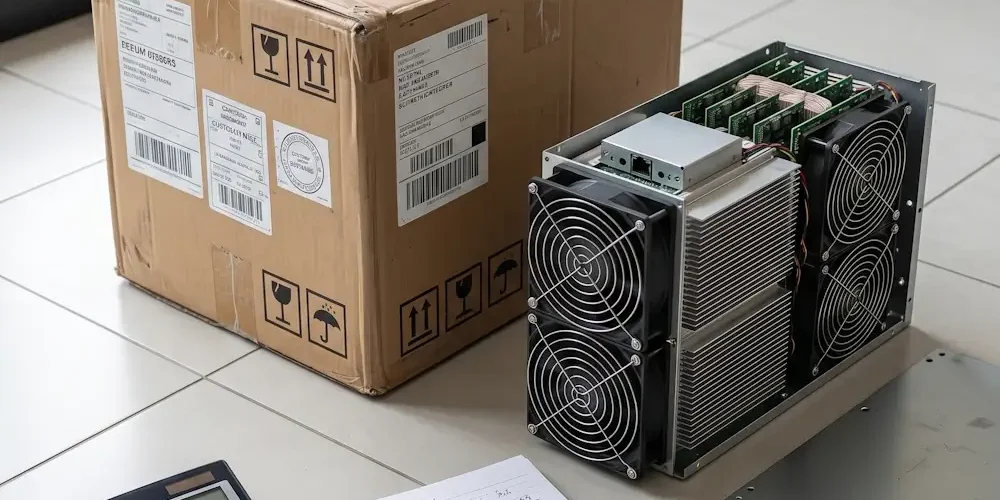
The “should I import an ASIC miner myself” question used to have a simple answer: yes, you saved money. In 2026 that answer has flipped. Local SA pricing has dropped to the point where DIY imports rarely beat buying from a verified reseller, and the supplier-verification headache when you’re transferring rand to a stranger in Shenzhen is real.
This guide is the honest decision framework. We’ll cover the pros and cons of self-import, what to verify before you commit, a worked landed cost example, the air freight vs sea freight trade-off, why DIY imports often go wrong, and how to verify an SA-based seller. By the end you’ll know whether your specific situation justifies the risk or whether buying local is the smarter play.
Note for South Africa:
- SA retail pricing on new BTC ASICs has come down materially. A new S21+ 235Th is R75 000 VAT inclusive locally in April 2026.
- Direct imports from China typically land at R94 000 to R110 000 for the same unit by the time you’ve paid freight, duty, VAT, and clearing.
- Most Chinese suppliers will not provide the kind of paperwork you’d need to safely resolve a warranty dispute from SA.
At a glance:
- At current SA retail pricing, DIY imports rarely save money.
- Risk asymmetry is the killer: small possible saving, large possible loss.
- Air freight is fast (3 to 5 days) but expensive. Sea freight is cheap but slow (4 to 6 weeks).
- Verified SA resellers carry the supplier risk for you, not the other way round.
Key takeaways:
- Calculate landed cost in full before you commit. Most DIY importers miss 15 to 25 percent.
- Never wire-transfer to an unverified Telegram or Alibaba account.
- For one or two units, local resellers almost always win on risk-adjusted price.
Quick checklist: import yourself or buy SA?
Five questions to answer before you decide:
- Are you buying one unit or multiples? Multiples justify some of the import overhead. Singles rarely do.
- Do you have a clearing agent in Johannesburg or Cape Town who has handled ASICs before?
- Can you afford to wait 3 to 6 weeks for sea freight, or is air freight worth the premium?
- Are you willing to lose the unit if it gets damaged in transit or held up at the port?
- Have you compared the import landed cost against current SA retail? Have you actually done the maths in detail?
If you answered no or “I’m not sure” to any of these for a single-unit purchase, buy local. The premium on a verified SA reseller usually evaporates against the import risk and time cost. Browse our Bitcoin ASIC stock as a price reference.
The pros and cons of importing yourself
Let’s be honest about both sides.
| Pros of self-import | Cons of self-import |
|---|---|
| Lowest possible FOB price (no reseller margin) | No local warranty support if the unit fails after 30 days |
| Direct manufacturer relationship for bulk pricing | Currency exchange risk between order and delivery |
| Choice of any model on the global market | Verification of supplier legitimacy is on you alone |
| Bulk orders can amortise freight costs | Customs delays can lock up capital for weeks |
| You learn the import process for future orders | Damaged-in-transit recourse is hard to enforce internationally |
The pros only stack up at scale (3-plus units) and only if you have an existing import infrastructure. For a first-time SA buyer with one or two units in mind, the cons dominate.
What you can check before you commit
If you decide to proceed with a self-import, run these supplier verification checks. Skipping them is how customers end up calling our Bedfordview office in tears after sending R60 000 to a stranger.
- Verify the supplier’s manufacturer relationship. Bitmain, IceRiver, and other manufacturers publish authorised partner lists on their sites. Cross-check before you transfer.
- Reverse image search the product photos. Stolen Bitmain stock images are a common scam signal.
- Ask for a video call showing the actual stock with serial numbers visible.
- Check the manufacturer’s spec sheets directly. The Bitmain Antminer S21 product page is the source of truth for what’s real.
- Pay via a method that gives you recourse if things go wrong (escrow, letter of credit, or trade-finance through your SA bank). Never SWIFT direct to a personal account.
- Cross-reference the FOB price against AsicMinerValue’s profitability index. If the price is 25 percent below market, it’s a scam.
Even with all these checks, supplier risk is significant. We’ve seen it go wrong enough times to flag it as the single biggest reason DIY imports fail.
Worked example: landed cost calculation
Here’s a realistic landed cost calculation for a new S21+ 235Th imported direct from China to OR Tambo. ZAR-USD assumed at R18 per USD. Numbers rounded for clarity.
| Cost layer | Air freight (3-5 days) | Sea freight (4-6 weeks) |
|---|---|---|
| FOB ex-China (S21+ 235Th) | R68 400 | R68 400 |
| Freight and insurance | R10 500 | R3 500 |
| CIF value | R78 900 | R71 900 |
| Duty (electronic equipment, around 5%) | R3 945 | R3 595 |
| VAT (15% on duty-inclusive) | R12 427 | R11 324 |
| Clearing and handling | R2 800 | R3 200 |
| Bank forex and SWIFT fees | R900 | R900 |
| Total landed cost | R98 972 | R90 919 |
| Compare: SA retail (S21+) | R75 000 | R75 000 |
Pricing verified April 2026. Currency rates and freight quotes shift weekly.
Local retail wins by R16 000 to R24 000 on a single S21+ in 2026. The picture only flips for multi-unit orders (5-plus) where freight amortises better, or if you have direct manufacturer pricing that beats wholesale FOB. Cross-check daily revenue assumptions on WhatToMine’s BTC SHA-256 calculator before you commit to either path.
Air freight vs sea freight
If you do import, the air-vs-sea decision depends on your cashflow and timing.
| Factor | Air freight | Sea freight (LCL) |
|---|---|---|
| Transit time | 3 to 5 days | 4 to 6 weeks |
| Cost per unit (S21+ size) | R8 500 to R12 000 | R3 000 to R4 500 |
| Customs clearance time | 3 to 7 working days | 10 to 20 working days |
| Damage risk in transit | Low (fewer handlings) | Moderate (multiple handlings) |
| Best for | Single units, urgent timelines | Multi-unit orders, budget-conscious |
Sea freight LCL (Less than Container Load) is the sweet spot for 3 to 6 units shipped together. For one unit, air freight is usually only R5 000 more expensive but saves you 4 to 5 weeks of opportunity cost. A MyBroadband piece on SA mining costs covered some of these trade-offs through 2025.
Why DIY imports often go wrong
Five failure modes we see at our Bedfordview office a few times a quarter:
- Buyer paid upfront, supplier disappeared. Most common with Telegram and unverified Alibaba sellers.
- Unit shipped, but the wrong PSU revision arrived. Some 240V-only PSUs marginally fail on SA single-phase under load.
- Customs flagged the shipment for inspection. Two-week storage charge before release.
- Hashboard damage in transit. No recourse without local warranty.
- Firmware locked to a non-SA pool or region. Buyer locked out without supplier cooperation.
Single-unit DIY imports save 5 to 12 percent on retail at best in 2026 SA conditions. They cost 100 percent of the unit if any of the above happens. Risk-adjusted, the maths rarely works for one or two miners.
For reference, current SA-stocked units worth comparing against any import quote include the Bitmain Antminer S21 Pro 245TH and the Bitmain Antminer S23 318TH.
How to verify an SA-based seller
Six checks. Run them before you transfer.
- CIPC company name visible on the website. Cross-reference on CIPC public search.
- Valid VAT number on the invoice. Verify on SARS e-filing.
- Physical address you could visit. Phone the landline and ask to confirm directions.
- Stock visible in person or on a video call. Ask for a live walk-through.
- Bank account in the company name, not a personal account.
- Written warranty terms. 30 to 90 days for used, 12 months or more for new.
If you have an existing miner you want to verify pre-purchase, our piece on how to verify a used miner’s hashrate walks through the bench test you should run. For the new vs used decision, see new vs used ASIC trade-offs. The full Sell Your PC crypto mining hub covers the broader buyer journey.
If solar yield is your import rationale, the Avalon Q 90T is the kind of low-watt-per-TH unit that already lands competitively in SA stock.
Common mistakes
- Skipping the landed cost calculation and assuming retail equals FOB plus 20 percent.
- Sending payment via SWIFT to a personal bank account instead of a registered company.
- Believing “no VAT” deals from grey-importers. Compliance gaps come back to bite.
- Using a clearing agent without ASIC experience. They under-classify and cause delays.
- Forgetting that ongoing income tax applies once the miner earns. See SARS guidance on crypto-asset tax for the regular tax treatment of mining income.
- Trusting a supplier price that’s 30 percent below the global FOB benchmark.
If you have never imported tech
- Don’t try a single-unit ASIC import as your first international purchase. The learning curve is expensive.
- If you must import, register for an importer code via SARS first. Free, but takes 5 to 10 working days.
- Use a clearing agent who has handled ASICs specifically. Ask for references.
- Pay only via a bank that supports forex with proper trade-finance documentation, not a forex bureau.
- Insure the shipment for full landed value. Air freight loss is rare but expensive.
If you have imported electronics before
- Confirm classification with your clearing agent before goods leave port. Some Chinese suppliers use generic codes that get flagged.
- For multi-unit orders, sea freight LCL saves 60 percent on freight at 4-plus units.
- Pre-clear with your agent before goods land. Avoids storage fees at OR Tambo bonded warehouses.
- Build a relationship with one or two manufacturers’ SA distributors. Bulk pricing follows trust.
- Need a sanity check on a planned import or want a comparison quote? Just contact our team.
Frequently asked questions
Is it cheaper to import an ASIC miner myself in SA in 2026?
Almost never on a single unit. SA retail pricing has dropped to the point where a new S21+ at R75 000 locally beats a typical landed cost of R90 000 to R99 000 from a direct China import. The picture only changes for multi-unit orders (5-plus) where freight amortises across more units, or if you have a direct manufacturer pricing relationship that beats wholesale FOB. For one or two miners, local always wins on risk-adjusted price.
How long does customs clearance take for an ASIC in SA?
Typically three to seven working days from arrival at OR Tambo or Cape Town International, assuming the paperwork is in order. Add five to ten days if SARS requests additional documentation, which sometimes happens for unfamiliar suppliers or ambiguous classifications. Sea freight clearance via Durban runs longer, two to three weeks total. The biggest delays come from missing commercial invoices, classification disputes, and value disputes when SARS thinks the declared value is too low for the model shipped.
What’s the cheapest way to ship an ASIC to South Africa?
Sea freight LCL via Durban is roughly R3 000 to R4 500 per unit but takes four to six weeks. Air freight via DHL or Aramex Global runs around R8 500 to R12 000 for one unit, three to five days transit. For one unit, the cost gap between air and sea rarely justifies the wait. For three or more units, sea freight starts to make sense if you can carry the cashflow over the longer cycle. Always factor in the extra storage and clearing time when comparing.
What happens if my imported miner arrives damaged?
You file a claim with the freight insurer (which is why you must insure the shipment). Manufacturer warranty rarely covers transit damage, and supplier-side recourse is hard to enforce internationally. Without insurance, you’re absorbing the loss. This is the single biggest hidden cost of self-import. Verified SA resellers carry transit risk on their stock, which means they replace damaged units before they reach you. That’s the structural value you’re paying for in the local margin.
Can I claim back VAT on an imported ASIC if I’m VAT-registered?
Yes if you’re a registered VAT vendor and the miner is used to generate taxable supplies (which mining typically is, since SARS treats mining income as gross income). You’ll need the import paperwork to claim the input VAT on your next VAT return. Most small SA miners aren’t VAT-registered because turnover is below R1 million per year. Above that threshold, registration is mandatory and the input VAT claim becomes useful. Talk to a tax practitioner before you assume the claim is straightforward.
Summary
- At current SA pricing, single-unit DIY imports rarely beat local retail.
- Landed cost adds 20 to 35 percent to FOB. Most importers underestimate this.
- Air freight is fast and expensive. Sea freight LCL is cheap and slow.
- Supplier verification is on you alone. Most failures trace back to skipped checks.
- Verified SA resellers carry the import risk so you don’t have to.
This is educational content, not financial advice.

