
Kaspa (KAS) Mining in South Africa
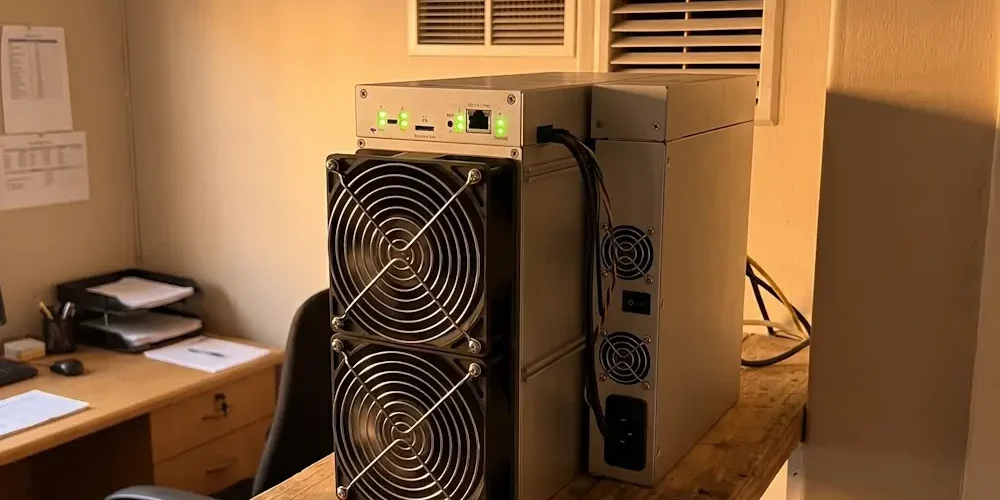
Kaspa has been the most-asked-about altcoin in our Bedfordview office through 2025 and into 2026. The combination of fast block times, a unique algorithm, and ASIC availability has made it the go-to BTC alternative for SA miners looking to diversify.
This guide is the practical SA take. By the end you’ll know what KAS actually is, which ASICs are worth buying in 2026, what the maths looks like across pure Eskom, hybrid solar, and full off-grid, and the specific risks Kaspa carries that Bitcoin doesn’t.
Note for South Africa:
- KAS ASICs are smaller and quieter than BTC miners. Most run from a single 220V socket without DB-board upgrades.
- Pool variance is higher than BTC. Daily payouts swing 30 to 60 percent on smaller hashrate setups.
- KAS price volatility is also higher than BTC. Don’t model a single price scenario.
At a glance:
- Kaspa uses kHeavyHash, a custom proof-of-work algorithm requiring its own ASICs.
- The IceRiver KS5L (12 TH/s) and Bitmain KS5 Pro are the dominant 2026 picks.
- On pure Eskom residential, KAS mining loses money daily. Off-grid solar is the only consistently profitable scenario.
- Browse current SA stock and pricing on our Kaspa ASIC stock.
Key takeaways:
- Kaspa is genuinely useful for diversification, but treat the price as the highest-risk variable.
- The KS5L has a better rand-per-TH at SA prices than newer Bitmain units.
- Pool choice matters more for KAS than BTC because of higher variance.
What Kaspa is and why it has its own ASIC
Kaspa is a proof-of-work cryptocurrency built on the GHOSTDAG protocol. Instead of one block per 10 minutes (Bitcoin), Kaspa produces one block per second. The network reaches consensus across parallel blocks, which is why the algorithm is called kHeavyHash and why it needs purpose-built silicon.
Find the protocol overview on the Kaspa project’s official site. The short version: it’s a Bitcoin-like store of value with much faster confirmations and no smart-contract layer (yet). Whether that holds long-term value is the open question.
Kaspa cannot be mined on a Bitcoin S21 or a Litecoin L7. The kHeavyHash algorithm is incompatible with SHA-256 and Scrypt silicon. You need a Kaspa-specific ASIC, which is what makes the IceRiver and Bitmain units relevant. The Sell Your PC crypto mining hub covers the broader SA mining landscape.
Quick checklist for an SA Kaspa miner
Five things to confirm before buying:
- Your effective tariff is under R1.50 per kWh (KAS economics need this in 2026).
- You can tolerate 30 to 60 percent daily payout variance.
- You have a stable internet connection (KAS pools are chatty, brief outages cause stale shares).
- You’re comfortable with a small-cap altcoin price profile.
- You have airflow and acoustic cover. KS5Ls aren’t quiet, just quieter than an S21+.
2026 KAS ASIC lineup compared
The 2026 lineup is dominated by the IceRiver KS5L spec page and the Bitmain KS5 Pro. A few older units (KS3, KS5) still trade in the secondary market at lower prices.
| Model | Hashrate | Power | Efficiency | Notes |
|---|---|---|---|---|
| IceRiver KS3 | 8 TH/s | 3 200 W | 400 W/TH | Older gen, used market only |
| IceRiver KS5 | 12 TH/s | 3 400 W | 283 W/TH | Mid-tier balance of cost and efficiency |
| IceRiver KS5L | 12 TH/s | 3 400 W | 283 W/TH | Most common in our SA stock |
| Bitmain KS5 Pro | 21 TH/s | 3 150 W | 150 W/TH | Premium efficiency, higher capex |
Current SA pricing on these models shifts with availability. Check live pricing on our Kaspa ASIC stock page. The Bitmain Antminer KS5 Pro 21TH is the efficiency benchmark in the Kaspa lineup right now. Cross-reference live profitability on AsicMinerValue’s KAS miner index. Pricing verified April 2026.
For the underlying efficiency principles that decide which unit makes sense at your tariff, see J/TH efficiency basics.
Power and cooling requirements
Most KAS units run on 220V single-phase and pull 3 100 to 3 500W at the wall. Heat output is similar to a BTC miner. The acoustic profile is slightly better, partly because the fans are smaller and partly because the boards run cooler at lower W/TH for newer units.
- Single dedicated 16A circuit per miner. Don’t share with anything else.
- Inlet temp under 30 degrees C in summer. Karoo summers will push this without proper ducting.
- Through-flow ventilation, not a sealed room.
Eskom tariff context applies the same as for BTC. Cross-check your block against Eskom’s tariff schedule and our Eskom vs solar cost-per-kWh breakdown.
Pools and payout variance for KAS
The dominant KAS pools as of 2026 are HeroMiners, Woolypooly, ViaBTC, and 2Miners. PPLNS payout structure is most common. PPS variants are rarer than for BTC.
The variance is higher than BTC for two reasons. Smaller total network hashrate means less smoothing, and faster block times mean payout windows are tighter. Expect daily KAS payouts to swing 30 to 60 percent on a single KS5L. Over a 30-day window the variance smooths to about plus or minus 8 percent.
For pool selection logic and how PPLNS variance differs from PPS, see how pool variance affects payouts.
Profitability scenarios at SA tariffs
Run an IceRiver KS5L at three SA scenarios. Assumptions: 12 TH/s, 3 400W (82 kWh per day), KAS at R2.80 per token, current network difficulty per WhatToMine’s Kaspa calculator, 1 percent pool fee, 97 percent uptime, R38 000 representative capex.
| Power scenario | Effective tariff | Daily power | Daily revenue | Monthly net | Payback |
|---|---|---|---|---|---|
| Pure Eskom residential | R2.80/kWh | R230 | R120 | -R3 300 | Loss-making |
| Hybrid solar | R1.50/kWh blended | R123 | R120 | -R90 | Marginal loss |
| Full off-grid solar | R0.80/kWh amortised | R66 | R120 | R1 620 | ~1.9 years* |
*Excludes solar capex. Pricing and payback maths verified April 2026 against current Kaspa difficulty and price.
The pattern is harsher than BTC because of KAS price volatility. Stress-test by dropping KAS to R1.50 per token: even off-grid solar struggles. Push KAS to R4.50 and the maths transforms. The BTC halving doesn’t apply directly to Kaspa (different emission schedule), but the broader crypto cycle still drives KAS price moves.
For SA buyers looking past the KS5L baseline, the IceRiver KS7 30TH is the unit that most aggressively pushes the price-per-TH lower for buyers ready to commit to higher capex.
Risks worth understanding
- KAS price volatility is materially higher than BTC. A 40 percent drop in 30 days has happened more than once since 2023.
- Network difficulty grows when KAS price climbs. Your TH/s effectiveness drops faster than BTC equivalents.
- Smart-contract roadmap risk. Kaspa is adding L2 functionality. If that ships and shifts mining incentives, ASIC value drops.
- Liquidity risk on exchanges. KAS pairs are thinner than BTC pairs. Selling large amounts moves the price.
- Regulatory uncertainty. Smaller-cap PoW coins have less protection in evolving global regulation.
Common mistakes
- Modelling KAS profitability with a single price scenario.
- Buying a KS3 because it’s cheap. The W/TH is awful and it stops being profitable above R1.20 per kWh.
- Mixing KAS and BTC miners on the same pool dashboard. Use separate workers for clean reporting.
- Using a generic UPS. KAS ASICs draw 3 400W, more than most home UPS units handle.
- Ignoring pool variance and panicking on a low-payout day.
- Modelling power costs in cents per kWh. SA tariffs are in rands per kWh.
If you are new to altcoin mining
- Start with one KS5L, not a multi-rig setup.
- Run for at least 30 days before judging payout variance.
- Hold some KAS rather than auto-converting to ZAR. The optionality has real value.
- Use a pool with PPS+ rather than pure PPLNS for your first month, to smooth variance.
- Monitor difficulty trends weekly.
If you already mine BTC
- Don’t repurpose your S21+ power circuit. KAS units need their own dedicated breaker.
- Treat KAS as a portfolio satellite, 10 to 20 percent of total hashrate capex.
- Cross-pool monitoring is helpful. Run BTC and KAS pools through the same dashboard for unified reporting.
- Resale market for KAS units is thinner than BTC. Plan exits longer.
- For a side-by-side on the new vs used decision specifically for KAS hardware, see new vs used ASIC trade-offs.
- Considering a KAS purchase or a portfolio rebalance? Just contact our team for a tariff-specific scenario.
Frequently asked questions
Is Kaspa mining still profitable in South Africa in 2026?
On pure Eskom residential, no. On hybrid solar, marginally break-even at best. On full off-grid solar, yes, with payback in roughly 1.5 to 2 years on the miner alone. The maths is sensitive to KAS price more than BTC because of higher volatility. Run scenarios at R1.50, R2.80, and R4.50 per KAS to see the spread. Most economically successful SA Kaspa miners run hybrid or off-grid solar with a portfolio approach where they hold a portion of the KAS rather than auto-converting.
Can I mine Kaspa on a Bitcoin or Litecoin ASIC?
No. Kaspa uses the kHeavyHash algorithm, which is incompatible with SHA-256 (Bitcoin, Bitcoin Cash) and Scrypt (Litecoin, Dogecoin) silicon. You need a Kaspa-specific ASIC like the IceRiver KS series or the Bitmain KS5 Pro. GPUs can technically mine Kaspa but are completely uncompetitive against modern ASICs. Don’t waste electricity trying. If you want algorithm flexibility, you’re looking at GPU mining altcoins, but the SA economics on GPU mining have been bad since 2022.
How does Kaspa pool variance compare to Bitcoin?
Materially higher. A single KS5L on a KAS pool can see daily payouts swing 30 to 60 percent because of the smaller network hashrate and faster block times. Over 30 days the variance smooths to about plus or minus 8 percent. By contrast, a Bitcoin miner on a major PPS pool sees almost no variance day-to-day. If you can’t tolerate the daily swing, choose a PPS or PPS+ pool instead of pure PPLNS, and accept a slightly lower long-run yield in exchange for predictability.
What’s the best KAS ASIC to buy in SA in 2026?
For the average SA buyer, the IceRiver KS5L offers the best blend of price, efficiency, and SA market support. The Bitmain KS5 Pro is more efficient (150 W/TH vs 283 W/TH) but costs roughly twice as much in capex, which extends payback at current KAS prices. The KS3 and older KS5 are only worth it if the price is materially below normal levels and your tariff is under R1.20 per kWh. Avoid grey-import deals on Telegram. The KAS used market is thin and verification is harder than for Bitcoin units.
How long will Kaspa ASICs remain profitable?
Hard to predict. ASIC efficiency floors keep rising. A KS5L bought today should remain profitable on hybrid or off-grid solar for 18 to 30 months, assuming KAS price holds within plus or minus 50 percent of current. The bigger risks are protocol changes (Kaspa is rolling out L2 features) and difficulty spikes during price rallies. Build the business case on 18 to 24 months of effective life, not 5 years. If KAS surges and the unit pays back in 6 months, treat the rest as upside.
If you are testing Kaspa economics on a smaller capex commitment first, the IceRiver KS7 Lite is the entry into current-gen KAS hardware without the full KS5 Pro price tag.
Summary
- Kaspa needs purpose-built kHeavyHash ASICs. Bitcoin and Litecoin units don’t work.
- The KS5L is the sweet spot for SA buyers in 2026.
- Profitability in 2026 needs hybrid or off-grid solar. Pure Eskom is loss-making.
- Pool variance is high. Use PPS+ if you can’t tolerate daily swings.
- Treat KAS as portfolio diversification, 10 to 20 percent of hashrate capex.
This is educational content, not financial advice.

